
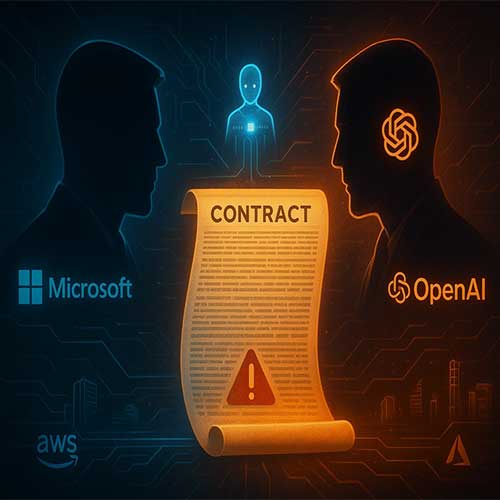
OpenAI’s latest agreement with Amazon Web Services (AWS) to deliver AI capabilities to U.S. government agencies marks a pivotal shift in the global AI power structure. The deal enables OpenAI to provide its models for both classified and unclassified government workloads, including defense applications—an expansion that significantly strengthens its position in the public sector.
At the core of this development is a critical evolution in OpenAI’s long-standing partnership with Microsoft. Historically, Microsoft’s Azure platform acted as the exclusive gateway for OpenAI’s enterprise and government deployments. However, recent changes to the agreement removed key exclusivity constraints, allowing OpenAI to work with other cloud providers and directly serve national security customers.
This structural shift has opened the door for OpenAI’s collaboration with AWS, one of the most secure and widely used cloud platforms for U.S. government operations. By leveraging AWS infrastructure, OpenAI can now integrate its models into highly sensitive environments, including Pentagon systems, while maintaining strict compliance and security protocols.
The timing of the deal is equally significant. OpenAI has recently secured defense contracts after the Pentagon distanced itself from rival AI firm Anthropic due to disagreements over military usage policies. This has created a strategic vacuum that OpenAI is rapidly filling, positioning itself as the primary AI provider for U.S. defense and intelligence operations.
Beyond immediate contracts, this move reflects a broader transformation in OpenAI’s strategy—from a Microsoft-aligned AI lab to a multi-cloud, multi-partner platform. Its growing partnerships with AWS, alongside continued collaboration with Microsoft, indicate a deliberate effort to avoid dependency on any single infrastructure provider.
For Microsoft, this evolution introduces both opportunity and tension. While it remains a major investor and partner, the dilution of exclusivity could impact Azure’s dominance in AI workloads. At the same time, OpenAI’s expansion across cloud ecosystems may accelerate global AI adoption and enterprise integration.
Ultimately, the AWS deal is more than a contract—it is a signal that the AI industry is entering a new phase where flexibility, sovereignty, and multi-cloud strategy will define leadership in the race for government and defense AI dominance.