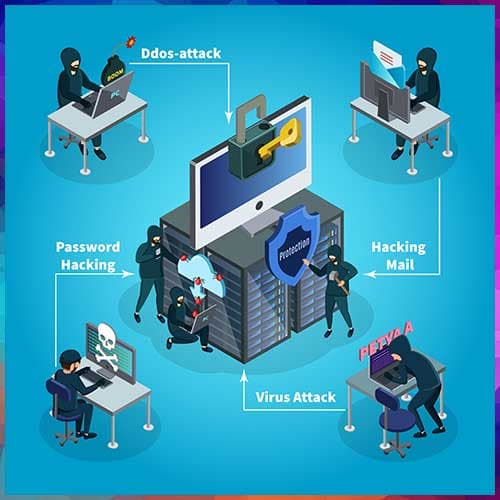
Enterprises have historically relied on periodic security checks — quarterly audits, scheduled vulnerability scans, annual penetration tests — to validate that their servers and data centers remain secure. That model is increasingly obsolete. As we've seen repeatedly this year, from the LiteLLM AI supply chain breach exposing 2,500+ companies in a 40-minute window, to state-linked attacks on U.S. water infrastructure exploiting exposed operational technology, the gap between periodic assessment and continuous exposure is exactly where modern attackers operate.
Why Continuous Monitoring Inside the Data Center Matters
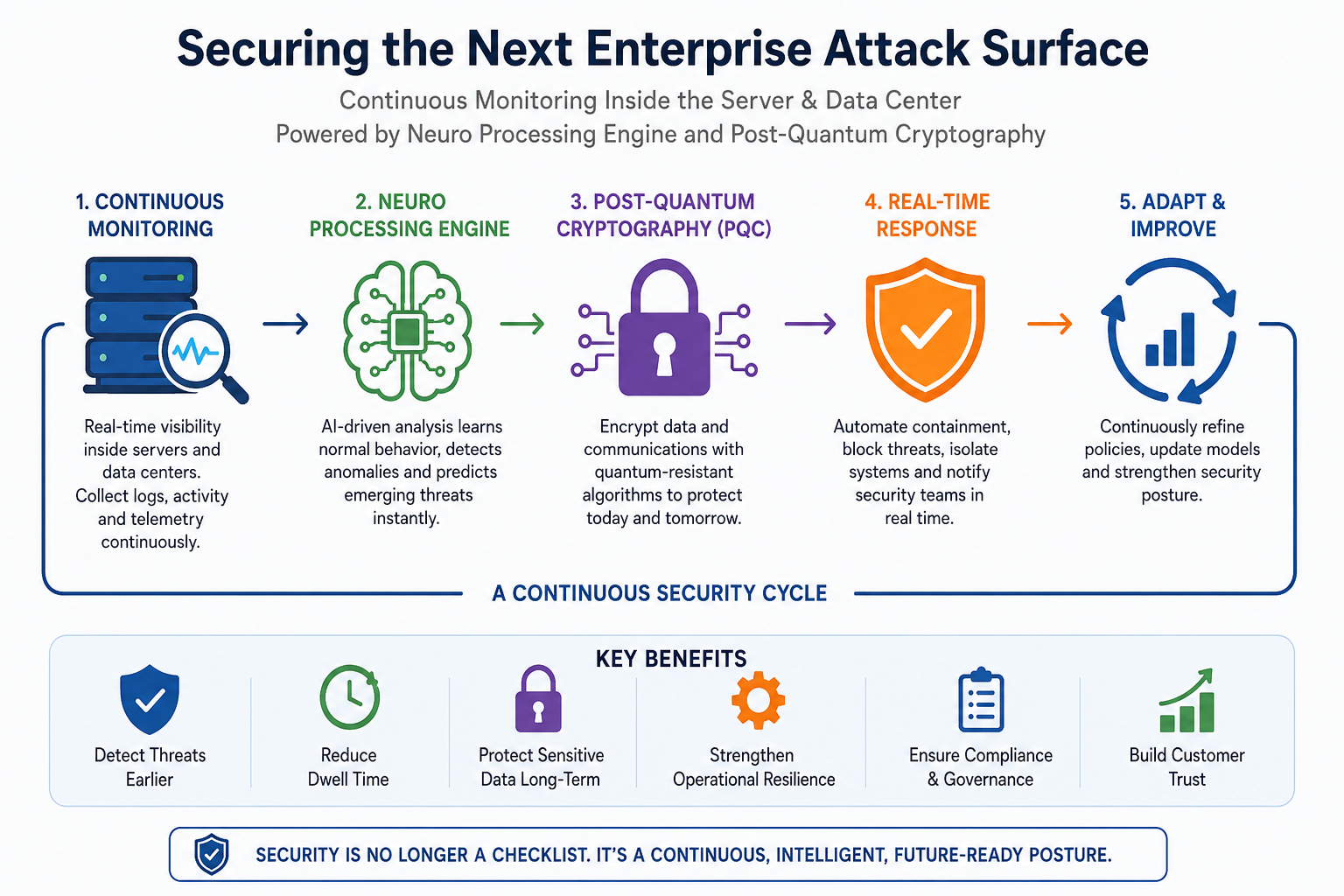
The shift enterprises need to make is from checking security at fixed intervals to monitoring it continuously, in real time, at the infrastructure layer itself — detecting anomalies, unauthorized access attempts, and emerging threats as they happen inside servers and data centers, not after the fact during the next scheduled review.
This matters because modern attacks increasingly don't announce themselves with an obvious breach signature. Credential misuse, lateral movement, and privilege escalation inside a data center can look like legitimate administrative activity unless a system is actively watching behavioral patterns for deviation — echoing the same principle behind behavioral biometrics and continuous identity verification we've discussed elsewhere: a single checkpoint is a moment-in-time defense, while continuous monitoring is a standing one.
Where a Neuro Processing Engine Fits In
A Neuro Processing Engine — AI-driven analysis purpose-built for real-time pattern recognition — extends this continuous-monitoring capability by learning what "normal" infrastructure behavior looks like across servers, network traffic, and access patterns, then flagging deviations instantly rather than relying on static, rule-based alerts that attackers have learned to route around. This is the same architectural shift underlying modern EDR and XDR platforms: moving detection logic from fixed signatures toward adaptive, learned baselines that can catch novel attack patterns — including AI-accelerated ones — before they fully unfold.
Why Post-Quantum Cryptography Belongs in the Same Conversation
Pairing this with Post-Quantum Cryptography (PQC) addresses a different, longer-horizon risk: data encrypted today with current cryptographic standards could be harvested now and decrypted later once quantum computing matures enough to break it — a strategy security researchers call "harvest now, decrypt later." For enterprises handling sensitive data with long confidentiality requirements (financial records, health data, government communications, critical infrastructure credentials), that future risk is a present-day design decision. NIST has already finalized its post-quantum cryptographic standards, and the practical challenge now facing enterprises is migration: identifying where current encryption is embedded across infrastructure and systematically transitioning to quantum-resistant algorithms before the threat becomes exploitable rather than theoretical.
The Combined Case
Real-time behavioral detection and quantum-resistant encryption solve two different problems — one defends against attacks happening now, the other defends data that needs to remain confidential years from now — but together they represent the same underlying shift the rest of this year's security stories have pointed toward: security built as a continuous, adaptive, forward-looking posture, not a periodic compliance exercise. For enterprises evaluating where to invest next, the infrastructure layer — servers and data centers, not just endpoints and applications — is becoming the attack surface that periodic security checks were never designed to catch.
Many OEM's Zero Trust Offerings Fall Short in Practice
Zero Trust has become one of the most overused labels in cybersecurity marketing — nearly every OEM now claims a "Zero Trust" product. But the gap between the principle (never trust, always verify) and what's actually shipped by most vendors is substantial. Here's where the common gaps lie:
1. Zero Trust in Name, Perimeter Security in Practice
Many OEMs simply rebrand existing firewall, VPN, or NAC (Network Access Control) products as "Zero Trust" without fundamentally changing the architecture. True Zero Trust requires continuous, context-aware verification of every request — not a one-time login check followed by implicit trust for the rest of a session. Most commercial offerings still authenticate once at the perimeter and then trust the session, which is functionally the old castle-and-moat model with a new label.
2. Identity Verification Is Static, Not Continuous
This is a gap we've discussed repeatedly in this conversation — most Zero Trust implementations verify who logged in, not whether the person acting right now is still the same legitimate user. A stolen session token, a compromised credential used mid-session, or an insider threat that begins after a valid login can all slip past identity checks that only fire at authentication time. Genuine Zero Trust needs continuous behavioral and contextual verification (device posture, location, typing patterns, anomalous access) — capability that few OEM platforms build natively, and that's exactly the gap behavioral-biometrics and continuous-authentication vendors are trying to fill.
3. Fragmented Point Solutions, Not Unified Architecture
Zero Trust isn't one product — it spans identity, device trust, network segmentation, application access, and data protection. Most OEMs specialize in one slice (say, identity or network micro-segmentation) and market it as complete Zero Trust. Enterprises end up stitching together multiple vendors' tools that don't share context, creating visibility gaps at the seams — precisely the kind of blind spot that let a single compromised employee email cascade into a major breach in cases like Bank of Baroda's.
4. Poor Coverage of Non-Human and Machine Identities
As we discussed with Secret Manager solutions, machine identities — API keys, service accounts, AI agents, IoT devices — now vastly outnumber human identities in most enterprises. Many Zero Trust platforms were designed around human user authentication and retrofit machine identity support poorly, leaving service accounts and agentic AI systems under-governed. This is a growing risk as autonomous AI agents gain broader system access, as we saw with the LiteLLM supply chain breach.
5. Third-Party and Supply Chain Blind Spots
Zero Trust products typically govern access within an organization's own perimeter but struggle to extend meaningfully into third-party vendor systems, SaaS platforms with embedded AI, or partner integrations. Schellman's AI governance research found only 36% of boards even discuss third-party AI risk — Zero Trust tooling has largely not solved this problem either, since it depends on visibility the OEM's platform simply doesn't have into external systems.
6. Static Policy Engines, Not Adaptive Risk Scoring
Many implementations rely on relatively static rule sets (role-based access control lists) rather than dynamic, continuously recalculated risk scores that factor in real-time signals — device health, threat intelligence, behavioral anomalies, geographic impossibility. Without adaptive risk scoring, "Zero Trust" access decisions are really just more granular versions of traditional RBAC, missing the "continuous verification" component the model is supposed to deliver.
7. Weak Handling of Deepfake and Synthetic Identity Threats
This is an emerging and largely unaddressed gap: most Zero Trust frameworks were built before generative AI made synthetic identities, cloned voices, and deepfake video calls practical attack vectors. Verifying "this credential is valid" says nothing about whether "this human is real" — a distinction that's becoming critical for video KYC, remote approvals, and executive communications, and one that current OEM Zero Trust stacks generally don't address at all.
The Bottom Line
Zero Trust as a philosophy is sound; the problem is that most OEM implementations deliver partial, siloed, moment-in-time verification dressed up in Zero Trust marketing language, rather than the continuous, identity-centric, context-aware architecture the model actually requires. Closing that gap increasingly means layering behavioral intelligence, continuous authentication, and synthetic-media detection on top of traditional Zero Trust infrastructure — not replacing it, but completing what most current offerings leave unfinished.