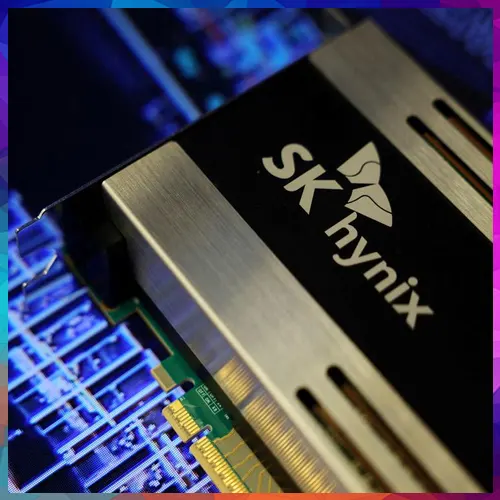
SK Hynix’s HBM business head Choi Joon-yong said robust AI demand and rising cloud providers’ capital spending could significantly boost HBM adoption, noting its efficiency for complex applications and projecting the market to reach tens of billions by 2030
South Korea’s SK Hynix expects the global market for high-bandwidth memory (HBM) chips — a specialised form of DRAM optimised for artificial intelligence workloads — to expand at an average annual rate of 30% through 2030. The forecast reflects strong demand from AI developers, despite concerns over potential price pressures in the semiconductor sector.
Speaking in an interview, Choi Joon-yong, head of HBM business planning at SK Hynix, said end-user AI demand remains “very firm and strong.” He noted that projected capital spending on AI infrastructure by major cloud providers such as Amazon, Microsoft, and Google could rise further, directly boosting HBM adoption.
Choi described the connection between AI infrastructure growth and HBM demand as “very straightforward,” adding that the company’s outlook factors in possible constraints, including energy availability. HBM technology, introduced in 2013, stacks chips vertically to save space, improve power efficiency, and process vast datasets required for complex AI applications. SK Hynix estimates the market could be worth tens of billions of dollars by the decade’s end.
Next-gen HBM spurs customisation
The industry is also undergoing structural change. With the next-generation HBM4, companies like SK Hynix, Samsung Electronics, and Micron Technology integrate a customer-specific “base die” that manages memory functions, making it harder to interchange rival products. Choi anticipates rising demand for further customisation, noting that while Nvidia receives tailored designs, smaller clients still rely on standardised models.
SK Hynix remains the primary HBM supplier to Nvidia, with Samsung and Micron providing smaller volumes. Samsung recently cautioned that HBM3E supply may temporarily outpace demand, potentially affecting pricing.
Tariff concerns amid chip trade
The market outlook also comes against a shifting geopolitical backdrop. Last week, U.S. President Donald Trump signalled plans for a 100% tariff on semiconductor imports from countries not manufacturing in the United States or without firm plans to do so. While no formal tariff announcement has been made, South Korea’s trade envoy Yeo Han-koo clarified that Samsung and SK Hynix would be exempt if such measures were introduced, given their U.S. investments.
Samsung operates fabrication plants in Texas, while SK Hynix has announced a chip packaging facility and AI R&D centre in Indiana. In 2024, South Korea exported $10.7 billion worth of chips to the U.S., accounting for 7.5% of total chip exports, with a significant portion of HBM chips sent to Taiwan for packaging.