
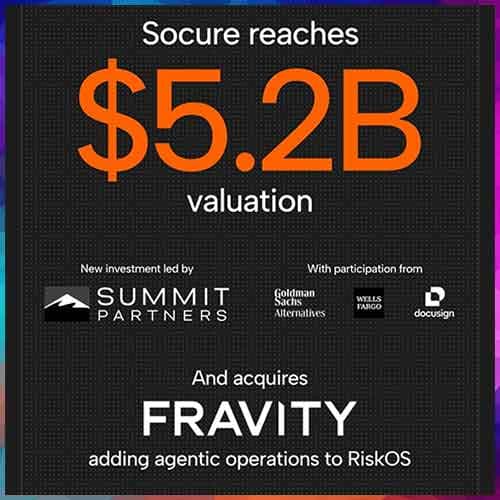
Identity and risk intelligence company Socure has reached a $5.2 billion valuation following a strategic growth investment involving Summit Partners, Goldman Sachs Alternatives, Wells Fargo and DocuSign. The transaction includes primary capital as well as a secondary tender offer providing liquidity to existing employees.
Socure positions itself as an AI-native trust infrastructure platform, serving more than 3,000 customers, including the five largest U.S. banks. Its RiskOS platform combines AI, machine learning and online and offline data intelligence to perform real-time identity verification, risk orchestration and decisioning.
Alongside the investment, Socure has acquired Fravity, an agentic AI platform designed to automate fraud, risk and compliance operations. Financial terms were not disclosed. Fravity will become RiskOS_Agents, adding first-party agent development and an agentic operations layer directly into Socure's existing platform.
The acquisition reflects a fundamental change in financial-crime prevention. Socure says AI-driven fraud attacks have increased 8,000% over the past year, creating alert volumes that human investigation teams cannot address simply by adding more employees. Fravity says its existing deployments have reduced cost per case by 80%, accelerated case resolution by as much as five times and reduced false positives by up to 70%.
CEO Johnny Ayers argues that institutions cannot “hire their way out” of increasingly automated financial crime. Socure's strategy is therefore to combine proprietary data, AI models, domain expertise and autonomous agents into a continuous fraud-decisioning infrastructure. Rather than merely generating another fraud alert, agents could help investigate, contextualize and resolve cases at machine speed.
Fraud Defense Is Moving From Detection to Autonomous Action
This potentially changes the economics of fraud management. Financial institutions traditionally employ large teams to review alerts generated by rules and machine-learning systems. Agentic platforms can automate parts of investigation, evidence collection, case prioritization and compliance workflows while escalating higher-risk decisions to human analysts.
The competitive battleground in identity security is consequently expanding. Accuracy in identity verification remains essential, but platforms will increasingly compete on their ability to establish identity trust, detect synthetic identities and AI-generated fraud, orchestrate risk decisions, and automate the resulting investigation and response.
For the wider industry, Socure's $5.2 billion valuation demonstrates the growing strategic value being placed on AI-native trust infrastructure as deepfakes, synthetic identities and autonomous fraud systems increase the scale and sophistication of financial crime.