Technology is cretical and is the key to success for enterprises and Smes in this digital era. emerging technologies are driving 4th Industrial revolutions. Artificial Intelligence (AI), eCommerce, social networking, IoT, 5G, blockchain are impacting the industries from healthcare to education to finance to manufacturing, the pandemic has forced companies to use technology to reimagine nearly every facet of their operations are being leveraged to blur the lines between industries, creating new business models and converging sectors.
In the wake of the outbreak, everything from doctors’ appointments to schooling to workouts went online. As more people worked, learned, banked, exercised, relaxed, and even sought medical care from home during Covid-19, they received a crash course in how much can be accomplished at home. There are cases, the technological changes inspired by Covid-19 will come in the form of an acceleration of existing trends for example, industrial automation and contactless payments.
New advances in technology are still disrupting the common lives in many cases for the best. Some of them are already in place, but they are still evolving and changing at a rapid pace, meaning the impact of these advances will only amplify. eCommerce was ranked as the most disruptive business model. eCommerce continues to capture attention with its dramatic growth prospects. Global eCommerce spending is expected to increase from $3.5 trillion in 2019 to $6.5 trillion in 2023.
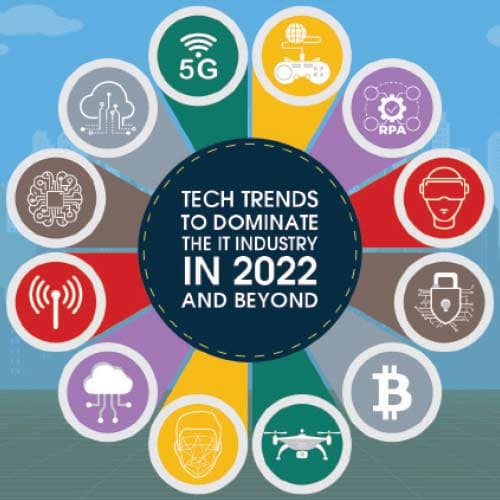
In this article, we have specified 20 most influential technologies which are going to influence the market in 2022.
1. 3D and 4D printing
Introduction: Three-dimensional (3D) printing technology has potential of high-impact implementation in applications ranging from personal tools to aerospace equipment. As 3D printing becomes more than just a simple production process, it has come to support a convergence of technologies and applications such as sports equipment, food packaging, and jewelry, as well as products in the high tech fields of aerospace, medicine, architecture, education, automotive industry, military support, and others. Four-dimensional printing (4D printing; also known as 4D bioprinting, active origami, or shape-morphing systems) uses the same techniques of 3D printing through computer-programmed deposition of material in successive layers to create a three-dimensional object.
3D printing technology consolidates the number of components and processes required for manufacturing. This has a significant impact on global supply chains, decreasing complexities, saving on production costs, enhancing lead times and improving time-to-market. The most obvious advantage of 4D printing is that through computational folding, objects larger than printers can be printed as only one part. Since the 4D printed objects can change shape, shrink and unfold, objects that are too large to fit a printer can be compressed for 3D printing into their secondary form.
OEMs into the sector:
Autodesk, Samsung, 3D Systems, Vicon Motion Systems and Dassault Systèmes
2. 5G
Introduction: 5G is the fifth generation mobile network. It is meant to deliver higher multi-Gbps peak data speeds, ultra low latency, more reliability, massive network capacity, increased availability, and a more uniform user experience. Higher performance and improved efficiency empower new user experiences and connect new industries. 5G is designed to deliver peak data rates up to 20 Gbps based on IMT-2020 requirements. In addition to higher peak data rates, 5G is designed to provide much more network capacity by expanding into new spectrum, such as mmWave.
With high speeds, superior reliability and negligible latency, 5G will expand the mobile ecosystem into new realms. 5G will impact every industry, making safer transportation, remote healthcare, precision agriculture, digitized logistics and more a reality. According to a study, 5G’s full economic effect will likely be realized across the globe by 2035 supporting a wide range of industries and potentially enabling up to $13.1 trillion worth of goods and services.
OEMs into the sector:
TCS, Qualcomm, Ericsson, Cisco ,Tech Mahindra, Sterlite Technologies, ITI and Tejas Networks
3. Artificial Intelligence (AI) and Machine Learning (ML)
Introduction: Artificial Intelligence and Machine Learning is helping to automate models which can analyze bigger, complex data to return more fast and accurate results. AI is projected to have a lasting impact on just about every industry imaginable. Artificial Intelligence is seen in smart devices, cars, healthcare systems and favorite apps, and its influence can be seen to permeate deeper into many other industries for the foreseeable future.
Artificial Intelligence is of utmost importance because AI forms the very foundation of computer learning. Through AI, computers have the ability to harness massive amounts of data and use their learned intelligence to make optimal decisions and discoveries in fractions of the time that it would take humans. Artificial Intelligence is becoming responsible for everything from medical breakthroughs in cancer research to cutting-edge climate change research. Most industries with enormous volumes of data have recognized the value of Machine Learning.
OEMs into the sector:
Google, Facebook, Nvidia, Amazon, Microsoft and IBM
4. Blockchains and distributed ledgers
Introduction: Distributed ledgers and Blockchain technology have rapidly become a part of the FinTech vernacular. The terms “blockchain” and “distributed ledger” are generally employed interchangeably, because the verification protocol on most open-source distributed ledgers is currently implemented on a public blockchain. The first idea of a distributed, permission-less ledger was the form of Bitcoin, emerged in 2009. The original Bitcoin blockchain was designed to create an electronic payment system based on cryptographic proof instead of trust, allowing any two willing parties to transact without the need for a trusted third party.
Blockchain is the most widely-known distributed ledger technology. Distributed Ledgers and Blockchain have potential to give companies a secure, digital alternative to banking processes that are often bureaucratic, time-consuming, paper-heavy, and expensive. Distributed ledgers such as blockchain are exceedingly useful for financial transactions because they cut down on operational inefficiencies and save money. They also provide greater security due to their decentralized nature, as well as the fact that the ledgers are immutable.
OEMs into the sector:
Hyperlink InfoSystem, Accenture, Infosys, Capgemini India, Tata Consultancy Services, Tech Mahindra and Zensar Technologies
5. Cloud and Edge computing
Introduction: Cloud computing is the act of running workloads within clouds, while edge computing is the act of running workloads on edge devices. Edge computing is a form of cloud computing. Edge computing is used to process time-sensitive data, while cloud computing is used to process data that is not time-driven. Besides latency, edge computing is preferred over cloud computing in remote locations, where there is limited or no connectivity to a centralized location.
Impact to the Industry:
In this unprecedented time cloud is offering new ways to access computing capacity and data quickly and inexpensively. It can also boost innovation and put companies on a fast track to leverage disruptive practices and technologies while Edge computing’s most significant benefit is its ability to increase network performance by reducing latency, as speed is the new best practise. By 2024, the global cloud computing market is expected to surpass $1 trillion. The main benefits of edge computing are: better data management, lower connectivity costs and better security practices, reliable and uninterrupted connection.
OEMs into the sector:
Microsoft, Amazon, Google, Cisco, Dell Technologies, HPE, NetApp and Hitachi Vantara
6. Cloud-Native Platforms (CNPs)
Introduction: Cloud-native technologies empower organizations to build and run scalable applications in modern, dynamic environments such as public, private, and hybrid clouds. Containers, service meshes, microservices, immutable infrastructure, and declarative APIs exemplify this approach. This is about speed and agility. These deployed systems become resilient, manageable, and observable. Combined with robust automation, they allow engineers to make high-impact changes frequently and predictably with minimal toil.
To truly deliver digital capabilities anywhere and everywhere, enterprises must turn away from the familiar “lift and shift” migrations and toward Cloud-Native Platforms (CNPs). CNPs use the core capabilities of cloud computing to provide scalable and elastic IT-related capabilities “as a service” to technology creators using internet technologies, delivering faster time to value and reduced costs. For this reason, Gartner predicts that cloud-native platforms will serve as the foundation for more than 95% of new digital initiatives by 2025 up from less than 40% in 2021.
OEMs into the sector:
Netflix, Uber, Huawei, Pinterest and WeChat
7. Cryptocurrency
Introduction: Cryptocurrency is a form of digital payment which can be exchanged online for goods and services. Many companies have issued their own currencies, often called tokens, and these can be traded specifically for the goods or services that the company provides. One will need to exchange real currency for the cryptocurrency to access the goods or service. Cryptocurrencies work using a technology called blockchain. Blockchain is a decentralized technology spread across many computers that manages and records transactions.
Cryptocurrency can revolutionize the Indian economy. Though 2% of the Indian population is crypto users, India’s crypto ecosystem has over 300 crypto companies and 60 lakh investors, investing millions of dollars in them. Cryptocurrencies can have a considerable impact on developing countries, by increasing financial inclusion of individuals and companies. In particular, by reducing the transaction fees and time, cross-border payments can be improved. The two main advantages of using the cryptocurrency are its peer-to-peer focus that removes intermediaries and its pseudonymous design that eliminates the need for identification information for both parties.
OEMs into the sector:
CoinDCX, WazirX, CoinSwitch Kuber and Zebpay
8. Cybersecurity Mesh
Introduction: A Cybersecurity Mesh involves designing and implementing an IT security infrastructure that does not focus on building a single 'perimeter' around all devices or nodes of an IT network, but instead establishes smaller, individual perimeters around each access point. This is to ensure that each access point’s security can be effectively managed from a centralized point of authority; while not providing access to the broader network should a breach occur on a given node.
Now-a-days assets and users can be anywhere; the traditional security perimeter is gone. This requires a cybersecurity mesh architecture (CSMA). CSMA helps provide an integrated security structure and posture to secure all assets, regardless of location. A Cybersecurity Mesh can establish a more robust, flexible and modular approach to network security. By 2024, organizations adopting a CSMA to integrate security tools to work as a cooperative ecosystem will reduce the financial impact of individual security incidents by an average of 90%.
OEMs into the sector:
Fortinet, CrowdStrike, Splunk, McAfee and
Palo Alto Networks
9. Digital twins
Introduction: A digital twin is a virtual model designed to accurately reflect a physical object. The sensors used in this produce data about different aspects of the physical object’s performance, such as energy output, temperature, weather conditions and more. This data is then relayed to a processing system and applied to the digital copy. Once informed with such data, the virtual model can be used to run simulations, study performance issues and generate possible improvements, all with the goal of generating valuable insights which can then be applied back to the original physical object.
Digital Twin is at the core of the development of future industry, which enfolds automation, data exchange, and manufacturing processes, producing endless opportunities for industries to grow. The use of digital twins enables more effective research and design of products, with an abundance of data created about likely performance outcomes. That information can lead to insights that help companies make needed product refinements before starting production. Digital twin technology can empower manufacturers to improve the customer experience as it provides them with better insights into customer needs, which allows them to innovate solutions for existing products, operations and services while identifying new business opportunities.
OEMs into the sector:
General Electric, Azure , Siemens, IBM, Cisco, Oracle, Dassault Systems and Bosch
10. Distributed Enterprise
Introduction: With the rise in remote and hybrid working patterns, traditional office-centric organizations are evolving into distributed enterprises composed of geographically dispersed workers. A corporation may distribute the different types of operations across a large region, or even across international boundaries. State of the art telecommunications and data networks are making distributed operations of this sort increasingly common. Applications developed to implement this type of strategy allow businesses to reduce costs and enhance their offerings of services to customers around the world.
Impact to the Industry:
Gartner expects that by 2023, 75% of organizations that exploit distributed enterprise benefits will realize revenue growth 25% faster than competitors. An important goal of a distributed system is to make it easy for users (and applications) to access and share remote resources. In this new work culture, it is cheaper to have a single high-end reliable storage facility be shared then having to buy and maintain storage for each user separately.
OEMs into the sector:
Netflix, Uber, eBay, Amazon and SoundCloud
11. Drones and Unmanned Aerial Vehicles
Introduction: Aerial drones or Unmanned Aerial Vehicles (UAVs) are an emerging technology with significant market potential. UAVs are used for observation and tactical planning. UAVs may lead to substantial cost savings in monitoring of difficult-to-access infrastructure, spraying fields and performing surveillance in precision agriculture, as well as in deliveries of packages. In some applications, like disaster management, transport of medical supplies, or environmental monitoring, aerial drones may even help save lives. UAVs are classified based on the altitude range, endurance and weight, and support a wide range of applications including military and commercial applications.
Operators can use Unmanned Aerial Vehicles with the appropriate license to provide security and surveillance to private companies, sporting events, public gatherings, and other venues. Drones can also gather valuable data during and after natural disasters to aid in security and recovery efforts. Drones can capture, store, and transmit data, giving businesses the opportunity to integrate more data into their current processes. The data that drones capture is more advanced than in the past.
OEMs into the sector:
IdeaForge, Aarav Unmanned Systems, Grene Robotics, Skylark Drones and Skye Air Mobility
12. Fintech
Introduction: Fintech refers to financial technology and seeks to improve and automate the delivery and use of financial services. Fintech is utilized to help companies, business owners and consumers better manage their financial operations, processes, and lives by utilizing specialized software and algorithms that are used on computers and, increasingly, smartphones. Fintech also includes the development and use of crypto-currencies such as bitcoin. Fintech describes a variety of financial activities, such as money transfers, depositing a check with a smartphone, bypassing a bank branch to apply for credit, raising money for a business startup, or managing investments, generally without the assistance of a person.
According to researchers the Fintech industry will develop unique and innovative models of assessing risks. Leveraging big data, machine learning, and alternative data to underwrite credit and develop credit scores for customers with limited credit history will improve the penetration of financial services in India. The Fintech startups are likely to reduce costs and improve quality of financial services.
OEMs into the sector:
Instamojo, Razorpay, Paytm, Policybazaar, Shiksha Finance, PineLabs, BharatPe and ZestMoney
13. Hyperautomation
Introduction: Hyperautomation consists of increasing the automation of business processes by introducing Artificial Intelligence (AI), Machine Learning (ML) and Robotic Process Automation (RPA). Where almost any repetitive task can be automated and it is even possible to find out which processes can be automated and to create bots to perform them. It further automates already automated processes, taking business operations beyond individual input.
Hyperautomation enables accelerated growth and business resilience by rapidly identifying, vetting and automating as many processes as possible. The term “hyperautomation” was coined by the research firm Gartner, which called it the number-one trend in strategic business technology in 2020. Gartner research shows that the top-performing hyperautomation teams focus on three key priorities: improving the quality of work, speeding up business processes, and enhancing the agility of decision-making. Business technologists supported an average of 4.2 automation initiatives in the past year, too. Hyperautomation will continually use new tools and technologies, touch even more employees, and accelerate the automation of the next generation of business processes.
OEMs into the sector:
Accenture, IPsoft, and UiPath
14. Internet of Things (IoT)
Introduction: The Internet of Things makes people live and work smarter. IoT is a system of interrelated computing devices, mechanical and digital machines, objects, animals or people that are provided with unique identifiers (UIDs) and the ability to transfer data over a network without requiring human-to-human or human-to-computer interaction. IoT can make use of AI and ML to aid in making data collecting processes easier and more dynamic.
IoT is essential to business. It provides businesses with a real-time look into how their systems really work, delivering insights into everything from the performance of machines to supply chain and logistics operations. IoT enables companies to automate processes and reduce labour costs. It also cuts down on waste and improves service delivery, making it less expensive to manufacture and deliver goods, as well as offering transparency into customer transactions. It will continue to pick up steam as more businesses realize the potential of connected devices to keep them competitive.
OEMs into the sector:
TCS, Infosys, LTI, HCL Technologies, Tech Mahindra, Mphasis and Wipro
15. Online gaming & eSports
Introduction: Online gaming describes any video game that offers online interactions with other players. Online games are important to understand because they offer a huge amount of fun, enjoyment, teamwork, collaboration and imaginative adventure for children. Played healthily they contribute an essential part of children’s development and socialization. Due to Covid-19 outbreak when every child was forced to stay indoors this on-line gaming and different esports have entertained them. Not only kids, even adults have kept them busy with this gaming culture. Millions of people will view esports at Asian Games 2022 as esports has been recognized as a medal-winning event. In India, e-sports is slowly growing popular, and it is expected that the audience will become five times with the upcoming Asian Games in 2022.
Impact to the Industry:
With the practice of social distancing reducing consumer and business activity to a minimum, gaming offers an engaging distraction for people at home looking for social interaction, and initial data shows huge growth in playing time and sales since the lockdowns began. It encourages the boost of the global video game industry. A separate part of gaming is esports, which refers to organized, multiplayer video game competitions. Business models in esports closely follow professional sports – though competitions are far more fragmented – with the majority of revenue coming from advertising and broadcasting.
OEMs into the sector:
Dream 11, MPL, The Pokemon, Cricplay, Zapak, Rummy Circle, Fancy 11,Epic Games and Zynga
16. Quantum computing
Introduction: Quantum computing harnesses the phenomena of quantum mechanics to deliver a huge leap forward in computation to solve certain problems. Quantum computers can create vast multidimensional spaces in which very large problems are addressed. Classical supercomputers cannot do this. Algorithms that employ quantum wave interference are then used to find solutions in this space, and translate them back into forms which can be used and understood.
As per reports, the benefits of quantum computing will extend to all aspects of society. Quantum computing will quite literally change the world in various sectors including privacy, finance, healthcare, entertainment and technology. Quantum computing could easily become a reality within the next five to ten years. One of the major impacts of quantum computing might actually be more cost- and energy-efficient approaches to problems. This “quantum advantage” will enable organizations to perform tasks much more efficiently on quantum systems.
OEMs into the sector:
AT&T, Microsoft, IBM, Honeywell, Zapata Computing and D-Wave Solutions
17. Video conferencing
Introduction: Video conferencing has made our lives easy while the pandemic started. From enterprises to schools every sector has taken help of video conferencing to keep going. It is a live video-based meeting between two or more people in different locations using video-enabled devices. It allows multiple people to meet and collaborate face to face long distance by transmitting audio, video, text and presentations in real time through the internet.
The impact of video conferencing is huge, as it is proven in unprecedented time. With the new work culture, video meetings help teams maintain human connections, irrespective of physical location, which speeds up decision making and improves ability to collaborate globally. Video conferencing boosts productivity, saves time, reduces travel expenses, and overall promotes collaboration. The advantage of video conferencing is the ability to facilitate all of those benefits without requiring constant travel for face-to-face communication. Companies are upgrading their web conferencing providers and finding more value in full video conferencing solutions that include audio conferencing, screen sharing, chat, meeting recording and event live streaming.
OEMs into the sector:
Zoom , Microsoft(Team), Google (Meet), Poly, Cisco, GoTo Meeting and TeamViewer
18. Virtual reality
Introduction: Virtual Reality (VR) is a computer-generated environment with scenes and objects that appear to be real, making the user feel they are immersed in their surroundings. This environment is perceived through a device known as a Virtual Reality headset or helmet. VR allows users to immerse themselves in video games as if they were one of the characters, to improve the quality of sports training to maximize performance. It is fully immersive and everything users see is part of an environment artificially constructed through images, sounds, etc.
Though users of virtual reality games have reported a host of troubling effects, including damage to their vision, disorientation, and even seizures, VR has the potential to boost GDP globally by 2030 by up to $1.5 trillion. VR and AR have the potential to deliver a $1.5 trillion boost to the global economy by 2030. Virtual reality can provide a safe environment for patients to come into contact with things they fear, whilst remaining in a controlled and safe environment.
OEMs into the sector:
Microsoft, HTC, Samsung, Alphabet/Google, Nvidia, AMD and NextVR
19. Wearable and Human Augmentation
Introduction: Wearable technology is any kind of electronic device designed to be worn on the user’s body. A wearable device uses AI-enabled technology to learn its wearer's patterns and vitals and would use that knowledge to assess that possibly generates warning signals. Human augmentation focuses on creating cognitive and physical improvements as an integral part of the human body. It is generally used to refer to technologies that enhance human productivity or capability, or that somehow add to the human body. Common wearable technologies are smart jewelry, such as rings, wristbands, watches and pins. Body-mounted sensors that monitor and transmit biological data for healthcare purposes and fitness trackers are also examples of this.
Wearable devices have a major upside; they can be easily removed, upgraded, and controlled. However, they do not truly augment the human body; they just provide augmented access. Wearables have achieved major hype and digital tattoos will create the hype. It has been predicted by Forrester that more than 14 million U.S. workers will use smart glasses by 2025. Wearables are the next step in the evolution of the IoT and serve an important role in creating an environment where humans work with machines.
OEMs into the sector:
Apple, Facebook, Fitbit (Google) and Huawei
20. Wi-fi
Introduction: Wi-Fi has become the most well known technology in every household. It is the wireless technology used to connect computers, tablets, smartphones and other devices to the internet. Wi-Fi is the radio signal sent from a wireless router to a nearby device, which translates the signal into data that one can see and use. The device transmits a radio signal back to the router, which connects to the internet by wire or cable.
Impact to the Industry:
Wi-Fi connects hot spots, GSM helps mobile phone enterprises, allows users to stay connected with Wi-Fi at all hours, so it can be used for emergencies. Wireless networks allow smartphone users to access information in real-time so that they can roam anywhere they want without being removed from the network.
OEMs into the sector:
Airtel, Reliance, BSNL, Vi and ACT Fibernet