

As artificial intelligence advances towards increasingly realistic synthetic content, the technology industry is confronting a critical challenge: How can we distinguish genuine digital evidence from AI-generated deception?
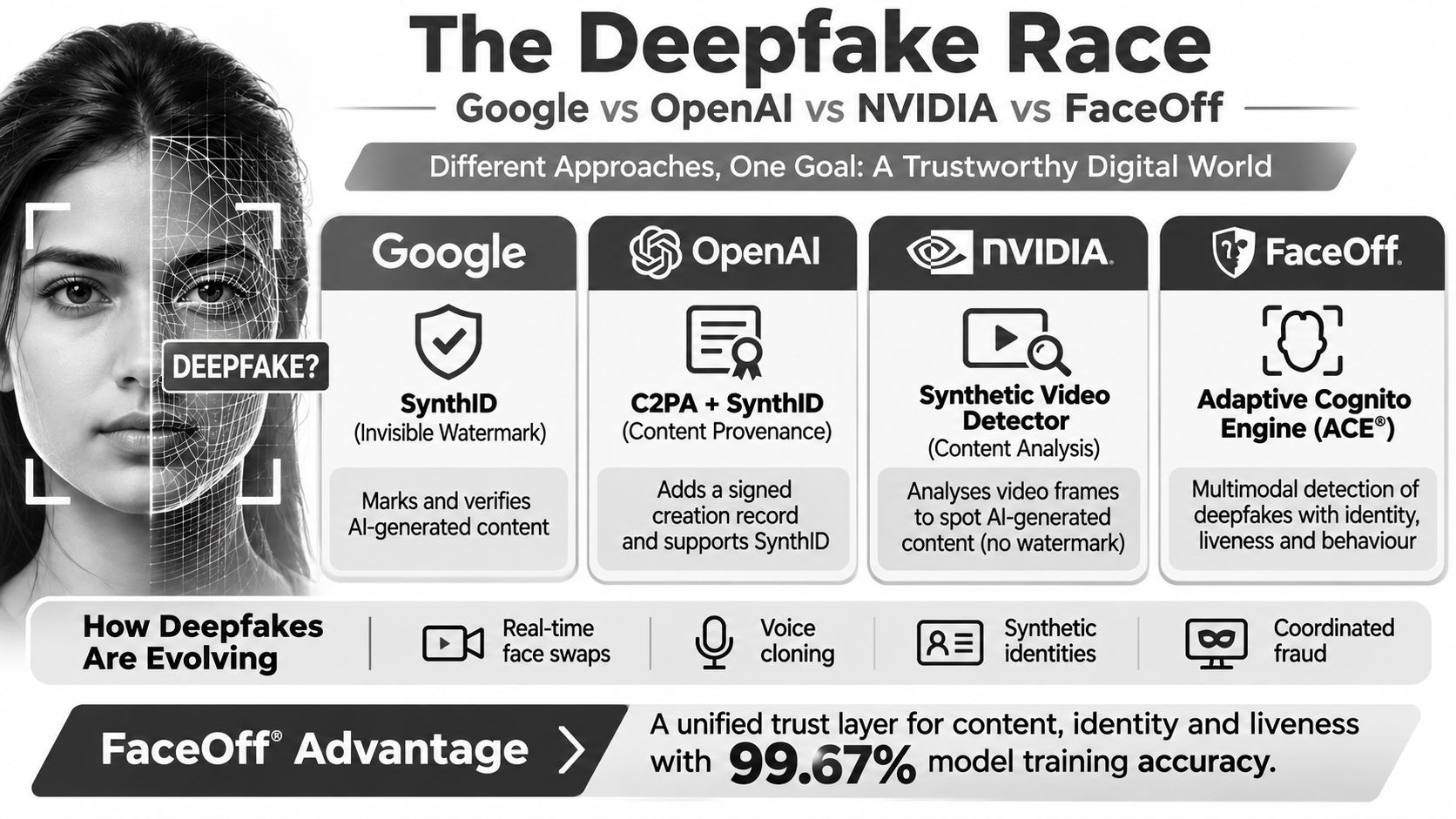
Google, OpenAI and NVIDIA are approaching this challenge through different technologies. While Google focuses on invisible watermarking, OpenAI emphasises content provenance, and NVIDIA analyses video for synthetic manipulation. Each addresses a different layer of the deepfake problem.
Google: Identifying AI-Generated Content at Its Source
Google's SynthID technology embeds invisible watermarks into AI-generated content, helping identify material produced by supported Google systems.
Its principal advantage is the ability to verify supported content without relying exclusively on visible labels or conventional metadata. However, it cannot reliably identify every deepfake produced by third-party or unmarked AI models.
Google's frontier Gemini models, including the Argon and Carbon systems described in the supplied material, should not be confused with dedicated deepfake detectors.
OpenAI: Establishing Content Authenticity
OpenAI's approach centres on content provenance through standards such as C2PA, which can provide cryptographically signed information about a file's origin and editing history.
The supplied material also describes cooperation around SynthID, although the specific adoption and product claims require independent confirmation.
The advantage of provenance is that it can establish a verifiable creation history. Its limitation is that missing or removed credentials do not automatically prove that content is fake.
NVIDIA: Detecting Synthetic Video Without Watermarks
NVIDIA represents a different approach: examining the video itself for patterns associated with AI generation.
According to the supplied material, its Synthetic Video Detector uses frame-level analysis to identify potentially manipulated footage, without depending on embedded watermarks.
This approach could be particularly useful for live video and content originating from unknown generators.
However, compression, evolving generation techniques and unfamiliar manipulation methods can reduce detection reliability. The performance figures quoted in the supplied article should be treated as vendor-reported rather than independently established benchmarks.
How Deepfake Threats Are Evolving
The threat is moving beyond manipulated photographs and prerecorded videos towards real-time face swaps, voice cloning, synthetic identities and interactive impersonation.
Increasingly, attackers can combine convincing visual content with cloned voices and fraudulent digital identities, creating coordinated attacks against financial institutions, enterprises and individuals.
Consequently, detecting whether a file was generated by AI is no longer sufficient. Organisations must also establish whether the person, voice, interaction and underlying identity can be trusted.
FaceOff Technologies: Differentiation Through Multimodal Trust Intelligence
FaceOff Technologies is developing a broader approach through its proprietary Adaptive Cognito Engine (ACE®), combining deepfake analysis with multimodal biometric, behavioural and liveness signals.
Unlike solutions focused primarily on watermark detection, provenance records or video-frame classification, FaceOff's approach is designed to examine multiple indicators, including facial inconsistencies, micro-expressions, eye movements, voice characteristics, behavioural patterns and physiological signals.
FaceOff reports 99.67% detection accuracy from its model training and evaluation. This is a company-reported performance figure; independent validation, dataset composition and testing conditions would be needed to establish how consistently it performs across real-world attacks.
Its proposed differentiation is the combination of synthetic-content detection, identity assurance, liveness verification and explainable risk assessment within a unified trust framework.
The Future: From Deepfake Detection to Digital Trust
Google is strengthening content watermarking, OpenAI is advancing provenance, and NVIDIA is pursuing content-based detection. These technologies are complementary rather than direct substitutes.
FaceOff's opportunity lies in connecting deepfake forensics with identity, behaviour and real-time authentication, particularly for banking, government, telecom and other high-trust environments.
The next frontier is not simply detecting whether content is fake. It is establishing whether the identity behind the content is genuine, the interaction is trustworthy and the evidence is reliable.
That is where the competition is moving: from detecting deepfakes to establishing digital trust.