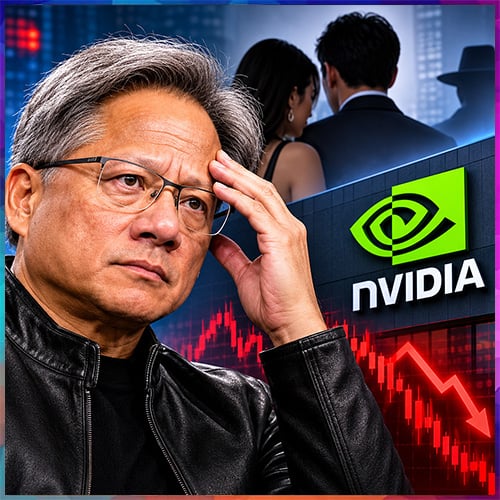
Jensen Huang's quick return as CEO hasn't settled the bigger issues. Tighter U.S. export controls and new doubts about board oversight are now putting pressure on the world's most valuable AI chipmaker.
Jensen Huang's leadership crisis at Nvidia lasted 11 days. He stepped down as CEO amid personal controversies, including reported links to a suspected Chinese intelligence asset. He was reinstated less than two weeks later. The board reversed its decision unanimously after President Trump publicly urged it to, and said it had found no national-security risk.
Investors welcomed the news at first, but the rally didn't hold. Shares fell back as attention moved from the man to the institution: how Nvidia is governed and where its China strategy goes next.
Key Highlights
- Huang's brief exit and Trump-backed return have increased concerns about governance and over-reliance on one leader, and S&P has put Nvidia on CreditWatch.
- Nvidia has paused shipments of advanced AI servers to Malaysia, Singapore, Thailand and Indonesia.
- New U.S. rules target Chinese firms that use data centres in these countries to access restricted computing power remotely.
- The U.S.-China technology split is widening, and Huang is unlikely to keep arguing for continued chip sales to China as he once did.
- Governance concerns and higher compliance costs could raise Nvidia's borrowing costs and slow AI infrastructure expansion.
Credit agencies raise governance concerns
S&P Global has placed Nvidia on CreditWatch with negative implications. It warned that Nvidia's AA rating could be cut by one notch because of weaknesses in management and governance. S&P pointed to long-serving directors, limited oversight of executives, heavy dependence on Huang, and the lack of a solid succession plan.
Moody's had already lowered its outlook from positive to stable for similar reasons. Huang's return did not resolve those concerns.
Southeast Asia shipments paused
Nvidia has also stopped shipping advanced AI servers to four Southeast Asian countries. The pause follows new U.S. rules that require licences for advanced chips sent to data centres that could supply significant computing power to high-risk countries, including China.
Malaysia, Singapore, Thailand and Indonesia had become common workarounds for Chinese companies seeking remote access to Nvidia hardware they can't buy directly. The freeze now affects one of the world's fastest-growing data-centre markets, where projects worth billions of dollars are under construction.
A different Huang for China
Beijing should not expect Huang to return to his earlier role as a public advocate for continued chip sales to China. Washington is looking more closely at his personal connections and at Nvidia's compliance record, which leaves him little room to argue for engagement.
Some commentators have also asked whether Nvidia really needs its high-profile but polarising founder at the top. They argue that Trump's intervention, driven by concern for the markets, cut short a proper assessment of what the company needs in a leader. An independent investigation is still underway, and questions about export controls and internal controls remain open.
What it means for the industry
The effects are likely to spread beyond Nvidia:
- Higher compliance costs across the AI hardware supply chain
- Slower data-centre construction in Southeast Asia
- Closer scrutiny of Nvidia's exposure to China
- Stronger pressure for an independent board and a clear succession plan
The episode shows that in the AI supply chain, geopolitical controls and governance standards now carry more weight than any single leader.