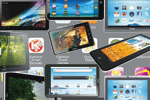
Low-cost tablets that account for 78 per cent of the total tablet market in the country is believed to be an answer to today’s ailing PC and laptop market. But does this provide sufficient reason for it to survive the threat from international tablet brands?
Tablet is one of the many product ranges that has emerged over the past few quarters and has caught the fancy of many a vendor. Since the time it was first introduced, the tablet has gone through several technological advancements, with each tablet vendor vying to be better than the other. For instance, the first-generation tablets worked only on Wi-Fi followed by tablets that supported 2G Voice calls and Data. The next series were 3G-based single core tablets and then on a Dual-Core platform. Now it is Quad-Core tablets with 3G that is currently ruling the roost.
 |  |  |  |
| Gaurav Tikoo, Global Head - Mobility Marketing, HCL Infosystems | Suneet Singh Tuli, CEO & President, Datawind | Indrajit Sabharwal, Managing Director, Simmtronics Semiconductors Ltd | Saji Kumar, Director - Product Management, Acer India |
Low-Cost Indian Tablet Market
The low-cost tablet PC market in India has witnessed a burgeoning growth with multiple players joining the bandwagon. The market has grown into an intensely competitive market with cheaper and smaller screen-size form-factors leading the charge in the second half of 2012. The low-cost 7-inch tablets made up for close-to 78 per cent in the total volume shipments in Q4 2012, with the growth attributed to local vendors and the increasing Chinese imports in the Indian market.
With a series of launches in the price range of below Rs.15,000 in 2012, the market for low-cost tablets is maturing all of a sudden. About 50 per cent sales come from tier-II and tier-III cities which is a primary target market for low-cost tablets. “For a price-sensitive market like ours, a gadget that provides most value and features at a more affordable price range will encourage more usage. So for smaller players it is not only price points that have become critical, but the ability to produce feature-rich and innovative tablets that will become important,” opine Gaurav Tikoo, Global Head – Mobility Marketing, HCL Infosystems.
HCL that enjoys a good share in the low-cost tablet category has recently launched its 2G calling tablet, ME Connect V3 and has been consistently ranked # 3 or 4 in the overall tablet market in India.
 |
| India Tablet Vendor Market Rankings, CY 2012 and 4Q 2012 (% of unit shipments) |
"Consumers are on the lookout for multitasking devices that offer portability and long battery life. Evolving consumer needs have driven the demand for the low-cost tablet PC market in India. There has been a spur in consumers adapting to the 7” tablet. We are confident that this segment will witness robust growth in the year ahead," informs Saji Kumar, Director – Product Management, Acer India.
Acer has earlier this year launched the 7” ICONIA B1 tablet and with its launch, the company became the first MNC branded player in the marketplace to enter the budget tablet segment. “Our tablet PC was very well-accepted in the marketplace. We have launched tablet PCs on both Windows as well as Android platforms on different form-factors and have plans to further expand our product lineup in this category,” says Saji.
“Tablets have now created a benchmark in the industry. Ever since their launch, they have secured a strong positioning. The larger screen size of the tablets, portability, cost-effectiveness and touch-screens have created a spur in the industry settling a strong wave-front for the tablet industry,” views Indrajit Sabharwal, Managing Director, Simmtronics Semiconductors Ltd.
Simmtronics has manufactured around 2,40,000 tablets in the last quarter.
Datawind that got embroiled in manufacturing issues during the launch of its Aakash tablet project has shipped over 1,40,000 units in the last quarter and around 60,000 in the government vertical. Adding to this, Suneet Singh Tuli, CEO & President, Datawind, says, “We currently ship around 3,000 tablets per day. We offer almost all the required application embedded in the tablet at a very low cost if compared with any other big brand.”
“Too many me2 products and a huge influx of China-made models brought down the price mark in the market. Following above, some of the known local brands focussed on announcing the possible cheapest price tablet as their USP and thus the bandwagon of low-cost tablets started in India,” says Sushmita Das, Vice-President – Business, Kobian Pte Ltd. According to her, India has always remained dominated by the price factor, but lately there has been a switch to quality products. “The current focus has been moving to in-built 3G models and faster processor based Tablets,” she says.
 |  |  |  |
| Sushmita Das, VP - Business, Kobian Pte Ltd | Abhijit Chaudhari, Director, GATEFORUM | Sandeep Arya, Managing Director, Amtrak Info System Pvt. Ltd | Kapil Wadhwa, Managing Director, Champion Computers Private Ltd |
Factors fuelling growth
Specifications and Performance
Among verticals, the adoption of tablets in the education segment continues to surge with educational institutes pinning their hopes on making e-learning a reality among its students. Abhijit Chaudhari, Director, GATEFORUM, observes, “India, with its vast geography, varied demographics and dearth of good faculty, is an ideal country to embrace e-learning in a big way. The biggest impediments to the adoption of e-learning, however, are an access device and connectivity. And while desktops come at a reasonable price, they do not offer mobility and are also vulnerable to the vagaries of power supply. Laptops, on the other hand, are still an expensive proposition. This is where tablets come in. They offer the convenience of laptop at a far more affordable rate.”
In May 2013, the Rajasthan Government gave away Rs.210 crore to 3.5 lakh class VIII students in the State-run schools under the Rajiv Gandhi Vidyarthi Digital Scheme, in which every student got Rs.6,000 to buy a tablet. The Digital Scheme has been supported by Amtrak who has assisted the students by supplying them with its education tablets. Supporting the cause and ensuring the availability of suitable for education tablets. “The Government has been pushing for education tablets for various other unannounced projects for both at the pre-school and primary school level. This will ensure a big boost to low-cost entry-level tablets not only in the education segment, but also in Rural Development, Agriculture and Aadhaar projects,” opine Sandeep Arya, Managing Director, Amtrak Info System Pvt. Ltd.
 |
“Whether it happens through the Government or any distribution agency, low-cost tablets have found many takers amongst Indian customers, especially in the education segment. The number is growing and the market will see even higher growth in the coming quarters,” says Kapil Wadhwa, Managing Director, Champion Computers Private Ltd. Champion Computers has this month entered into a strategic alliance with BSNL to launch a range of tablets, besides other product ranges, the name of which is still under wraps.
But will they survive for long?
Both international and indigenous brands have different target groups. While big international brands are focussed on the high-end of the market, small brands focus on breaking the affordability barrier for the masses to take advantage of the latest technology. Low-cost tablet devices are being purchased by people who cannot afford an iPad or expensive devices. Students who are mainly dependent on their pocket money, educational institutions as well as the office-goers who prefer carrying portable devices to work remain as the main target groups for low-cost tablet vendors.
“An excellent performance and price equation is the only strategy for the survival. Brands that are only relying on price and cutting down on features, etc shall not be able to grow. Products need to be at par with the big brands in terms of specification and should also have a decent performance and experience for the customer,” remarks Sushmita.
Sometimes, the prevailing competition in the market happens to bring down the prices of products. Price then becomes the factor on which a user shall purchase a local brand against the big names. “With the influx of so many competing brands in the market and with the random innovation in technology, we are left with but a little choice to put in place an inert survival strategy of sweeping the market with affordability and compatibility as the parameters,” explains Sabharwal.
To conclude…
According to IDC's forecast, several State Governments like UP, Rajasthan, Meghalaya and Chhattisgarh have already announced plans to deploy tablets for school and college students with an aim to improve the digital literacy rate among students and lessen the country’s digital divide that has been a prime focus for some time now. This is expected to beef up business of tablet vendors and the overall tablet market.
However, what remains to be seen is a vendor’s ability to make available to the users better devices that will eventually determine the long-term growth potential of the market. India being a price-sensitive market, vendors who offer more value at a lower price are going to score more. The fact that tablets are available at the same price as that of a smartphone with even better features than the latter can be the winning formula here.
Another trend that is fast picking up and will soon create a flutter in the Indian market is Phablets, which are tablets with cellular connectivity having the ability to take a regular SIM for voice and data access. The growth of Phablets is further expected to bolster the Indian market comprising of users who vouch for an amalgamation of tablets and smartphones.
samrita@varindia.com