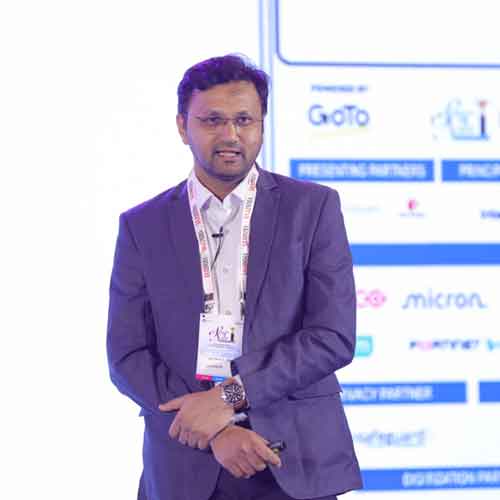
Akshay Balaganur,
Co-Founder & CEO,
LinkEye
Today, the network functions much like a utility—similar to electricity or water. When it’s running smoothly, it goes unnoticed; but the moment it fails, everything is disrupted. In the last 10 years, we have been working with several enterprise customers here in India and outside with our small company called Airowire Networks. In the last 10 -15 years, with the onset of technologies like cloud, SAS and now AI, the network is no longer constrained to the office. It is to be found everywhere.
The next big challenge is the huge amount of data that the network generates that is not humanly possible to assess or analyze it. The third biggest shortcoming is the shrinking size of the IT teams and engineers. We don't have network engineers anymore who are managing the network. Most importantly, our attention span as humans has gone down. So, we decided to work on making network monitoring very simple, measurable and actionable.
In India, the Internet is the biggest challenge, unlike the West. The last-mile connectivity provided by internet service providers to customer locations often becomes unstable for several reasons. Indian partners cater to a wide range of Indian companies, many of which have sites numbering in the hundreds or thousands. Each of these sites might have two or three ISP links, which are unstable. Now, you have 3000 or 4000 links to be managed by your IT team. This is a huge operational overhead. SD- WAN does solve the problem of giving you an uptime, but a failed link still has to be dealt with by the IT. So Airowire Networks has an AI agent which talks to the SD-WAN, does the troubleshooting and then figures out if it is AN ISP problem.

See What’s Next in Tech With the Fast Forward Newsletter








Tweets From @varindiamag
Nothing to see here - yet
When they Tweet, their Tweets will show up here.