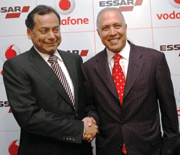
If mega deals are the ones which are clinched in a mega way, then Vodafone’s Hutchison deal would be the first claimant to that title, as far as the Indian market is concerned. Arun Sarin’s Vodafone bamboozled its rival bidders by wrapping up Hutchison Telecom International’s 67-per cent stake in Hutchison Essar at a staggering $11.1 billion last month. And, with this, the battle royal for India’s mega telephoney has begun. Hold your breath! VARIndia familiarizes you with the pros and cons of the matter; the outlook that designed it and the unprecedented implications the deal is all set to generate.
The Deal
The UK telecom major acquired Hutchison’s stake in the Indian mobile company, which is valued at $18.8 billion last month and created ripples in the national mobile telephoney circles. Vodafone assumed a net debt of approximately $2.0 billion. As of now, it looks like Essar will remain the minority partner with 33-per cent stake. Vodafone, however, had expressed its willingness to buy Essar’s stake at the equivalent price per share it has agreed with HTIL (Hutchison Telecom International Ltd.). With this, the company also sells 5.6-per cent stake in Bharti Airtel to promoters for $1.6 billion and plans to retain the remaining 4.4-per cent stake, to remain a financial investor in Bharti. Readers be reminded here that Vodafone had created a bang in October 2005 by buying up 10-per cent stake of Bharti at US$1.61 billion. Both the companies have also reached an infrastructure sharing agreement, which means they will compete and collaborate.
A statement said that while “Hutch Essar and Bharti will continue to compete independently, Vodafone and Bharti have entered into an MoU relating to a comprehensive range of infrastructure sharing options in India between Hutch Essar and Bharti”. Infrastructure sharing is expected to reduce the total cost of delivering telecommunication services, especially in rural areas, enabling both parties to expand network coverage more quickly and to offer more affordable services to a broader base of the Indian population,” the statement added.
The transaction is expected to close in the second quarter of calendar year 2007 and is conditional on the Indian regulatory approval. HTIL’s existing partners (Analjit Singh of Max India and Asim Ghosh, CEO of Hutch, who were warehousing the stake for HTIL), and who hold between them a 15-per cent interest in Hutch Essar, have agreed to retain their holdings and become partners with Vodafone. So, Vodafone’s interest will be 52 per cent following completion of the deal. If Essar decides to accept Vodafone’s offer, these local minority partners between themselves will increase their combined interest in Hutch Essar to 26 per cent.
In the race for Hutch, Vodafone has beaten players like Reliance Communications, the Hindujas (along with Russia’s Altimo and Qatar Telecom), and Essar itself.
What necessitated the Deal Market Rationale driving Hutchison Selling
Li Ka-Shing’s Hutchison Whampoa has a history of building up a business and selling it on when the company attains a good value. This time, there were multiple incentives for the company to sell its most lucrative telecom business in the fast-growing Indian market. Firstly, the valuation of Hutchison Essar was high. Secondly, Hutchison Whampoa needs money to repay debts after HTIL failed to take its Indian unit public. Thirdly, the management tensions between HTIL and Essar were apparent, which had led HTIL to drop a long-planned initial public offering (IPO) of Hutchison Essar. In addition, Hutchison Whampoa, with interests in ports, real estate, retail, telecoms, energy and infrastructure, was facing challenges in running its telecom businesses in general. Both its emerging market group HTIL and its 3G mobile business in Europe – called 3 Group – have struggled to make a profit. Last year, Hutchison Whampoa sold a 19.3-per cent stake in HTIL to Egypt’s Orascom Telecom for US$1.3 billion. During April, Orascom subsequently raised this stake to 23 per cent. According to Reuters, the leading Middle Eastern mobile operator also said, in October, that it was in negotiations with Hutchison Whampoa to increase its stake even further, with a view to achieving either a full takeover or to take a controlling stake in HTIL. In Europe, Hutchison Whampoa’s 3 Group is also reported to have been eyed by its competitors, including France Telecom and Vodafone. Although Hutchison Whampoa has insisted that it will not sell 3 Group, there can hardly be any justification not to sell if its recently launched X-Series mobile broadband strategy flops.
Issues Other than Price
Although the war over Hutchison Essar was set to be expensive, price is not the only factor to be taken into consideration. As Indian regulations restrict foreign ownership of Indian telecom companies to 74 per cent, Vodafone would have to team up with Hutchison Essar or find another local partner, which could be difficult, given the cost of the remaining stake. Vodafone would also have to figure out what to do with the 10-per cent stake it already owned in India’s largest wireless operator, Bharti Airtel. When Vodafone signed the deal with Bharti’s owners’– Bharti Enterprises and SingTel – in October 2005, it agreed to a one-year non-competition clause should it wish to exit the contract.
Vodafone’s New Market Strategy
A bid for Hutchison Essar is in line with the Vodafone’s new strategy of shifting its focus to fast-growing markets and under-penetrated markets. Vodafone CEO Sarin’s comment reflects this. “It is fundamentally at the heart of our emerging market strategy of extracting growth. India is only 13 per cent penetrated, China is 40 per cent penetrated and Europe is 100 per cent,” articulated Sarin after clinching the deal. The company has quitted the Swedish, Japanese, Belgian and, lately, the Swiss markets, while boosting its presence in Turkey, South Africa, Kenya, India and China. Having failed to boost its stake in India’s leading mobile company, Bharti, beyond its present 10-per cent stake, an opportunity to take a leading role in an equally successful Indian operator is too good to be missed. Put simply, India, with over a billion people and net monthly additions of over five million customers, is on track to become the second-largest mobile market in the world after China, and the world’s leading mobile operator could not but vie for a bigger role in it. Given that Reliance was committed to launching a counter-bid, the stage was set for a clash between Vodafone and Reliance. Although Vodafone was expected to have a deeper purse, worries about overpaying and strong opposition from shareholders would have left little room for it to up the ante. In the event of losing the bidding war, memories of Vodafone’s ill-fated bid for AT&T in 2004 would have resurfaced, souring the company’s relationship with Bharti.
Sarin’s Corporate Redemption
Besides all this, the deal is being viewed in some quarters as Mr. Sarin’s corporate redemption. Mr. Sarin has been facing the heat of the major shareholders and his continuation as the CEO was also put under the scanner. On the foothills of all this, it must have come as a major relief to Sarin.
An elated Sarin greeted the deal as, “We are delighted to be deepening our involvement in the Indian mobile market with the full range of Vodafone’s products, services and brand. This announcement is a clear evidence of how we are executing our strategy of develop
ing our presence in the emerging markets. We have concluded this transaction within our stated financial investment criteria and we are confident that this will prove to be an excellent investment for our shareholders. Hutch Essar is an impressive, well-run company that will fit well into the Vodafone Group.”
What it bodes for the Consumer Value-Added Services
Post deal, the world’s largest mobile player is likely to bring some of its popular services such as Vodafone Passport, Vodafone Simply and Vodafone Live, besides other common services like video calling, video messaging and mobile television to India after it concludes the transaction by the first week of April so as to grab a higher share in the world’s fastest growing wireless market.
Vodafone Passport allows customers to take their domestic tariff plan abroad for a small connection fee to be added per call. Given that the roaming charges in India are still high even after the recent reductions by the regulator TRAI, Passport could be of much help to the Indians frequently visiting abroad.
Vodafone Simply, which offers basic mobile phone services and is used only for voice calls and text messages, could be another useful tool that the company can deploy, especially in rural areas. Since the UK firm is planning a rural push and sees low mobile penetration as a big opportunity for getting more market share, Vodafone simply would be an appropriate tool for low-end users.
The 3G Foray
The UK major may as well show its Third-Generation (3G) mobile technology prowess through a simple, on-screen menu and the latest multimedia phones ––“Vodafone Live!”. A 3G service would enable customers to send and receive larger pieces of information in voice, text and pictures, as well as video and music. Vodafone has also tied up with a Chinese company ZTE and would introduce low-cost handsets to capture more subscribers. It may also look at the possibility of tying up with vendors having a manufacturing plant in the country.
Reliance: Disappointing outcome but story intact
Reliance Communications losing the bidding war for Hutchison Essar to Vodafone may be a short-term negative for the Reliance stock. Since the stock had not run up significantly in the homestretch to the deal, the downside risks may be limited. However, concerns arise on two fronts. Firstly, from slower-than-expected grant of scarce frequency spectrum for execution of Reliance’s GSM technology strategy as opposed to its existing CDMA strategy, which it had articulated last year and, secondly, any slowdown in subscriber additions as Reliance changes its technology course may dampen the market sentiment.
Reliance Communications will be disappointed with the Hutchison Essar outcome, as, among the bidders, the company stood to gain the most from the acquisition. This would have fulfilled its aspirations of switching to GSM in a single stroke, with hardly any overlapping circles. Second, as an Indian company, Reliance Communications could have enjoyed the flexibility of buying out 100-per cent equity in Hutchison Essar, unlike Vodafone, which has to restrict its exposure to 74 per cent, under the FDI guidelines. Finally, the acquisition could have helped Reliance march past Bharti to garner a dominant market share.
Bharti Airtel: Focussed on ring-fencing its stake
Bharti Airtel’s market share leadership remains intact, with Vodafone winning the Hutchison Essar bid with Reliance Communications involved in the build-up of its GSM strategy, BSNL struggling to resolve its mega GSM tender and Vodafone-Hutch caught in the integration process, Bharti will be well placed to strengthen its subscriber additions and extend its market share lead in the near term, before intense competition picks up again.
Bharti has also extricated itself smoothly from a slightly sticky shareholding situation. Vodafone, which held a 10-per cent equity stake in Bharti Airtel, has granted a Bharti group company the option to buy 5.6-per cent equity at Rs.686 per share for $1.6 billion. The remaining 4.4 per cent will be retained by Vodafone as an ongoing relationship with Bharti. The Bharti management’s ability to enter into an infrastructure-sharing relationship with Vodafone may be positive for it in the long run, as the telecom regulator is reviewing the need to share active network infrastructure.
Essar plays the recondiliatory tune
One month up the road after losing the bidding war, the Ruias, the junior stakeholders in Hutch Essar have chosen to wave the banner of truce. Ending a month-long uncertainty, both the players have chosen to bury their differences, as per the latest information. According to the agreements Essar group Vice-Chairman Ravi Ruia would be the non-executive Chairman of the telecom company, but Vodafone will retain management control. While Vodafone CEO Arun Sarin will be the Vice-Chairman, Ashim Ghosh would be invested with the responsibility of Managing Director & CEO. Vodafone has agreed to a four-year put option for Essar. Essar reserves the right to enter the capital market to divest its holding and can raise an amount equal to its stock value as debt. But the 67-per cent stakeholder did not agree on a higher valuation and the put option has been based upon a deal-time enterprise value of $18.8 billion. And going against all brand maintenance cautions, the nascent partnership has decided to bestow a new nomenclature for the company. Henceforth, the telecom entity will don the name of Vodafone Essar instead of the parent name of Hutch Essar.
Cementing the Indo-EU Ties
Apart from the brilliant marketing jugglery involved in the deal that redefined the realignment of mobile market forces, the historic deal has also been hailed as a medium to cement the Indo-EU ties.
The European Union has said the recent big-ticket mergers and acquisitions between the Indian and European companies, including Tata-Corus and Vodafone-Hutch, would pave the way for greater economic integration between the two economic powers.
Conclusion
Post deal, The Economic Times said on its front page: “The India victory song that started with Corus has reached a crescendo. As Vodafone would say: ‘Make the most of now’.”
While some may see the deal as just the latest in a column of bouts that shows the power of Indian companies and the strength of the Indian market and some others may perceive it as the strike-back of globalization, for local consumers, the charges may go down as Vodafone intensifies the competition, and potentially opens the doors to 3G services. But whatever the impact on customers, analysts understand the deal as a prize-catch for Vodafone. Thus, the concluding line to the article can be the one from Ovum principal analyst John Delaney who branded the deal as a “bit of a coup” for Vodafone, adding it, is a return to its “swashbuckling” days of old and an emphatic execution of its emerging and sure-shot market strategy.