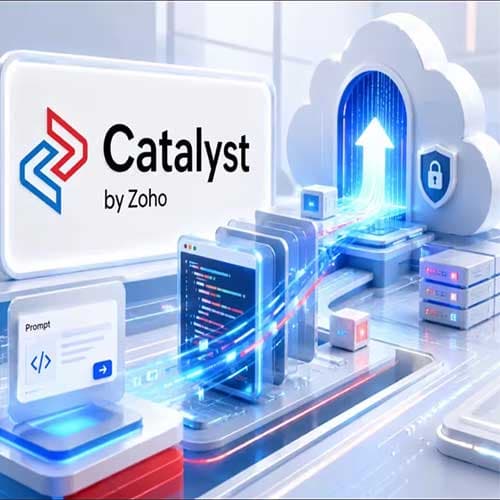
Zoho has announced the launch of Catalyst 3.0, the agent-ready full-stack cloud development platform, equipped with all-new capabilities to enhance the AI-native developer experience. Catalyst 3.0 brings enhancements, including AI IDE (Integrated Development Environment) integrations, Agent Skills, MCP support, and AI-assisted workflows, on a single integrated platform to empower developers by fast-tracking the prompt-to-production process. To enhance accessibility and equip future developers with modern tools, the platform is also offering a free student programme, allowing next-gen developers to learn, experiment and deploy applications seamlessly.
"Agentic AI coding assistants have transformed how quickly applications are being created, but getting that code deployed and operating in production remains a major hurdle," said Anand Nergunam, Global Vice President, Revenue Growth at Zoho. "For every app being built, developers spend a lot of time stitching together separate cloud services and managing infrastructure. We built Catalyst 3.0 to eliminate that friction. By delivering an agent-ready, serverless full-stack platform, we are providing developers and AI agents complete freedom from managing cloud infrastructure. They can build, deploy, and scale applications faster safely, with far less operational overhead."
Unlike its competitors that charge subscription fee in addition to usage, Catalyst has a straightforward pay-as-you-go pricing model with every feature bearing a per-unit cost. Users have complete visibility over their usage within the Console, and can set budget alerts and ceilings to prevent inflated cloud invoices.
"Additionally, to democratise access we are launching a free student tier. By putting Catalyst 3.0 in the hands of student developers, we are freeing them from the burden of traditional development cycles, so they can thrive in a rapidly shifting landscape. Ultimately, our aim is to remove technical friction so they can instantly convert their ideas into tangible outcomes," added Anand Nergunam.
AI-Native Development Capabilities and an Open Source Ecosystem
Catalyst 3.0 brings several improvements to the platform to make it better equipped to work with any AI coding assistant. To reduce the learning curve for the developers, Zoho has added Agentic AI skills that enable the AI coding assistants to understand the Catalyst platform and enable them to write production-grade code. Furthermore, the skills have also been made available across the Claude Code and Codex marketplaces, making it accessible for developers while helping them optimise token consumption.
To further improve the experience of AI-assisted coding sessions, Catalyst has introduced a non-interactive CLI (Command-Line Interface) that can perform tasks from start to finish without prompting the user for manual input during its execution. Additionally, MCP support for Catalyst enables a complete hands-off development process, with developers completing all actions and requests from within a single coding assistant console without the need to perform actions and configurations via the platforms UI console.
Orchestration, built into the Skill, ties the three capabilities together. When an AI coding assistant faces a decision about how to execute a request, the Skill routes it deterministically down the CLI or MCP path rather than leaving that choice to the model. This approach lowers the developer's cognitive load, reduces the risk of incorrect tool selection, and helps produce more reliable, production-ready applications.
To strengthen developer trust and transparency, Zoho has made the AI skills available as an open-source repository for developers to be able to inspect and further add to. Zoho is also open-sourcing Catalyst's SDK (Software Development Kit), CLI, as well as its lightweight Javascript Framework, Slyte.
An Integrated Platform Leveraging Zoho's Secure Infrastructure
Catalyst 3.0 offers native services to meet all the requirements of a full-stack application from frontend hosting and serverless functions to compute and data management. With every layer of the stack available in one place, developers can focus on building solutions instead of managing infrastructure, which generally spans across multiple providers.
Any application built on Catalyst inherits the security layer of Zoho's cloud infrastructure, and the developers have the option to host solutions in the company's India data centres, respecting data sovereignty. Catalyst has deep integration hooks into Zoho apps. It is available across data centres in regions like US and EU, for developers building compliance-sensitive applications. Catalyst also offers a few open-source LLM models, hosted on Zoho’s secure infrastructure, to add AI capabilities to the apps built on the