


AI Ignites India’s Data Centre Boom

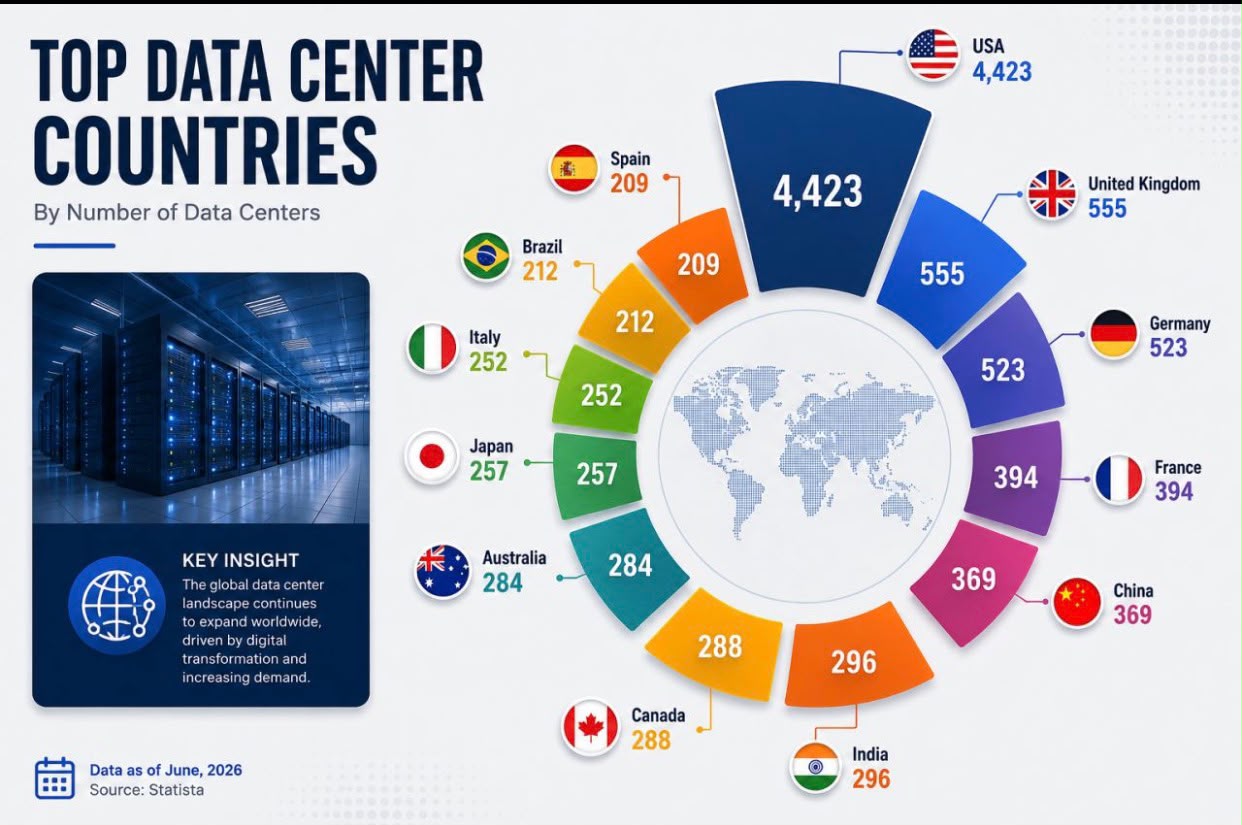
India is entering a new phase of digital infrastructure growth as AI, cloud computing, sovereign data requirements and the expanding digital economy drive unprecedented demand for data centres. The infographic shared places India at 296 facilities as of June 2026, but the more meaningful measure going forward will be compute and power capacity, not simply the number of buildings.
Government data shows India's data-centre capacity expanded from roughly 375 MW in 2020 to around 1.5 GW in 2025. More aggressive industry forecasts now see operational capacity reaching 10–12 GW by 2030, with Wood Mackenzie forecasting 12 GW as AI-dedicated capacity rises dramatically.
AI Changes the Data Centre Architecture:
The AI boom is creating a fundamentally different data-centre requirement. Training large models requires enormous GPU clusters, while inference and agentic AI create continuous compute demand as millions of applications and autonomous agents make repeated model calls.
At the same time, application developers are working to make AI more efficient through smaller models, quantization, model routing, optimized inference, caching and edge processing. The objective is increasingly to deliver more intelligence with fewer tokens, less memory and lower electricity consumption.
But efficiency will not necessarily reduce total power demand. As AI becomes cheaper to run, usage can expand much faster. India's government said in July that AI data centres alone could add 26.3 GW of load by 2031–32, illustrating the scale of the infrastructure challenge.
DPDP Will Strengthen Domestic Infrastructure:
Data protection and sovereignty will also support Indian data-centre demand. However, it is important not to say that the DPDP Act requires all Indian personal data to be hosted locally. The Act allows the government to restrict transfers to specified countries or territories, while other sector-specific rules can impose stronger localization requirements.
Nevertheless, growing compliance expectations, regulated-sector requirements and enterprise preferences for greater control over sensitive information are encouraging organizations to consider India-based cloud, sovereign infrastructure and domestic processing. KPMG similarly identifies data protection and localization frameworks as drivers of domestic data-centre demand.
Power Becomes the Real Bottleneck:
The next challenge is electricity. AI racks are becoming dramatically more power-dense, forcing operators to rethink power distribution, cooling and energy efficiency. High-density computing is accelerating adoption of direct-to-chip liquid and immersion cooling technologies.
India therefore needs to build more than data centres. It needs renewable generation, grid capacity, storage, high-speed networks, water-efficient cooling and geographically distributed infrastructure capable of supporting them.
From Hundreds of DCs to an AI Infrastructure Economy
The opportunity is much larger than increasing today's roughly 300 facilities into “multiple thousands.” There is not yet sufficient evidence to confidently forecast thousands of physical data centres, and hyperscale development could actually concentrate enormous compute capacity into fewer, much larger campuses.
The stronger story is that India is moving from a conventional data-centre market toward an AI infrastructure economy. Budget 2026–27 measures are explicitly intended to strengthen India's position as a global cloud and AI infrastructure hub, including incentives for eligible foreign cloud providers using Indian data centres.
The winners will therefore not simply be companies that build the most facilities. They will be those that can deliver:
Moving forward, the next AI race will not be won by algorithms alone—it will be won by countries that can provide the compute, power and trusted data infrastructure to run them.

See What’s Next in Tech With the Fast Forward Newsletter


Tweets From @varindiamag
Nothing to see here - yet
When they Tweet, their Tweets will show up here.


