
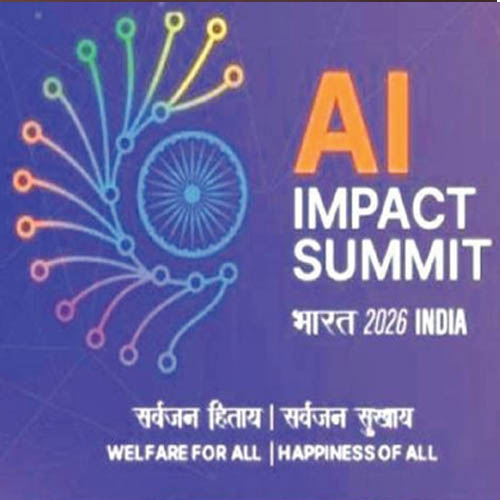
At the India AI Impact Summit 2026, New Delhi didn't just host the world's biggest gathering of AI minds — it staked a claim to lead the next chapter of the technology's story, on its own terms.
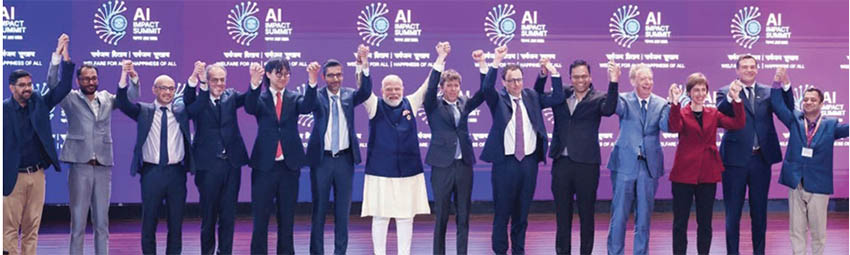
For six charged days in February, Bharat Mandapam in New Delhi became the nerve centre of the global artificial intelligence conversation. The India AI Impact Summit 2026 — the fourth in a series of global AI gatherings that began with the Bletchley Park AI Safety Summit in 2023 — drew more than 20 heads of state, 60 ministers, over 500 AI leaders, and delegations from more than 100 countries. Prime Ministers and Presidents rubbed shoulders with the CEOs of OpenAI, Google, Anthropic, and Google DeepMind. By the time the last session wrapped on February 21 — a day later than originally planned, extended due to "overwhelming public response"
— it had made history as the largest AI conference ever held in the Global South.
The symbolism was unmistakable. India was not merely a host. It was announcing itself as a principal author of where artificial intelligence goes next.
A Historic First for the Global South
The significance of geography was not lost on anyone in the room. Every previous summit in the series had taken place in a wealthy Western democracy or an advanced East Asian economy. India's turn represented a decisive shift. As Prime Minister Narendra Modi put it in his inaugural address on February 19: "Hosting this summit in
India is a matter of pride not only for the country but also for the entire Global South."
Modi's keynote was sweeping in its historical ambition. He drew parallels between the rise of AI and earlier civilisational turning points - the invention of writing, the discovery of fire, the advent of wireless communication - arguing that artificial intelligence represents "a transformation of the same magnitude as historic turning points in human civilisation." He called on nations to ensure that the technology's benefits are shared rather than concentrated, and extended an open invitation to the world: "Design and Develop in India. Deliver to the World. Deliver to Humanity."
Breaking briefly into English during a largely Hindi address, Modi captured the spirit of the summit's ambition in a single sentence: "We are entering an era where humans and intelligent systems co-create, co-work and co-evolve."
French President Emmanuel Macron, who co-headlined the opening ceremony, paid tribute to India's remarkable digital infrastructure. Pointing to the country's Aadhaar system, he noted that India had built a digital identity for 1.4 billion people — "something that no other country in the world has built." He also highlighted India's payment ecosystem, which now processes 20 billion transactions every month, and a health infrastructure that has issued 500 million digital health IDs. "We are clearly at the beginning of a huge acceleration," Macron said, praising the India Stack as a model of open, interoperable, sovereign digital architecture.
United Nations Secretary-General António Guterres offered a more cautionary note. He warned against leaving the future of AI to the "whims of a few billionaires," calling for open access to AI systems and broader multilateral governance. His remarks underlined the tension that ran quietly beneath the summit's optimistic surface: the risk that AI's extraordinary potential could end up concentrated in the hands of a very small number of powerful actors.
The Framework: Sutras, Chakras, and a New AI Philosophy
India brought more than spectacle to the summit table. It brought a conceptual architecture rooted in its own intellectual traditions.
The summit was organised around three foundational pillars called "Sutras" — a Sanskrit term meaning guiding principles or essential threads that weave together wisdom and action. These were People, Planet, and Progress, reflecting a vision of AI that serves humanity in all its diversity, aligns innovation with environmental responsibility, and ensures that the technology's gains are shared equitably.
Translating these Sutras into actionable outcomes were seven thematic working groups styled as "Chakras," covering areas including AI for economic growth and social good; democratising AI resources; inclusion for social empowerment; safe and trusted AI; human capital development; science; and resilience, innovation, and efficiency.
This was deliberate framing. India was not replicating the safety- focused language of Bletchley or the regulatory caution of Brussels. It was positioning itself as a country that has moved beyond anxiety about AI and into the business of deploying it at scale — for farmers, for patients, for students, for the 140 crore citizens who, as Modi noted, are eager to embrace new technologies.
Union Minister Ashwini Vaishnaw elaborated on the government's domestic vision, describing plans to build a "frugal, sovereign and scalable" AI ecosystem. As part of a concrete infrastructure push, the government announced plans to add more than 20,000 GPUs to India's existing base of 38,000 under the IndiaAI Compute Portal — a significant step toward building the sovereign compute capacity that India has identified as essential for technological self-reliance.
Titans of Tech Converge on New Delhi
The CEO roster at the summit read like a who's who of the global AI industry. Sundar Pichai (Google and Alphabet), Sam Altman (OpenAI), Dario Amodei (Anthropic), and Demis Hassabis (Google DeepMind) were all present. So was Mukesh Ambani of Reliance Industries, whose conglomerate has been making aggressive moves in AI infrastructure.
Altman, whose company now counts India among its top markets, disclosed that India accounts for more than 100 million weekly active ChatGPT users — second globally only to the United States. It was a data point that reinforced Modi's argument: any AI model that succeeds in India can be deployed across the world.
Google announced a raft of commitments at the summit, including new fiber-optic routes under the America-India Connect initiative to strengthen digital connectivity between the US, India, and locations across the Southern Hemisphere. Google DeepMind unveiled national partnerships in India focused on science, agriculture, and renewable energy, and Google.org launched a $30 million AI for Science Impact Challenge aimed at supporting researchers globally who are using AI to drive scientific breakthroughs. A separate Google.org Initiative, the AI for Government Innovation Challenge, was announced as a global call for organisations building AI-powered solutions that transform public services.
From the private sector, Adani announced an extraordinary $100
billion allocation to build AI data centres in India using renewable energy by 2035. The group said this investment would catalyse an additional $150 billion in adjacent industries including server manufacturing, sovereign cloud platforms, and advanced electrical infrastructure. India also earmarked $1.1 billion for a state-backed venture capital fund dedicated to AI and advanced manufacturing startups.
Made in India: A New Generation of AI Models
Perhaps the summit's most consequential domestic story was the parade of homegrown AI products and models that debuted on the expo floor.
Sarvam AI, one of India's most closely watched AI laboratories, launched a new generation of large language models — including a 30-billion and a 105-billion parameter model built using a mixture of experts architecture. The company also unveiled text-to-speech, speech- to-text, and vision models, and introduced the Kaze smartglasses, its first hardware product. Prime Minister Modi personally tried the Kaze glasses at the expo, a moment that generated considerable attention on social media and underscored the government's enthusiasm for indigenous AI hardware.
The government-backed BharatGen Param2 model was also launched at the summit — a 17-billion parameter model supporting all 22 official Indian languages with multimodal capabilities. It was a pointed assertion of India's commitment to language-inclusive AI at a time when the global model landscape remains overwhelmingly English-centric.
Cohere Labs joined the indigenisation theme from a different angle, launching a family of multilingual models with open weights supporting more than 70 languages. Voice AI company Cartesia, in partnership with India-based orchestrator Blue Machines, announced enterprise-grade voice solutions with local data residency.
The summit also broke a Guinness World Record: 250,946 valid pledges were collected for an AI responsibility campaign between February 16 and 17, conducted in partnership with Intel India — far exceeding the initial target of 5,000.
The Delhi Declaration: A Governance Blueprint from the South
The summit's most consequential formal output was the New Delhi Declaration on AI Impact, endorsed by 88 countries and international organisations. It outlined a shared global vision for collaborative, trusted, resilient, and efficient AI, with a strong emphasis on inclusion and the equitable distribution of AI's benefits. Technology Minister Ashwini Vaishnaw had signalled ahead of the final day that at least 70 signatories were expected; the final tally of 88 exceeded expectations.
The Declaration was deliberately framed around the three principles that Modi and his ministers had championed throughout the week: sovereignty over data, inclusion by design, and accountability by default. It affirmed that "AI's promise is best realised only when its benefits are shared by humanity" - a formulation that marked clear ideological distance from pure market-driven approaches to AI development. Voluntary frontier AI commitments released alongside the Declaration placed particular emphasis on sharing data about real- world AI usage and building mechanisms to improve AI capabilities in under-represented languages, a priority well-suited to a country with 22 official tongues and hundreds of regional dialects.
For Guterres, the Declaration was a starting point, not a destination. The UN chief's parting message from New Delhi was characteristically direct: "The message of this Summit is simple: real impact means technology that improves lives and protects the planet. So let's build AI for everyone — with dignity as the default setting."
The UN General Assembly, he noted, had already taken two concrete steps in this direction — establishing an Independent International Scientific Panel on AI, comprising 40 experts from around the world, and launching a Global Dialogue on AI Governance scheduled for July.
The Bigger Picture: Geopolitics, Tensions, and Growing Pains
Not everything at the summit was triumphant. The most glaring geopolitical fault line ran between India's multilateralist aspirations and the position staked out by the United States delegation. White House official Michael Kratsios stated bluntly: "We totally reject global governance of AI." It was a remarkable declaration to make at an event premised on exactly that — and it underscored the fragility of the consensus that New Delhi was trying to build.
China, the world's second-largest AI power and India's strategic rival, was conspicuous by its near-total absence, with the summit coinciding with Chinese New Year. The resulting vacuum amplified a sense, noted by multiple delegates, of a widening technology divide between a small cluster of dominant AI powers and the rest of the world. As Isabella Wilkinson of Chatham House observed, "Full global consensus on how to govern AI is a far cry from reality."
Observers also noted structural tensions in how the summit was organised. Analysts argued that the CEO Roundtable and Leaders' Plenary effectively granted multinational corporations parity with sovereign governments, while civil society, labour organisations, and human rights defenders had no equivalent high-level platform. Meanwhile, a separate controversy erupted when a representative from Galgotias University presented what was marketed as an indigenous robot dog, only for social media users to identify it as a commercially available product made by Chinese company Unitree Robotics. IT Secretary S. Krishnan publicly stated that the government did not want exhibitors showcasing items that were not their own, and the university's stall was shut down. The university issued an apology, acknowledging the representative had been "ill-informed."
These moments, widely covered in international media, provided a reality check to what was otherwise a carefully orchestrated narrative of Indian AI ascendancy. Building a genuine AI industrial ecosystem is a different — and far harder — proposition than hosting the world's largest AI event.
Yet the broader political context gave India's ambitions a tailwind that might have seemed unlikely even a year earlier. With President Donald Trump threatening to take Greenland by force and calling NATO's future into doubt, many US allies had begun rethinking their dependence on American technology and security guarantees. In Delhi, there was a palpable sense among so-called "middle powers" —
Europe, Canada, India — of the urgent need to build sovereign AI capability: their own models, their own chips, their own data governance frameworks.
That framing — India's insistence that AI can and must be a tool of inclusive human development, not just a geopolitical instrument — may prove to be the summit's most enduring legacy.
As the series moves to Geneva in 2027, the question will be whether the ambitions declared in New Delhi translate into durable governance frameworks and genuine technological capacity. India has made clear that it intends to be at the table — and if possible, to set it.

See What’s Next in Tech With the Fast Forward Newsletter






Tweets From @varindiamag
Nothing to see here - yet
When they Tweet, their Tweets will show up here.