
TELECOM
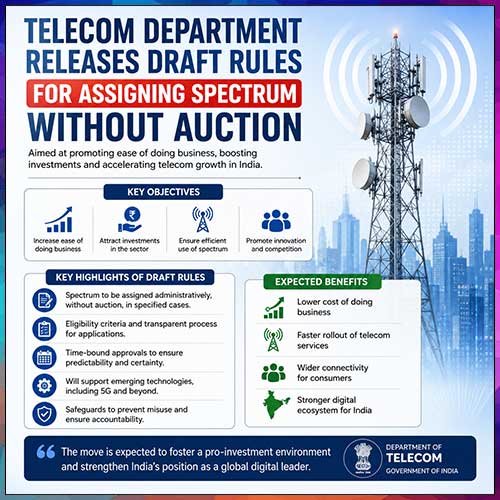
The telecom department has proposed new rules that spell out how the government will hand over radio airwaves, or spectrum, directly to certain users instead of selling them through auctions.
People have 30 days to send in their views before the rules are finalised.
India's Department of Telecommunications has released draft rules, called Spectrum Assignment by Administrative Process Rules 2026, explaining how it will assign spectrum without holding an auction.
Spectrum is the set of radio frequencies that everything from mobile phones to satellites and walkie-talkies needs to work. Usually the government auctions it to the highest bidder, but some uses are too sensitive or too specialised for that. For these, the government assigns the airwaves directly. The new draft rules lay out exactly how that will happen.
The rules were published in the official government gazette on June 18, 2026. Anyone who wants to comment has 30 days to write to the telecom department in New Delhi once the rules are made public.
The rules cover 19 types of use. These include the armed forces and national security, the police and crime prevention, disaster relief, scientific research, weather forecasting, and safety systems for roads, railways, ports and airports. They also cover community radio, in-flight and at-sea internet, space and satellite operations, certain satellite TV and direct-to-home services, and a special category for testing new technologies. State-owned telecom firms BSNL and MTNL are covered too.
Anyone who wants spectrum will have to apply online and pay a fee of 1,000 rupees, which is not refundable. The application has to spell out what the spectrum will be used for, where, and with what equipment. If the government approves, it will first send a letter of intent listing the charges to be paid. Once the applicant pays and buys the equipment, the spectrum is formally granted through an online portal.
There are some conditions. Companies applying must keep any foreign investment within the limits Indian law allows, and their senior staff have to clear security checks. Users cannot link their private networks to public phone or internet networks without permission, and they must immediately report any hacking, jamming or other security problem.
The draft also says BSNL and MTNL will not be able to simply renew the spectrum they get this way. They will have to apply afresh, and any spectrum they give back will be handled under a separate set of auction rules.

See What’s Next in Tech With the Fast Forward Newsletter








Tweets From @varindiamag
Nothing to see here - yet
When they Tweet, their Tweets will show up here.