Featured story
Analysis
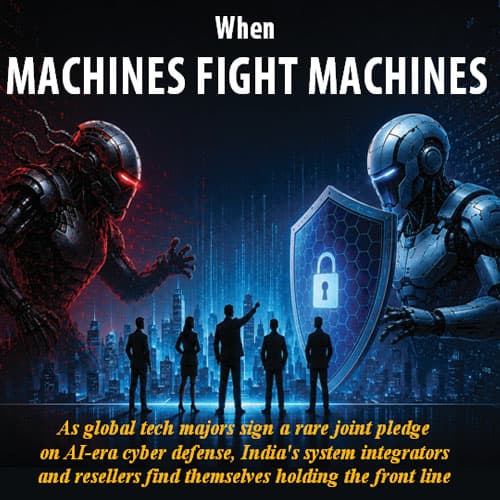
WHEN MACHINES FIGHT MACHINES
As global tech majors sign a rare joint pledge on AI-era cyber defense, India's system integrators and resellers find themselves holding the front line In late August, more than 130 companies did something the technology industry almost never does: they put their names on the same page. OpenAI, Anthropic, Microsoft, Google, AWS, IBM, Cisco, Palo Alto Networks, Cloudflare, CrowdStrike, and dozens of others - fierce competitors on any given Tuesday — co-signed an open letter titled "A call for collective action on cyber defense." The letter is a call from industry, government, and AI leaders for collective action to strengthen cyber defenses and protect the critical infrastructure that societies depend on. For channel partners in India — the system integrators, managed security providers, and value-added resellers who actually deploy and maintain security stacks for hospitals, banks, utilities, and mid- sized enterprises — the letter is less a Silicon Valley press moment and more an early warning siren. The signatories are, in effect, telling the market: the threat landscape is about to change speed, and most organizations are not ready. THE WARNING BEHIND THE LETTER The letter's opening line is blunt. It states that in the coming months, AI-enabled cyberattacks will become far more widespread and sophisticated as models around the world grow increasingly capable, putting the companies and public services communities depend on — from hospitals to water treatment plants to the infrastructure powering the internet - at risk. But the signatories also frame this as an opportunity rather than pure doom: today's AI advances are already giving defenders new ways to fix weaknesses that have accumulated for years, and decisive action now could use this "defenders' window" to make the digital world substantially more secure. That phrase — the defenders' window — is worth sitting with. It implies a narrowing gap between the moment AI gives attackers new capability and the moment it gives defenders equivalent or greater capability. Whoever moves first in that window sets the terms for the next several years of enterprise risk. Three principles anchor the letter. First, that status-quo security will not be enough — longstanding bugs, excessive permissions, misconfigurations, unpatched software, weak authentication, and legacy technical debt have already left systems exposed, and historically under-resourced security teams need a surge in tools and resources, particularly in critical infrastructure. Second, that AI itself should be used to multiply the number of capable defenders — bringing specialist skills to more defenders, making core security tasks faster, cheaper, and better, and letting one organization's fixes protect many others through shared tools and verified playbooks. Third, that this cannot be solved by any single company or country — cyber capabilities are advancing globally, which the letter frames as a net positive so long as no single company controls the future, but which also demands new cross-border partnerships to raise security standards. The letter then assigns homework to four constituencies: every organization, cybersecurity vendors and technology partners, governments, and frontier AI companies themselves. Organizations are told to treat cyber defense as an immediate leadership priority, fix their highest-risk weaknesses with the urgency of an active incident, raise the security bar for everything they buy, build, or deploy — including AI-generated code — and apply compensating controls where systems cannot be patched without disrupting essential services. Cybersecurity companies and technology partners are asked to test their defenses continuously against frontier-level attack capability, make AI-powered defense accessible to critical- infrastructure operators who cannot afford it outright, and measure their own success by how many organizations they actually protect. Governments are called on to coordinate defense across local, national, and international channels, fund cyber defense for essential services that lack budget or staff, and give hospitals, water utilities, and local governments access to defensive AI and hands-on support through trusted partners. Frontier AI companies, for their part, commit to providing model access, funding, and hands-on support to under-resourced defenders, building observability tools, and sharing threat assessments with governments and open-source maintainers. It is, in short, a coordination document. And coordination documents only matter if someone downstream actually implements them. ONE SIGNATORY'S DEEPER ARGUMENT Among the 130-plus signatories, identity-security firm SpecterOps offered one of the more candid explanations of why it put its name on the letter. Jason Frank, the company's co-founder and COO, wrote that SpecterOps signed because it agreed with the letter's three central premises, framing the choice as agreement that "the weaknesses already exist, advanced AI needs to reach more defenders, and the response must be collective and widespread." Frank's argument goes a layer deeper than the open letter itself. His point is that attackers still need a path to what matters — that enterprise environments are dense webs of identities, permissions, and trust relationships, and that a misconfiguration trivial on its own becomes dangerous only once it connects to several others. AI agents, he notes, are adding still more identities and delegated permissions to that web, which is precisely why he argues security leaders should be measuring progress not by tools deployed but by a sharper question: how many dangerous paths to their most critical assets have actually been eliminated. It's a useful corrective for Indian security buyers wading through a wave of "AI-powered defense" marketing this year: the letter's principles are only as good as an organization's ability to see its own attack surface clearly enough to act on them. WHY THIS LANDS DIFFERENTLY IN INDIA Read against India's own numbers, the letter's urgency stops feeling like Silicon Valley theatre and starts looking like a fairly accurate diagnosis of a market already under strain. Start with volume. According to the Data Security Council of India's 2025 India Cyber Threat Report, cited in recent reporting, behaviour-based cyber threat detections in India jumped from 13 million in 2022 to 54 million by the end of 2024 — a more than fourfold increase in two years, well before the current generation of agentic AI tools became widely available to attackers. That trajectory is precisely the "far more widespread and sophisticated" curve the OpenAI-led letter is warning about, except it is already underway rather than hypothetical. Then there is the AI-specific anxiety. The Thales 2026 Data Threat Report found that 64% of Indian organizations now rank AI- enabled attacks as their single biggest data security risk — marginally ahead of the 70% global figure, but notable because it places AI risk above ransomware, insider threat, and supply-chain compromise in the minds of Indian security leaders. The same study found that 65% of Indian organizations reported experiencing deepfake-driven incidents, and that credential theft — now increasingly automated and personalized using AI — is the leading attack technique against cloud infrastructure in India, cited by 68% of respondents. Only 30% of companies globally, India included, have set aside a dedicated AI security budget; the majority are still stretching existing security spend to cover a fundamentally new threat class. Layer on top of that a widely reported talent shortfall: India currently has roughly 350,000 professionals working in cybersecurity, against an estimated market demand for around one million engineers — a gap that industry stakeholders say has persisted and even widened as attackers weaponize generative AI faster than institutions can train defenders. Most available cybersecurity credentials in India remain short-form certificates rather than the deep, CISO-track qualifications that critical infrastructure operators actually need. CERT-In, for its part, has been vocal about India's cybersecurity ecosystem crossing the $20 billion mark, powered by more than 400 startups and roughly 6.5 lakh professionals, and about its own growing use of AI-driven analytics for real-time incident detection and response. That is real institutional momentum. But it also underscores a structural truth the OpenAI letter gestures at directly: government agencies, however well-resourced, cannot single-handedly close a defenders' gap this wide. The letter's insistence that "no single company should control the future" of cyber capability applies with equal force to no single agency carrying the entire defensive burden. WHERE THE CHANNEL FITS This is the part of the letter that VAR’s in India should read most closely — not the signatures, but the second item on the list: cybersecurity companies and technology partners. Globally, that category is being asked to do three things: continuously test its own defenses against frontier-level attack capability, embed AI into existing tools rather than treating it as a bolt-on, and — critically — make AI-powered defense deployable for organizations that cannot afford to build it themselves, with hands- on help rather than just a license key. In India, that third clause is where the channel earns its relevance. Hospitals, municipal utilities, mid-market manufacturers, and regional banks are exactly the kind of "critical infrastructure with limited budgets" the letter references, and they are precisely the customers who do not buy directly from Palo Alto Networks, Cisco, or Microsoft — they buy through, and are supported by, Indian system integrators, MSSPs, and value-added resellers. If the defenders' window the letter describes is real, it will not be won in Redmond or San Francisco. It will be won or lost in the implementation work done by partners who show up on-site, patch the unpatched system, tune the SIEM, and explain a compensating control in language a hospital administrator or municipal engineer can act on. That is also where the opportunity sits. AI-native security tooling — automated triage, agentic patch verification, natural-language threat hunting — is rapidly lowering the cost of delivering enterprise- grade defense to organizations that could never previously afford a full-time SOC. Partners who build AI-augmented managed security offerings now, rather than waiting for demand to force their hand, stand to capture a genuinely under-served segment of India's critical infrastructure and mid-market. Partners who treat this as someone else's problem — a hyperscaler's marketing exercise, a CERT-In compliance checkbox — risk watching that segment get served by faster-moving competitors, Indian or otherwise. THE HONEST CAVEATS It would be naïve to read the letter as pure altruism. Every signatory on that list also sells security products, cloud infrastructure, or AI models, and a public commitment to "collective cyber defense" is, among other things, good positioning ahead of a wave of enterprise AI security spending. Critics of this genre of open letter — and there have been several in the AI industry over the past two years — note that broad, principle-level commitments are easy to sign and hard to audit; the letter itself offers no binding targets, timelines, or enforcement mechanism, only a shared statement of intent. For Indian buyers and partners, that is a reason for healthy scepticism, not dismissal. The underlying diagnosis — that AI is accelerating attacker capability faster than most organizations' defenses, that legacy technical debt remains the biggest single point of failure, and that under-resourced critical infrastructure needs external help it currently is not getting — holds up independently of who signed the letter, because India's own threat data says the same thing. WHAT COMES NEXT The letter closes with an instruction that reads almost like a mandate to the channel, even if it was not written with India specifically in mind: fix the most dangerous weaknesses, verify the fixes, and share what works so others can build on it. For India's resellers and integrators, that is a fair summary of the next eighteen months of work — less about waiting for a global coordination framework to materialize, and more about using the AI-native tools now reaching the market to close a defenders' gap that the country's own numbers show is already wide open. Whether India's channel treats this moment as a compliance update or a genuine market opening will likely determine which partners are still relevant to critical infrastructure security by the time the "defenders' window" the letter describes closes.
Read full story