
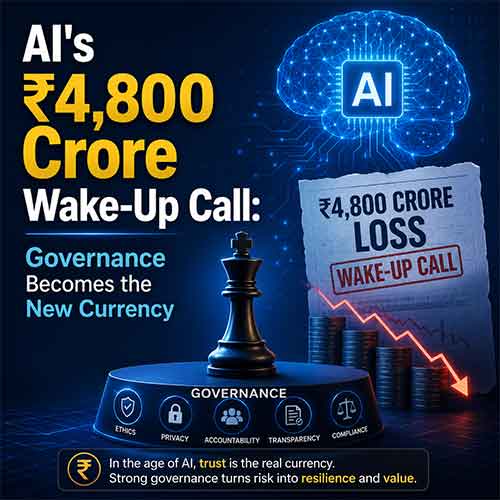
The enterprise AI revolution has reached a critical inflection point. While organizations worldwide are racing to deploy advanced AI assistants, coding agents, and autonomous workflows, a recent incident involving an estimated ₹4,800 crore (approximately US$500 million) monthly bill for Anthropic's Claude AI has exposed the hidden risks of uncontrolled AI adoption.
According to industry reports, the massive expense was incurred by an unnamed enterprise that provided thousands of employees with unrestricted access to Claude AI without implementing spending limits, usage controls, or governance frameworks. What began as an effort to accelerate productivity quickly evolved into uncontrolled AI consumption, highlighting the financial risks of agentic AI at scale.
The incident has become a defining moment for enterprise AI. Employees increasingly used AI for coding, content generation, research, and routine tasks, driving extraordinary token consumption. The phenomenon, often referred to as "tokenmaxxing" or "vibe coding," demonstrated how AI spending can spiral beyond expectations when adoption is measured by usage rather than business outcomes.
The impact has been felt across the technology industry. Reports indicate that Microsoft reduced internal Claude Code deployments, Amazon discontinued internal token-consumption leaderboards, and several enterprises introduced stricter controls on AI access. These actions are not a retreat from AI but a shift toward responsible governance and cost optimization.
The core challenge lies in the misconception that AI behaves like traditional SaaS software. Unlike fixed-seat licensing models, modern AI systems operate on token-based consumption. Autonomous agents, coding assistants, and multimodal workflows can generate enormous computational costs within hours if left unmanaged.
This development reinforces a growing reality: AI Governance, FinOps, Security, and Digital Trust must evolve together. Organizations need spending controls, role-based access, audit trails, data governance, and continuous visibility into AI consumption. Success will increasingly depend on measuring value created per token consumed.
The next generation of AI leaders will not be the companies that spend the most on AI. They will be the organizations that can clearly answer a simple question: What business outcome did every AI dollar deliver? In the Agentic AI era, governance is becoming the new unit economics, and trust is emerging as the foundation of sustainable AI adoption.
Rising LLM usage costs, escalating GPU infrastructure expenses, and unpredictable token consumption are forcing many organizations to reassess their AI strategies. Instead of pursuing full automation, companies are increasingly adopting human-in-the-loop models, where skilled employees work alongside AI to balance productivity, quality, governance, and cost efficiency.

See What’s Next in Tech With the Fast Forward Newsletter



Tweets From @varindiamag
Nothing to see here - yet
When they Tweet, their Tweets will show up here.