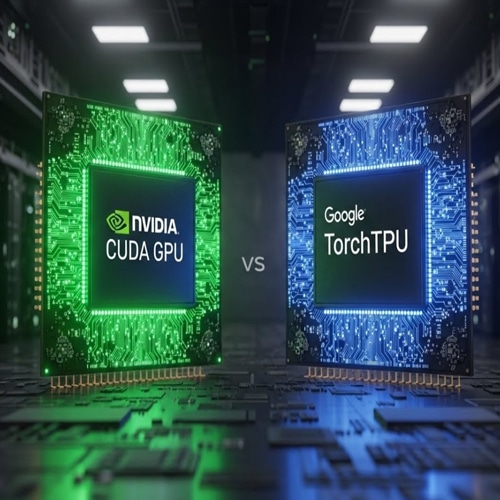
Google is intensifying its competition with Nvidia by introducing TorchTPU, an open-source software initiative designed to make its Tensor Processing Units (TPUs) more accessible to artificial intelligence developers.
The development represents a strategic shift in the AI semiconductor industry, where software compatibility is becoming as important as processing power, performance, and energy efficiency.
For years, Nvidia has dominated AI computing through its powerful GPUs and CUDA software ecosystem, which enables developers to build, train, and deploy AI models efficiently.
Google's biggest challenge has been convincing developers to move beyond Nvidia's established infrastructure. Migrating workloads to Google's JAX-based TPU environment often required substantial engineering effort.
TorchTPU aims to eliminate this barrier by enabling developers to run existing PyTorch workloads on Google's specialized AI processors with minimal code modifications.
Developed in collaboration with Meta, TorchTPU could significantly expand Google's addressable market by simplifying AI model training, inference, and deployment across TPU infrastructure.
The initiative comes as enterprises increasingly explore alternatives to Nvidia amid rising AI infrastructure costs, supply constraints, and growing demand for efficient inference computing.
Google Expands Its AI Infrastructure Strategy
Google is simultaneously expanding its TPU portfolio with the introduction of TPU 8tx and TPU 8i Max, targeting confidential AI processing and applications requiring massive context windows.
The company's growing relationships with major AI developers and cloud providers, including Anthropic, Oracle, and OpenAI, highlight increasing commercial interest in alternative AI computing architectures.
However, Nvidia retains substantial advantages through CUDA's mature developer ecosystem, optimized libraries, extensive hardware availability, and established enterprise relationships. Software portability alone will not immediately eliminate these strengths.
Moving forward, Google's strategy signals a fundamental transformation in AI infrastructure competition. As enterprises prioritize performance, cost efficiency, software flexibility, and reduced vendor dependence, the industry could shift toward heterogeneous computing environments. The next battle for AI supremacy will be fought not only through faster chips, but through the software ecosystems that make those chips indispensable.