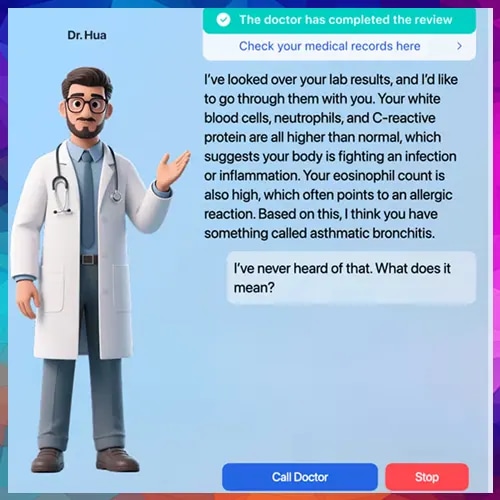
Revolutionizing patient care, Saudi Arabia’s AI clinic employs “Dr Hua” to manage complete consultations, while licensed physicians review AI-generated diagnoses and treatments, blending automation with human oversight for safe, efficient healthcare delivery
Saudi Arabia has become the first country to host an artificial intelligence-driven clinic that conducts end-to-end patient diagnosis and treatment planning. The groundbreaking initiative, a collaboration between China’s Synyi AI and Almoosa Health Group, is currently being piloted in the eastern province of Al-Ahsa.
The AI clinic introduces a transformative healthcare model where artificial intelligence serves as the primary point of contact for patients. Dubbed “Dr Hua,” the AI system manages the full consultation process — from initial symptom assessment to prescribing treatment. However, human physicians remain closely involved to oversee and approve AI-generated decisions, ensuring safety and accuracy.
According to Synyi AI, the system allows patients to describe their symptoms through a tablet interface. The AI then interacts with patients by asking follow-up questions, analyzing responses, and interpreting any accompanying images or data collected by human assistants. A detailed treatment recommendation is subsequently reviewed and approved by a licensed doctor.
Next step in AI healthcare
Currently, the system focuses on respiratory conditions, covering approximately 30 ailments such as asthma and pharyngitis. Plans are underway to expand the AI’s medical knowledge to include up to 50 diseases across respiratory, gastrointestinal, and dermatological categories.
The pilot phase aims to generate diagnostic data that will be submitted for regulatory review by Saudi health authorities, with approval anticipated within the next 18 months. Synyi AI reports a low error rate of just 0.3% during pre-trial testing, underscoring its potential reliability.
“This marks a pivotal shift in healthcare, moving from AI-assisted support to direct AI-led diagnosis and care,” said Zhang Shaodian, CEO of Synyi AI. The company, supported by investors including Tencent and GGV Capital, emphasizes that the AI system is built on localized large language models tailored to regional medical terminology, languages, and cultural nuances.
If successful, the AI clinic model could set a new precedent for integrating machine intelligence into mainstream healthcare delivery.