As enterprises accelerate their adoption of artificial intelligence, the conversation is shifting from experimentation to building secure, scalable, and economically sustainable AI infrastructure. Nutanix is positioning itself at the center of this transformation by combining hybrid multicloud capabilities, cloud-native technologies, enterprise AI solutions, and integrated security.
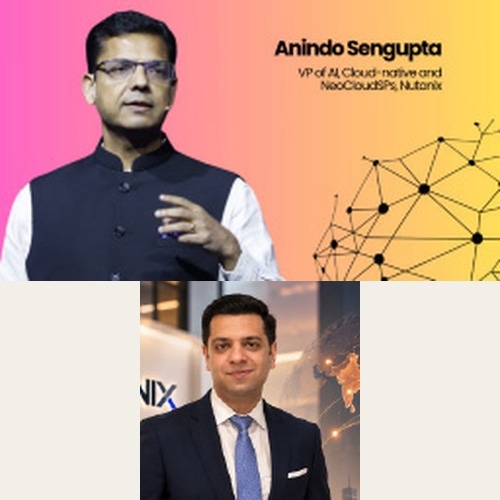
At .NEXT Mumbai 2026, Faiz Shakir, Vice President, Sales, APJ, Nutanix and Anindo Sengupta, Vice President, AI, Cloud-Native and Neocloud/MSP Products and Solutions, Nutanix shared their perspectives on India's growing role in global innovation, the evolution of hybrid cloud infrastructure, the economics of AI inference, and the increasing importance of data sovereignty and cyber resilience.
India Emerges as a Global Innovation Powerhouse
India has become far more than a strategic sales market for Nutanix. It is now a major center for engineering, product development, and technological innovation.
According to Faiz Shakir, approximately 40% of Nutanix's global patent filings originate from its India-based engineering teams, highlighting the country's contribution to technologies deployed worldwide.
“India has been at the forefront of innovation at Nutanix for many years,” Shakir explained, emphasizing that Indian engineers are not simply supporting global development but actively shaping the company's technology roadmap.
India is also Nutanix's largest commercial market in the Asia-Pacific and Japan region, reflecting sustained enterprise adoption and strong relationships with customers and channel partners.
This growth mirrors Nutanix's broader evolution. Originally recognized for simplifying infrastructure through hyperconverged infrastructure (HCI), the company has expanded into hybrid multicloud, Kubernetes, cloud-native applications, and enterprise AI.
The transformation reflects a fundamental change in enterprise IT requirements. Organizations increasingly need virtual machines, containers, and AI workloads to operate seamlessly across different infrastructure environments.
Hybrid Cloud Becomes the Foundation for Sovereign AI
As enterprises deploy generative and multimodal AI, data sovereignty, security, and infrastructure flexibility are becoming critical considerations.
Shakir highlighted findings from Nutanix's Enterprise Cloud Index research, which indicated that 96% of surveyed Indian enterprises planned to repatriate workloads to hybrid environments to support AI-ready infrastructure.
Additionally, 82% of respondents identified data sovereignty as a priority.
These findings suggest that organizations increasingly want greater control over where their data resides, how AI models process sensitive information, and which infrastructure supports business-critical workloads.
Nutanix believes its hybrid multicloud architecture addresses these requirements by allowing organizations to operate workloads across private infrastructure and public cloud environments while maintaining consistent management and security capabilities.
For regulated industries such as banking, healthcare, telecommunications, and government, this flexibility can be particularly important when balancing innovation with compliance obligations.
Rethinking the Economics of AI Inference
One of the most significant challenges facing enterprises is the rising cost of AI inference.
As organizations adopt multiple AI models, usage-based pricing can make operating expenses difficult to predict. Every additional query, transaction, or generated token may increase costs.
Anindo Sengupta explained that Nutanix is addressing this challenge through its Enterprise AI inference offering, which emphasizes a fixed-price infrastructure model rather than per-token billing.
Under this approach, enterprises deploy AI workloads on GPU infrastructure they control, supported by Nutanix software.
Organizations can run multiple AI models on shared infrastructure without paying an external inference provider for every token generated.
The economic advantage lies in greater cost predictability, particularly for businesses processing large and recurring AI workloads.
However, enterprises must still account for hardware investment, electricity, cooling, maintenance, software licensing, and operational expertise when evaluating total cost of ownership.
Beyond economics, customer-controlled infrastructure can strengthen data governance by keeping sensitive AI workloads within designated environments.
Security and Cyber Resilience Move to the Forefront
As AI becomes embedded in enterprise operations, protecting infrastructure and ensuring business continuity are increasingly important.
Shakir emphasized that security and sovereignty must evolve together. Nutanix integrates security capabilities into its infrastructure platform while collaborating with technology partners to deliver broader enterprise protection.
Sengupta highlighted the company's longstanding focus on data management, disaster recovery, and cyber resilience.
Nutanix provides capabilities designed to assess potential cyber risks, isolate affected systems, and support recovery of compromised data.
These functions are increasingly valuable as enterprises confront ransomware, infrastructure attacks, and threats targeting interconnected applications and data environments.
Rather than positioning itself as a replacement for every cybersecurity technology, Nutanix emphasizes a combination of built-in protection and ecosystem partnerships.
The Road Ahead: AI Infrastructure Built Around Control and Trust
Nutanix's strategy reflects a wider industry transition from infrastructure modernization toward intelligent, distributed, and increasingly autonomous computing.
Enterprises are expected to prioritize platforms that support multiple AI models, predictable operating costs, flexible deployment, data sovereignty, and rapid recovery from cyber incidents.
For Nutanix, India's engineering capabilities and expanding enterprise market provide a strong foundation for this next phase of growth.
The larger industry message is clear: successful AI adoption will depend not only on computing performance, but also on infrastructure economics, operational resilience, data control, and enterprise trust.
By bringing hybrid cloud, enterprise AI, and cyber resilience together, Nutanix aims to help organizations move beyond AI experimentation toward secure, scalable, and sustainable production environments.