

AI is not a recent add-on for Kaspersky, but it is the foundation. For more than two decades, Kaspersky’s research and development teams have integrated AI and machine- learning into every layer of its security architecture. This long-term commitment has allowed Kaspersky to build mature, robust detection models and risk-assessment frameworks that evolve along with adversary tactics.
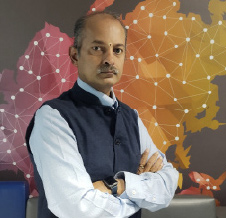
Speaking to VARINDIA, Jaydeep Singh, General Manager for India, Kaspersky explains how this association with AI strengthens their credibility and differentiates them from companies that are only recently adopting AI.
How is Kaspersky using AI to strengthen its XDR platform?
Kaspersky’s XDR platform is fundamentally powered by decades of AI and ML innovation. The AI engine is not an afterthought. It is embedded deeply to drive detection, behavioral analysis, correlation, and automated responses. Our ML models can detect abnormal behavior patterns, fileless attacks, and stealthy lateral movements with far greater precision than traditional signature-based tools, while also reducing false positives, a major pain point for many SOC teams.
By unifying telemetry from endpoints, networks, cloud environments, and OT systems under a single AI-driven analytics layer, XDR enables context-aware detection and comprehensive visibility, allowing faster investigations and response. For enterprises in India, especially those operating in hybrid or complex digital environments, this means they get enterprise-grade security that scales with infrastructure complexity and threat sophistication.
What sets Kaspersky’s Threat Intelligence apart today?
Our Threat Intelligence stands out because it merges global scale and long-term human expertise with AI-driven enrichment and context. The nearly 1,000 APT groups we monitor continuously feed into global threat databases, research pipelines, and detection systems.
We do not just supply raw indicators. Using AI-powered OSINT enrichment, campaign clustering, and context analysis, combined with expert human review, we deliver actionable, strategic intelligence: adversary motivations, infrastructure evolution, attack-pattern trends, and likely next steps. This gives enterprises and governments clarity not only on what threats exist but also how adversaries operate, their potential intentions, and what defensive posture to adopt.
We maintain a global, in-house threat intelligence operation which tracks nearly 1,000 advanced persistent threat (APT) groups and campaigns worldwide. That combination, seasoned AI and widespread threat visibility, gives us a vantage point few in the industry can match, and ensures our solutions stay ahead of both old and emerging threats.
In the Indian context, where digital adoption is rapidly increasing and attackers increasingly target local organizations, this kind of actionable intelligence is especially critical. It helps businesses anticipate sophisticated attacks rather than reacting after the fact.
How does Kaspersky ensure fast, effective Incident Response?
Kaspersky’s Incident Response capability blends structured global playbooks with decades of AI-driven detection research and the experienced judgment of elite in-house analysts. When an incident occurs, whether malware, ransomware, spyware, or a targeted APT intrusion, our IR teams follow standardized, proven workflows spanning containment, forensic analysis, root-cause investigation, remediation, and post-incident hardening.
Because of our deep threat intelligence and long-standing AI telemetry data, investigations are accelerated. Evidence collection is streamlined, suspicious behavior and patterns are identified faster, and threat context, including known APT behavior, is available immediately.
Which major industry challenges is Kaspersky solving with better threat visibility?
Enterprises today, especially in rapidly digitizing markets like India, face three interlinked challenges: fragmented infrastructure, alert overload, and lack of adversary context.
• Fragmentation and complexity: Many organisations operate with a mix of legacy infrastructure, cloud services, remote work, and OT systems. Kaspersky’s XDR unifies telemetry across all these layers, giving a consolidated, contextual view of events.
• Alert fatigue and SOC overload: With AI-driven detection, enrichment, and prioritization, Kaspersky reduces noise and ensures SOC teams only act on high- value, high-confidence alerts, boosting SOC efficiency and reducing burnout.
• Lack of adversary context: Thanks to ongoing global threat tracking of nearly 1,000 APT groups, combined with our Threat Intelligence and IR experience, enterprises do not just get alerts. They understand attacker TTPs, likely next moves, and infrastructure patterns, enabling proactive defense instead of reactive firefighting.
For Indian enterprises, often under- resourced with limited in-house threat hunting, this intelligence-led, visibility-first approach is exactly what is required to build resilience.
How is Kaspersky preparing enterprises for upcoming AI-driven cyber threats?
Kaspersky’s preparation for AI-driven cyber threats is twofold: defensive hardening and anticipatory readiness.
Our AI and ML models are constantly evolving to detect not only traditional malware and exploits but also newer, AI- augmented threats, such as polymorphic malware, automated exploitation tools, fileless attacks, and AI-generated social engineering vectors. These capabilities are integrated into SIEM, XDR, and threat- intelligence platforms to ensure enterprises can detect even stealthy, dynamically changing attacks.
Through our global threat intelligence program and in-house research, we track how adversaries are adopting automation, generative tools, and AI-augmented techniques. That insight is fed back into detection rules, incident response playbooks, and enterprise guidance. For enterprises in India, especially those in critical infrastructure, manufacturing, finance, and government, this means they are not only protected against current threats but also better positioned to anticipate and mitigate future AI-driven attack vectors.

See What’s Next in Tech With the Fast Forward Newsletter








Tweets From @varindiamag
Nothing to see here - yet
When they Tweet, their Tweets will show up here.