
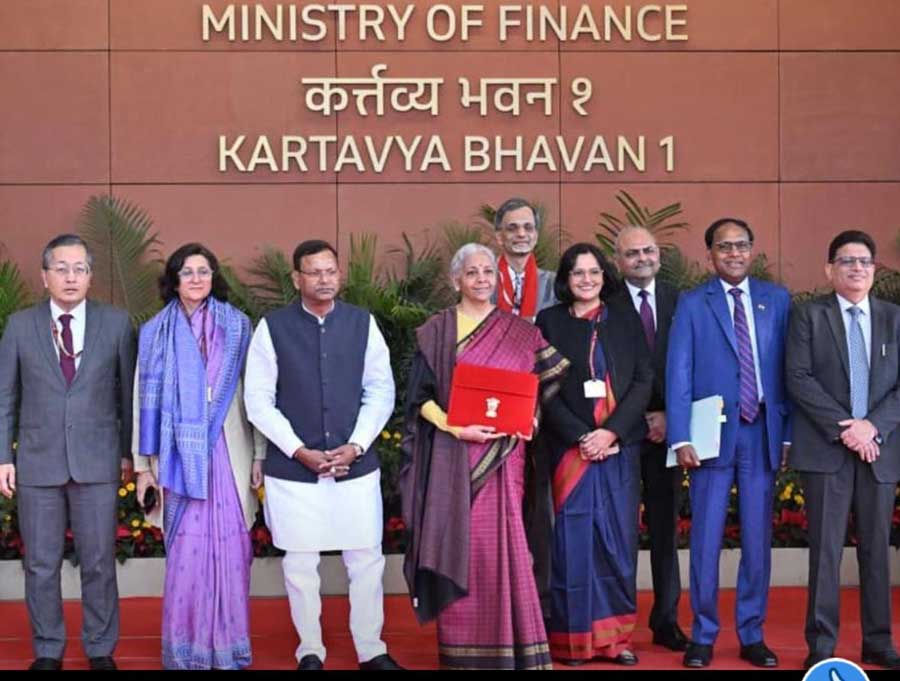
Finance Minister Nirmala Sitharaman delivered a mixed bag for India's IT sector in the Union Budget 2026, offering significant relief on transfer pricing while introducing measures to attract global cloud businesses to set up data centers in India.
Public Sector Banks will develop a dedicated Grameen Credit Score framework, as announced by the Finance Minister. The initiative is designed to capture the unique financial behaviour and income patterns of rural households, enabling more accurate credit assessment and improved access to formal finance for underserved communities.
The move forms part of broader financial sector reforms aimed at deepening inclusion, alongside measures such as simplified KYC norms. To strengthen last-mile delivery, the government will also expand the role of India Post Payments Bank in rural areas, ensuring that enhanced credit availability is supported by accessible and reliable banking infrastructure.
Major IT Sector Announcements
Transfer Pricing Relief
In what industry experts are calling a "game-changer," the government has streamlined safe harbour provisions for IT services. All software development, IT-enabled services, knowledge process outsourcing, and contract R&D services relating to software development will now be clubbed under a single category called "Information Technology Services" with a common safe harbour margin of 15.5%.
The threshold for availing safe harbour has been increased substantially from ₹300 crore to ₹2,000 crore, and the approval process will be fully automated without requiring tax officer examination. Once applied, companies can continue with the same safe harbour for five years at a stretch.
For companies preferring Advance Pricing Agreements (APAs), the government has committed to fast-track unilateral APAs for IT services, aiming to conclude them within two years, extendable by six months on request.
Cloud Services Push
In a bid to position India as a global data center hub, the budget proposes a tax holiday until 2047 for foreign companies providing cloud services globally using data center services from India. However, services to Indian customers must be routed through an Indian reseller entity.
The government is also offering a 15% safe harbour on costs for resident entities providing data center services to related foreign companies offering cloud services globally.
Electronics Manufacturing Incentive
The Electronics Components Manufacturing Scheme, launched in April 2025 with an outlay of ₹22,919 crore, has already attracted double the targeted investment. The government is increasing the outlay to ₹40,000 crore to capitalize on this momentum.
Additionally, India Semiconductor Mission (ISM) 2.0 has been launched to produce equipment and materials, design full-stack Indian IP, and fortify supply chains, with focus on industry-led research and training centers.
Skilling and Employment
Recognizing the impact of emerging technologies, including AI, on jobs, the budget proposes a High-Powered 'Education to Employment and Enterprise' Standing Committee to assess AI's impact on skill requirements and recommend measures.
The government will support skilling initiatives including AVGC (Animation, Visual Effects, Gaming and Comics) Content Creator Labs in 15,000 secondary schools and 500 colleges, targeting the sector's projected requirement of 2 million professionals by 2030.
Global Talent Attraction
To attract international talent, the budget proposes exemption from tax on global income (excluding Indian-sourced income) for non-resident experts visiting India for five years under notified government schemes. The expert must have been a non-resident in the previous five years.
Toll Manufacturing Boost
For electronics toll manufacturing, the government is providing safe harbour to non-residents for component warehousing in bonded warehouses at a 2% profit margin on invoice value, resulting in an effective tax of about 0.7%.
A five-year income tax exemption is also proposed for foreign companies providing capital goods, equipment, or tooling to toll manufacturers in bonded zones engaged in electronics manufacturing.
Tax Simplification
The New Income Tax Act 2025, effective from April 1, 2026, promises simplified compliance with redesigned forms allowing ordinary citizens to comply without difficulty. The integration of assessment and penalty proceedings aims to reduce litigation costs for IT companies.
Industry Reaction Awaited
While the transfer pricing safe harbour measures are expected to reduce compliance burden and litigation for mid-sized IT companies, the lack of specific announcements on traditional tax breaks or incentives for IT exports may disappoint some industry players. The government's focus appears to be on attracting new-age technology investments—cloud, data centers, and semiconductors—rather than providing direct benefits to the existing services export industry.
The budget's emphasis on AI, emerging technologies, and the services sector aligns with the government's vision to achieve a 10% global share in services by 2047, positioning India as a global leader in the sector.
Industry reactions to the Union Budget 2026–27 have been mixed
An overall reforms oriented budget, which stays within the guardrails of sticking to a reducing fiscal deficit glide path. The tax holiday on data centres will drive India to become a global data centre hub, similar to what Ireland did. With duty relief to specific industries, government has signaled that it will double down on civil aviation aircraft manufacturing, nuclear power plants, energy storage and electronics. Also SOPS to women oriented business and skill development also underlines the focus to enable women workforce. Focus on small package based e-commerce will also give a significant fillip to ecommerce exports. Overall a progressive budget that will support growth of domestic industries.
 Mr. Sunil Bharti Mittal, Founder & Chairman, Bharti Enterprises
“A bold Budget that combines growth with inclusion. The strong emphasis on skilling, alongside sustained investments in science, innovation, and research are timely & will strengthen domestic capabilities, advancing import substitution in critical sectors. Bolstering infrastructure and logistics, with a focus on energy efficiency and impetus for the data centre ecosystem, will further reinforce confidence in our burgeoning digital economy. Bharti remains highly committed to play its part in enabling technology-led growth, expanding financial inclusion, and accelerating future-ready education through Bharti Airtel Foundation to secure India’s talent dividend.”
 Mr. Harsh Goenka, chairman - RPG Enterprises
Harsh Goenka praised the Union Budget 2026, calling it a “thoughtful” exercise that resists the temptation to appease stock markets. In a post on X, he highlighted the sharp rise in defence spending to support India’s heroes at the “Border” and said the government has gone “Dhurandhar” on data centres, manufacturing, and nuclear power to shape the country’s future. Adding a light, filmy touch, Goenka referenced Bollywood hits Dhurandhar, Border, and Avatar to underline the Budget’s focus on youth upskilling, inclusive development, and simpler tax procedures, positioning it as a strong response to global trade pressures.
 Arundhati Bhattacharya, President & CEO, Salesforce South Asia
Budget 2026 marks India’s shift from technology consumption to AI-led innovation, offering a long-term blueprint for a $7-trillion intelligence-driven economy. The tax holiday for cloud services until 2047 strengthens data sovereignty and is expected to attract significant data centre investments, positioning India as a cloud hub for emerging markets. MSME reforms, including the ₹10,000-crore SME Growth Fund and TReDs expansion, enable scalable growth. The education-to-employment focus and pragmatic AI adoption—spanning agriculture and school curricula—signal generational thinking. However, higher R&D investment remains essential to ensure India evolves as a creator, not merely a consumer, of AI.
 Manoj Paul, Managing Director, Equinix India
The Union Budget 2026 is being seen as a strategic step towards positioning India as a global digital and AI powerhouse amid intensifying competition for large-scale technology investments. Industry has welcomed the proposed tax certainty measures, including a tax holiday until 2047 for foreign cloud service providers operating data centres in India and a 15% safe harbour margin for related-party services, as these enhance long-term predictability for capital-intensive infrastructure. The measures strengthen the role of data centres in enabling cloud, AI, and global connectivity while boosting local value creation. Continued support for power, fibre, sustainability, and network expansion will be critical to fully realise India’s AI-ready infrastructure ambitions.
 Hemant Tiwari, managing director & vice president, India & SAARC, Hitachi Vantara
The Union Budget 2026-27 is a significant step in strengthening India’s digital and data infrastructure. By providing long-term incentives and a clear safe harbour framework for data centres and cloud services, the government is creating an ecosystem that encourages global investment and drives technological innovation. These measures will accelerate the growth of world-class data centres, enable secure and efficient cloud operations, and foster the adoption of emerging technologies such as AI. By supporting infrastructure development across Tier 2 and Tier 3 cities and facilitating a robust digital services ecosystem, the budget positions India to become a global hub for data, cloud, and IT services, while creating new opportunities for talent and sustainable economic growth.
 Mr. Gagan Arora, Founder & President, Vertex Group.
This year's Union Budget makes it clear: India is intent on gearing its services sector for an AI-powered future already reshaping IT, business process management, design, customer care, and digital delivery. Although specifics about the new committee are still to come, the message is clear: AI is being positioned as both a productivity booster and a pillar of employment strategy.
For the tech industry, this marks a shift from traditional subsidies to prioritising talent pipelines, rigorous standards, and export-ready capabilities. The real test will be translating these policy ambitions into reality through updated curricula, industry-recognised certifications, and job-ready pathways.
 Dr. Jaijit Bhattacharya ,President - Centre for Domestic Economy Policy Research
The Union Budget 2026 signals a decisive shift in India’s technology and security journey, with a clear focus on building capability at home. The strengthened push under the India Semiconductor Mission 2.0 is not only about self-reliance, but about ensuring that the intelligence, computing power, and hardware powering next-generation AI systems are designed and manufactured in India.The government’s emphasis on artificial intelligence reflects a move from experimentation to real-world, mission-critical deployment. As AI becomes central to public safety, surveillance, and smart infrastructure, this Budget lays the foundation for scalable, secure, and responsible adoption across the country. For homegrown technology companies, this policy clarity creates long-term confidence to invest locally, innovate for Indian needs, and build globally competitive solutions. It positions India not just as a consumer of advanced technologies, but as a trusted creator of AI-led security and infrastructure solutions aligned with the vision of Make in India.
 Mr. Sunil Mathur, MD and CEO, Siemens Limited
“We welcome the government’s consistent focus on long-term economic growth and structural transformation in the Union Budget 2026-27. The record INR 12.2 lakh crore capital expenditure allocation, sustained emphasis on infrastructure development, and a fiscal deficit target of around 4.3% reflect a continued and disciplined approach to strengthening India’s growth foundations. The budget’s focus on technology-led manufacturing, digital infrastructure such as data centers, and next-generation mobility including high-speed rail supports India’s ambition to become a global innovation and manufacturing hub. Continued support for MSMEs, skilling, and ease of doing business will be critical in ensuring that growth is broad-based and resilient. As industries navigate rapid technological change, the government’s spotlight on scale, execution, and investments in connectivity, smart infrastructure, and talent development provides a clear and credible roadmap for sustainable and inclusive growth.”
 Mr. Aditya Khemka, Managing Director, Aditya Infotech Ltd (CP PLUS)
The Union Budget 2026–27 clearly recognises artificial intelligence as a strategic driver of inclusive growth and governance efficiency. The emphasis on AI missions, research funding, semiconductor ecosystem development, and capacity building reflects a shift from experimentation to deployment at scale. By aligning AI with national priorities such as infrastructure, public services, logistics, and security, the government is creating a robust ecosystem for applied artificial intelligence. Equally important is the focus on skilling and education-to-employment pathways, which will ensure that AI adoption is supported by a future-ready workforce. As AI becomes embedded across sectors, solutions that translate advanced research into real-world applications will play a critical role in enhancing productivity, safety, and operational efficiency across India’s rapidly expanding digital and physical infrastructure.
 Mr.Atul Rai CEO and CO founder - Staqu Technologies
Critical analysis of the Union Budget 2026 highlights a clear pivot from digital infrastructure creation to building sovereign technological depth. Initiatives like ISM 2.0 and enhanced electronics component funding signal a move from assembly-led growth to ownership of IP, materials, and full-stack capabilities. Incentives for global cloud and hyperscale players strengthen India’s data sovereignty play but raise concerns over domestic leverage. The Budget also acknowledges AI-led job disruption, proposing reskilling and sovereign compute access. However, gaps remain—particularly low R&D spending, absence of large-scale product innovation funds, and execution risks tied to long gestation projects. Simplified tax codes and expanded safe-harbour limits offer compliance relief but may mask deeper structural challenges.
 Mr. Pranav Pandya, Chairman & Director - GESIA IT Associuation
The Union Budget 2026 outlines a transformative vision for India’s digital future, positioning the country as a global digital hub. The tax holiday until 2047 for cloud providers using Indian data centres signals bold policymaking aligned with India’s $3 trillion digital economy ambition. By recognizing digital infrastructure as a core economic enabler, the Budget strengthens telecom, data centres, and networks that power fintech, healthcare, manufacturing, AI, and governance. The ₹10,000 crore SME Growth Fund and ₹2,000 crore Self-Reliant India Fund boost are vital for scaling MSMEs that underpin digital deployment. Sustainability measures, including duty exemptions for battery storage and solar glass, support green data centres, EV adoption, and long-term goals of Viksit Bharat 2047 and Net Zero 2070.
 Mr. Manoj Kumar Singh, Director General of the Digital Infrastructure Providers Association (DIPA)
“Union Budget 2026 strengthens the policy backbone required for India to operate as a global technology and AI execution hub. The focus on cloud infrastructure and long-term clarity for cloud services directly addresses a core constraint in scaling enterprise platforms, the ability to run regulated, data-intensive workloads with confidence and continuity. For GCCs, this creates the conditions to move beyond delivery into ownership, where India increasingly designs, builds, and runs core platforms and mission-critical systems for global enterprises. Greater predictability in tax and compliance frameworks is critical when technology platforms are designed to run for years. For large, globally distributed engineering and operations teams, clarity reduces friction in decision-making and allows accountability for core platforms and products to sit firmly in one place. This matters for GCCs that are moving into full-stack ownership, where India increasingly builds, runs, and scales enterprise platforms for global customers. When this predictability is complemented by sustained investments in advanced skilling, strong education-to-employment pipelines, and a sharper focus on women in STEM, it reinforces India’s ability to deliver trusted, enterprise-grade technology at scale.”

The Union Budget 2026–27 introduced multiple measures to support startups, MSMEs, and SMEs, with a focus on funding, credit access, manufacturing, and regulatory ease. The government announced three separate outlays of ₹10,000 crore each, including a fresh allocation to the Fund of Funds for Startups to support early- and growth-stage ventures through SEBI-registered funds. A ₹10,000 crore MSME Growth and Resilience Fund was proposed to help firms navigate global trade pressures. The Budget also unveiled the ₹10,000 crore Biopharma Shakti programme to boost domestic biopharma manufacturing. To strengthen electronics and semiconductors, ECMS funding was nearly doubled to ₹40,000 crore, alongside Phase II of the India Semiconductor Mission. Additional measures included tax holidays for foreign cloud providers and investments in AVGC talent development.
 Dr. Deepak KumarSahu, Founder & CEO- FaceOff Technologes Inc.
The Union Budget 2026 makes a clear statement on reimagining education as a direct driver of employability and economic growth. The proposed Education-to-Employment Standing Committee acknowledges the urgent need to align learning with industry demand and the accelerating impact of technologies such as artificial intelligence. Initiatives such as Content Creator Labs in 15,000 schools and the development of university townships near industry corridors mark an important shift towards hands-on, technology-enabled, and industry-connected learning environments. These measures will encourage creativity, collaboration, and real-world skill development across K-12 and higher education. Together with continued support for domestic manufacturing and the semiconductor ecosystem, the Budget creates a strong foundation for modern digital classrooms and future-ready campuses. It enables education and enterprise technology providers to play a meaningful role in building skills, improving learning outcomes, and preparing India’s talent base for global competitiveness. It will be good to see how these initiatives take shape in the coming days, and we will support them to the best of our ability.
 Mr. Rajeev Singh, Managing Director, BenQ India & South Asia
“The Union Budget 2026 sends a strong signal about where India is headed. It recognizes that AI-led growth isn’t possible without deep, resilient data and digital infrastructure at its core. With the economy sustaining momentum at around 7% and public capital expenditure increasing to ₹12.2 lakh crore in FY27, the focus on advanced technologies, especially AI, reflects a long-term commitment to building infrastructure at national scale. The extension of tax holiday incentives for data center services until 2047 is a particularly important step. It provides the certainty needed to unlock sustained investment in high-performance, energy-efficient, and resilient data centers - the foundation of modern AI and cloud ecosystems. As enterprises and public institutions accelerate adoption of data-intensive and AI-driven workloads, the ability to manage, protect and scale data securely will become mission-critical. Together, these measures reinforce India’s ambition to emerge as a global AI innovation hub and lay the groundwork for a truly future-ready digital economy.”
 Mr. Ramanujam Komanduri, Country Manager-Pure Storage India
The Union Budget 2026 marks a decisive shift in how India positions cloud and data centres as long-term strategic infrastructure powering AI adoption, digital public services, and economic growth. The tax holiday until 2047 for global cloud providers signals strong intent to accelerate investment, capacity creation, and enterprise cloud adoption. Equally important is the 15% safe-harbour provision, which brings long-term certainty and scalability as operations grow. As cloud and AI workloads become mission-critical, global players are expected to adopt asset-light models, relying on Indian partners for colocation and GPU infrastructure. This creates strong complementarity for sovereign platforms like Yotta, positioning Indian operators as compliant, AI-ready infrastructure anchors within India’s expanding digital ecosystem.
 Mr.Sunil Gupta, Co-founder, CEO & Managing Director-Yotta Data Services
"The Union Budget 2026 is a clarion call for the 'Intelligence-First' era. By proposing a tax holiday until 2047 for cloud services using Indian data centers and utilizing the ₹10,300 crore IndiaAI Mission to provide compute at a subsidized rate, the government has eliminated the cost barriers to high-end innovation. At TrueReach AI, we are particularly energized by the Economic Survey’s shift toward a bottom-up, sector-specific AI strategy. This aligns perfectly with our 'Entropy' platform, which already automates 90% of the SDLC. With the government targeting a 10% share of global services by 2047, we are no longer just an outsourcing hub; we are becoming an 'AI Factory' hub. The FM’s focus on Sovereign LMMs and the 38,000-GPU strong compute base ensures that Indian startups can now build production-grade, autonomous software 10x faster, allowing us to take 'Made in India' intelligence to the global stage with unprecedented scale."
 Mr. Amit Kumar Tyagi, CEO- TrueReach AI
The Union Budget 2026 signals a decisive push toward a sustainable and future-ready Indian economy. A long-term tax holiday for data centers and cloud service providers operating in India elevates digital infrastructure to a national priority, reinforcing India’s ambition to become a global hub for cloud, AI, and data-led services. The Budget emphasizes inclusive and steady growth by prioritizing MSMEs, manufacturing, skill development, green energy, and digital systems. Its continued focus on ESG principles highlights the importance of transparency, trust, and strong governance. However, success will hinge on execution. Businesses must strengthen operating models, manage risks, adopt responsible technology, and invest in cybersecurity and compliance to remain competitive globally and support India’s long-term economic leadership.
 Mr. Sachin Tayal, Managing Director- Protiviti Member Firm for India
The Union Budget 2026–27 reinforces the role of grassroots income growth as the bedrock of India’s economic expansion. Continued emphasis on farmers, weavers, and small enterprises reflects recognition that stable household incomes and access to formal finance are vital for sustaining rural demand. Initiatives such as the Bharat Vistaar AI platform and AgriStack aim to boost productivity, bridge information gaps, and enable data-driven credit. Investments in rural infrastructure, agriculture-linked value chains, and support for high-value crops and natural farming broaden livelihood opportunities. From a financial-sector standpoint, the Budget signals intent through measures like the ₹10,000 crore SME Growth Fund, expanded TReDS usage, higher RIDF allocations, and the proposed Banking for Viksit Bharat committee. Consistent, well-calibrated policy support will be crucial for strengthening last-mile financial delivery.
 Mr. LVLN Murty, Managing Director & CEO
"The Union Budget 2026 strengthens the Government's initiative to make technology, especially AI, a core driver of India’s next growth phase. Equally encouraging is the Budget’s emphasis on applied technology adoption, from AI-driven customised advisory tools and multilingual platforms like Bharat Vistar, to the use of AI for more efficient, transparent along with data-driven governance and is highly celebrated and reflects a strong commitment to integrating such initiatives at scale. Initiatives such as the ₹10,000 crore MSME Growth Fund and the renewed focus on cities as growth engines can meaningfully democratise AI beyond large enterprises, particularly across manufacturing and public services. That said, real impact will depend on execution, specifically lowering compute costs, expanding domestic data-centre capacity, enabling language-first AI systems, and building high-quality Indian datasets anchored in data dignity, consent, and trust."
 Nakul Kundra, CEO & Co-Founder, Devnagri
“The Union Budget 2026 sends a strong signal of intent around strengthening India’s electronics and high-tech manufacturing ecosystem. The continued focus on capital expenditure, the ₹40,000-crore boost to the electronics PLI scheme, and the launch of Semiconductor Mission 2.0 will accelerate localisation, deepen the component supply chain, and position India as a global hub for advanced technology manufacturing. For companies like us, this creates the right environment to expand local production, invest in innovation, and build products that are designed and made in India for global markets. We see this as a significant step towards making India truly self-reliant and globally competitive in the digital infrastructure space.”
 Mr. Sanjay Sehgal, CEO &MD, TP-Link India
"Union Budget 2026 makes it clear that AI and IT services will play a central role in shaping the next phase of India’s banking and financial services growth. As credit demand remains strong and banks operate under tighter funding and regulatory conditions, the emphasis on digital infrastructure, AI-led innovation and technology-enabled productivity is both timely and necessary. The Budget’s focus on strengthening IT services and deepening digital capabilities provides added momentum for banks to accelerate AI adoption across credit decisioning, risk management, compliance and customer engagement. With increasing system complexity and scale, AI-driven automation and data-led decisioning are becoming essential for banks to grow responsibly while improving efficiency and resilience. Overall, the Budget reinforces technology as a foundational pillar for sustainable growth in the banking ecosystem."
 Kishan Sundar, SVP and Chief Technology Officer, Maveric Systems
Union Budget 2026 makes it clear that AI and IT services will play a central role in shaping the next phase of India’s banking and financial services growth. As credit demand remains strong and banks operate under tighter funding and regulatory conditions, the emphasis on digital infrastructure, AI-led innovation and technology-enabled productivity is both timely and necessary.
The Budget’s focus on strengthening IT services and deepening digital capabilities provides added momentum for banks to accelerate AI adoption across credit decisioning, risk management, compliance and customer engagement. With increasing system complexity and scale, AI-driven automation and data-led decisioning are becoming essential for banks to grow responsibly while improving efficiency and resilience. Overall, the Budget reinforces technology as a foundational pillar for sustainable growth in the banking ecosystem.
 Mr. Prashant Iyer, CEO, M37Labs
“Bharat-VISTAAR brings the promise of making agri-advisory more intelligent, timely, and accessible at the farmgate. By integrating AI with AgriStack and ICAR advisories in multiple languages, it can support better decisions on crops, inputs, and markets, especially for smallholder and first-generation women farmers. The Rural Women-Led Enterprises initiative, building on the Lakhpati Didi programme, takes this further by enabling the shift from subsistence livelihoods to ownership. In our experience, such enterprises succeed when they are deeply embedded in local agri-value chains, with access to working capital, market linkages, and autonomy over key decisions. Many women-led groups are already leading the adoption of sustainable and climate-resilient practices. Strengthening them through enterprise support will generate both economic and environmental dividends. The Budget lays strong groundwork; execution will depend on how these initiatives reach real farms, in real time.”
 Mr. Anand Chandra, Co-founder & Executive Director-Arya.ag
The data-center tax holiday until 2047 marks a turning point for India’s digital economy. By encouraging foreign cloud providers to process data onshore and offering a 15% safe-harbour for related-party services, the Budget removes a key barrier to DPDP Act compliance. It resolves the long-standing tension between data localization and access to global-scale cloud infrastructure, enabling enforceable consent management and clearer data-principal rights. For regulated and privacy-sensitive sectors, this provides a long-awaited infrastructure base. However, localization alone does not ensure privacy. Once data is onshore, enterprises must implement strong consent frameworks, third-party risk controls, and accountability mechanisms. Those treating localization as a checkbox risk exposure as DPDP enforcement intensifies.
 Mr. Shashank Karincheti, Co-founder & CPO-Redacto.ai
“The Budget clearly prioritises building domestic capability and reducing strategic dependencies, while positioning AI as a governance and productivity multiplier. The focus on compute, semiconductors, and data infrastructure is directionally right and the taxation measures - tax holidays for investments in data centres, customs duty exemptions for capital goods for nuclear power and critical minerals, and expanded safe harbour provisions - are especially promising. Together, these signal a shift towards a more trust-based regulatory regime, where the government places greater faith in businesses rather than defaulting to bad faith assumptions. If implemented well, this approach could reduce litigation, improve investor confidence, and mark a meaningful change in how the state engages with business - ultimately supporting stronger economic growth. Having said that, the Budget stops short of addressing harder questions around sustained R&D funding, private-sector innovation incentives, and long-term access to frontier AI capabilities.”
 Mr. Rohit Kumar, Founding Partner -The Quantum Hub (TQH)
“The Budget clearly prioritises building domestic capability and reducing strategic dependencies, while positioning AI as a governance and productivity multiplier. The focus on compute, semiconductors, and data infrastructure is directionally right and the taxation measures - tax holidays for investments in data centres, customs duty exemptions for capital goods for nuclear power and critical minerals, and expanded safe harbour provisions - are especially promising. Together, these signal a shift towards a more trust-based regulatory regime, where the government places greater faith in businesses rather than defaulting to bad faith assumptions. If implemented well, this approach could reduce litigation, improve investor confidence, and mark a meaningful change in how the state engages with business - ultimately supporting stronger economic growth.
Having said that, the Budget stops short of addressing harder questions around sustained R&D funding, private-sector innovation incentives, and long-term access to frontier AI capabilities.”
 Mr. Ramki Gaddipati, CEO APAC and Global CTO, Zeta
“The proposed High-Level Committee on Banking for Viksit Bharat is a welcome step as it recognises a reality banks are already living with, that financial stability, consumer protection and technology resilience are inseparable. As banking operates at real-time, population scale, core architecture, cyber resilience and AI governance are now systemic priorities. With public sector banks on stronger balance sheets, this is a moment where governance and technology led reform is not just necessary, but achievable. The real test will be whether this intent translates into coordinated frameworks that strengthen the system as a whole.
The Budget’s push to strengthen domestic cloud and data-centre infrastructure is timely. In real-time banking, infrastructure choices are no longer neutral, they shape risk and trust.
The articulated vision for NBFCs, particularly its emphasis on credit expansion and technology-led efficiency, is also encouraging. As credit deepens through non-bank channels, scalable and transparent technology platforms will be essential to ensure resilience, accountability and responsible growth.
Recognising AI beyond productivity is encouraging. But as AI becomes foundational to fraud prevention, risk management and compliance, adoption alone will not suffice. What will matter is building robust governance frameworks, strong data foundations, and operational resilience to deploy AI safely at scale, without compromising trust.”
 Mr. Rajesh Mehra, Promoter & Director, Jaquar Group
"The Budget takes a constructive approach by continuing its focus on MSME support, electronics manufacturing, and greater self-reliance through domestic components production. The announcement of the Electronic Components Manufacturing Scheme signals a sustained effort to strengthen local manufacturing capabilities and reduce import dependence. In addition, the ₹10,000 crore MSME Growth Fund aimed at developing Champion MSMEs helps address the long-standing need for patient equity capital, allowing companies to scale in a more balanced manner. The ₹2,000 crore top-up to the Self-Reliant India Fund further supports the availability of long-term risk capital, contributing to a more stable environment for innovation and growth. Collectively, these initiatives help strengthen the foundation for sustainable growth in India’s electronics manufacturing ecosystem".
 Mr. Imran Kagalwala, Co - Founder of Unix India
The Union Budget 2026’s push in the India Semiconductor Mission 2.0 will significantly help the country’s utilities automation sector, saying, "The India Semiconductor Mission 2.0 represents a meaningful commitment by the Government of India to the growth of the utilities automation sector. With a ₹40,000 crore outlay, this initiative provides vital support to full-stack, deep-tech enterprises like ours as we develop domestic intellectual property and scale Indian innovation globally. The localization of critical semiconductor components will create a powerful snowball effect: improving accessibility, reducing lead times, and lowering costs, unlocking opportunities in price-sensitive domestic markets, and accelerating the digital transformation of utilities."
 Mr. Anil Agrawal, Founder & CEO of CIMCON Automation
India’s Union Budget is more than arithmetic; it is a moral architecture for growth, fairness, and national confidence. By pairing infrastructure with innovation and fiscal discipline with digital imagination, the nation signals that development must be inclusive, intelligent, and resilient. Artificial Intelligence is no longer a tool of the future but a trusted co-pilot in governance, productivity, and public service delivery. When policy empowers people and algorithms serve public good, prosperity becomes participatory, privacy becomes a pillar, and progress becomes a shared national promise that bridges aspiration with action. For a sovereign, secure, and innovative India. Powered by responsible AI.

"The Union Budget 2026 presents a clear and structured framework for strengthening India’s semiconductor and electronics manufacturing ecosystem. The announcement of India Semiconductor Mission 2.0, together with the enhanced ₹40,000 crore outlay for the Electronics Components Manufacturing Scheme, signals a strong commitment to strengthening chip design, advanced research, electronics systems design, manufacturing, and talent development. The emphasis on research infrastructure, design enablement, and skill-building will be critical in positioning India as a global hub for electronic systems R&D and full-stack design excellence. NXP welcomes this direction and remains committed to working closely with stakeholders to support the development of world-class design capabilities, cutting-edge research, and a robust innovation ecosystem, helping India to become an ESDM product nation.”

“The Union Budget 2026–27 reflects a responsible, growth-oriented approach to strengthening India’s position in the global digital and manufacturing economy, with a clear focus on long-term value creation. Anchored in the three Kartavyas of infrastructure development, capability-building, and economic security, the Budget recognises that leadership in the AI era will be shaped by sustained investments in physical, digital, and knowledge infrastructure. The strong emphasis on capital expenditure, including allocations for IT, telecom, and high-tech manufacturing, alongside the enhanced outlay under India Semiconductor Mission 2.0, signals a decisive push toward building a resilient semiconductor and advanced manufacturing ecosystem. These measures create the foundation for AI-enabled manufacturing, embedded systems, and next-generation engineering-led innovation. The focus on cloud and data centre infrastructure, supported by long-term tax incentives and safe harbour clarity, further strengthens India’s attractiveness as a global base for digital and AI-led services. The consolidation of IT and IT-enabled services into a unified sector complements this vision by improving ease of doing business and policy predictability. For companies like Happiest Minds, this reinforces our belief that sustainable AI success will be human-led built on responsible innovation, continuous skilling, and deep industry government collaboration.”

 LVLN MURTY, MANAGING DIRECTOR & CEO
Mr. Murty has diverse experience of over 29 years spanning across the domains of Sales, Channel Distribution, Strategy, Micro-finance, Financial Inclusion, Remittances, Customer Protection and Capacity Building for remote rural markets. He had earlier headed Operations and Financial inclusion business for Sahaj e-Village, the largest service centre agency operating 28k common service centres across 6 states. He had also worked for IFAPL (India Value Fund Advisor), Bharti AXA, ITC IBD, TATA AIG Life and Indian Express Newspapers (Bombay) Limited in the past. He has engaged and spear headed initiatives using IT as differentiator in terms of delivering and servicing financial products at affordable pricing.
 Rajesh Chhabra, General Manager, APAC, Large Markets, Acronis
"We applaud the administration for realizing how AI and other cutting-edge technology may propel inclusive national advancement. A strong basis for digital growth is established by the focus on large-scale AI capacity construction, which is backed by specialized technology and R&D missions. In addition to accelerating innovation, these measures will improve the security and resilience of India's quickly growing digital environment."
 Mr. Anuj Golecha, Co-founder, Venture Catalysts
Budget 2026 strengthens India’s long-term innovation capacity, even as immediate relief for startups remains limited. The emphasis on deep-tech, manufacturing, domestic capital pools, and expanded digital infrastructure is directionally positive, lowering technology costs and reinforcing the foundation for AI, SaaS, and platform businesses. Targeted investments in skill development, digital talent, and the creator economy broaden the innovation pipeline and build future-ready human capital. The shift in buyback taxation improves exit efficiency and supports capital recycling into the ecosystem. However, the absence of ESOP tax reform and clearer capital gains treatment continues to constrain liquidity and talent retention. While the Budget builds structural resilience, founder-friendly tax clarity will be critical to accelerating capital flow and global scale.
 Dr. Apoorva Ranjan Sharma Managing Director of 100 Unicorns
The emphasis on equity-backed SME funding, improved MSME cash flows, export enablement, and predictable tax rules directly addresses the real constraints faced by scaling companies. The focus on new-age sectors like AVGC is especially timely, with targeted investments in talent, creator labs, and digital infrastructure that recognise the sector’s global potential. By aligning capital availability, policy clarity, and sector-specific growth initiatives, this Budget shifts the startup ecosystem from early momentum to long-term scale, positioning entrepreneurs as key drivers of India’s economic expansion.”
 Supria Dhanda, CoFounder & Managing Partner of Wyser capital
The Union Budget 2026 clearly signals India’s strong push on AI and emerging technologies as key drivers of services-led growth and global competitiveness. The focus on technology-led innovation, digital exports, and job creation reflects a clear intent to future-proof the economy. The proposed High-Powered Standing Committee on AI and jobs is a timely step that balances rapid tech adoption with workforce readiness. For the industry, this provides the confidence to accelerate AI adoption, scale digital capabilities, and invest in future-ready talent.
 Abhilash Maurya, co-founder and CEO at Naxatra
The Union Budget 2026 presents a strong roadmap for India’s high-tech manufacturing and EV ecosystem, reinforcing the vision of a self-reliant industrial economy. Enhanced allocation for electronics manufacturing at ₹40,000 crore and the launch of India Semiconductor Mission 2.0 will strengthen domestic production across the semiconductor and electronics value chain, critical for EVs and advanced machinery. Dedicated rare earth corridors across key states will secure local supply of essential inputs for EV motors and clean energy systems. Backed by higher public capex of ₹12.2 lakh crore and a ₹10,000 crore SME Growth Fund, the Budget improves infrastructure, supports technology-led manufacturing, and fosters long-term innovation and clean mobility growth.
 Ravi Krishnamoorthi, Group President – Strategic Initiatives, Rosmerta Technologies
The government’s infrastructure-led growth strategy sends a clear and confident signal. Nearly 20% growth in capital expenditure to ₹12.2 lakh crore provides scale and certainty at a time when private investment is returning, while disciplined fiscal management keeps the deficit on a stable path at 4.3% through FY27. The focus is structural and long-term, with ₹40,000 crore under ECMS, new Dedicated Freight Corridors, coastal upgrades, and emphasis on domestic tooling and components strengthening logistics and supply chains. Tax rationalisation and customs duty reforms improve ease of doing business and support capital formation. Together with GST and income-tax reforms, these measures sustain demand, boost competitiveness, and provide businesses the clarity needed to plan and invest with confidence.
 Aparna Iyer, CFO, Wipro Limited
“It is commendable to see the government meeting the fiscal deficit targets for FY’26 despite a very volatile external environment, tax rate rationalization both on taxation for Individuals announced as part of the last budget and GST rates rationalization during the year.
The budget clearly articulates the Government’s vision to promote the Indian IT services sector as a primary driver of India’s economic growth, leveraging Artificial Intelligence (AI) as the force multiplier. By identifying AI as central to accelerating and sustaining economic growth, the government underscores its strategy to establish India as an AI-powered economic superpower. Proposal to provide long term tax exemption for data center services provided from India to foreign customers will help in establishing India as a data center hub.”
 Sanjay Chitkara, Co-CSMO, LG Electronics India Limited
“The Union Budget 2026 reinforces India’s ambition to become a global high-tech manufacturing hub through higher capital investment, Semiconductor Mission 2.0, and expanded support for electronics component manufacturing. Measures such as duty exemptions, MSME funding, and improved infrastructure will strengthen supply chains and enhance industry competitiveness. For companies like LG Electronics, this creates a stronger ecosystem for localized manufacturing, innovation, and long-term growth. At the same time, tax rationalization and policies aligned with middle-class needs will boost consumption and job creation, delivering balanced growth for both industry and citizens.”
 Amit Sharma, Founder & Whole Time Director, Matrix Geo Solutions
"The Union Budget 2026–27 sends a clear signal that India’s next phase of infrastructure growth will be driven as much by data and precision as by physical assets. With record capital expenditure of ₹12.2 lakh crore and a strong focus on transport, urban development, water systems, and digital ecosystems, infrastructure planning and execution are set to become more technology-led and outcome-focused. Large corridor projects, smart cities, flood mitigation, and logistics networks increasingly depend on accurate terrain models, authoritative base maps, and real-time geospatial intelligence to reduce risk and accelerate delivery. Continued policy support for drones, space technologies, and artificial intelligence reinforces the shift from static 2D drawings to integrated 3D and 4D planning environments. For project owners, PSUs, and EPC players, survey-grade, decision-ready geospatial data will now be as critical as construction itself.”
 Arjun Bajaj, Director - Videotex
'The Budget is a positive step for the consumer electronics industry, with the introduction of ISM 2.0 and a significant increase in the outlay for the Electronics Components Manufacturing Scheme to ₹40,000 crore, along with support for the rare earth permanent magnet ecosystem. These measures are expected to strengthen the sector over the long term. Overall, the Budget’s emphasis on skill development, domestic manufacturing, and infrastructure lays a strong foundation for innovation and long-term competitiveness across the electronics ecosystem".
 Sumed Marwaha, Managing Director - AHEAD India
“The Union Budget 2026-27 rightly doubles down on India’s strengths as a global digital engineering and services hub. Consolidating IT‑enabled services, KPO and contract R&D into a single information technology services category with a uniform 15.5% safe harbour margin and an enhanced ₹2,000 crore threshold brings the policy framework much closer to how large, integrated transformation programmes are actually delivered on the ground. This added clarity and predictability is critical for enterprises committing to multi‑year modernization journeys across cloud, data and applications. Equally important is the Budget’s emphasis on cloud and data centre infrastructure from the long‑duration tax holiday until 2047 for foreign companies providing global cloud services from India‑based data centres to the 15% safe harbour on cost for related data centre entities.”
 Pratap Mane, President & Country Head - India, Colt DCS
“The Union Budget 2026-27 marks a pivotal moment in accelerating India's digital infrastructure ambitions. The extension of the tax holiday to 2047 for foreign cloud providers leveraging Indian data centre capacity is a bold, investor-attractive policy that stands out globally for its long-term horizon. This provides the fiscal predictability essential for committing to large-scale, capital-intensive developments, directly supporting our ongoing expansion and efforts to deliver hundreds of megawatts of AI-ready, hyperscale capacity.
The 15% safe harbour for related-party data centre services further streamlines operations for international players building in India, reducing complexity and enhancing cost efficiency in a high-growth environment. We see this as a clear catalyst for India's rise as a preferred global hub, enabling operators like Colt DCS to scale sustainably and deliver the trusted, customer-centric infrastructure that global hyperscalers demand.”
 Narendra Sen, Founder & CEO, RackBank Data Centers, an AI Infrastructure Company
“We welcome the Union Budget 2026–27 as a strong and investor-positive signal at a time when global capital is actively comparing India with other data centre markets. India already contributes nearly 20 percent of the global data economy, while the global data centre market stands at approximately 120 GW. Even capturing one percent of this opportunity highlights the scale of the current capacity gap and the headroom for growth.
With deployed capacity still at an early stage, India has the potential to reach nearly 10 GW over the next five years, translating into investments of close to USD 70–100 billion across data centre infrastructure. Long-term tax certainty through the proposed tax holiday significantly improves return visibility for global investors, including infrastructure funds and real estate-focused capital, and makes Indian data centre platforms more attractive as a long-term asset class.”
 Rahul Garg, Founder-CEO, Moglix
“The Budget’s emphasis on artificial intelligence, quantum research and innovation-led missions strengthens India’s technology backbone. These investments enable enterprises to deploy AI across manufacturing optimisation, procurement automation and supply chain forecasting. When combined with sectoral programmes such as textile modernisation and industrial cluster rejuvenation, emerging technologies will play a critical role in improving productivity, quality control and operational efficiency across traditional and advanced industries.”
 Piyush Prakashchandra Somani, Promoter, Managing Director and Chairman, ESDS
The Union Budget 2026-27 sends a clear message to global cloud and hyperscale companies — set up your data center operations in India, serve the world from here, and enjoy a tax holiday until 2047. This is India's play to compete with Singapore, Ireland, and the Middle East for global cloud infrastructure investment.
It is important to understand what this provision actually does. The tax holiday is exclusively designed to attract foreign companies to establish data center operations in India and serve their international customers from Indian soil. Existing Indian cloud service providers who have been building and operating data centers in India for years do not receive any tax benefit from this provision. The incentive is squarely aimed at bringing foreign investment and global workloads into India — not at supporting the domestic cloud industry that already operates here.
The strategic logic is sound. India offers competitive real estate costs, abundant technical talent, improving power infrastructure, and a massive domestic market that foreign players can access through Indian reseller entities. The tax holiday sweetens this proposition significantly for global hyperscalers who are today choosing between data center locations in Southeast Asia, the Middle East, and Europe.
 Piyush Jha, Group Vice President & Head - APAC at GlobalLogic
“This Union Budget 2026–27 is a strong signal of policy confidence, positioning technology as the backbone of a Viksit Bharat. At a time when global macro headwinds are reshaping tech spending, the Budget brings much-needed certainty for India’s IT services and GCC ecosystem. The unified IT services safe harbour framework with a predictable 15.5% margin, along with faster closure of advance pricing agreements, meaningfully strengthens ease of doing business and reinforces India’s competitiveness as a global delivery and engineering hub.
Just as importantly, the Budget makes a clear long-term bet on AI, through AI-led governance and enabling digital infrastructure, while recognizing that India’s next growth curve will be won on talent. What is more encouraging is our government’s balanced approach, combining regulatory simplicity with long-term bets on AI-led governance, emerging technologies like quantum computing, and stronger participation of women in STEM. Put together, this is a decisive step towards making India not just a scale destination, but a high-value, trusted technology partner to the world.”
 Vidit Aatrey, Co-founder, Managing Director and CEO, Meesho
“The Union Budget 2026–27 reflects a clear shift from isolated support measures to an ecosystem-led approach for Indian MSMEs and digital commerce. Initiatives such as the ₹10,000 crore SME Growth Fund, deeper integration of TReDS with GeM, and stronger credit guarantees will meaningfully ease working capital constraints for small sellers, particularly in Tier 2 and Tier 3 markets where e-commerce is growing rapidly. The emphasis on logistics infrastructure, cluster modernisation, and cost-efficient supply chains is critical to improving efficiency and lowering cost-to-serve. The continued focus on strengthening the MSME ecosystem, including targeted efforts to encourage women entrepreneurs, will help broaden participation and deepen livelihood creation across regions.
Beyond MSMEs, the Budget’s focus on strengthening core technology infrastructure, including data centres and cloud capacity, is an important enabler for the broader economy. By lowering the cost of domestic digital infrastructure, these measures will support wider adoption of AI-driven tools and advanced technologies across businesses of all sizes. Taken together, the Budget lays the foundation for a more resilient, inclusive, and scalable growth ecosystem.”
 Girish Hirde, Global Delivery Head, InfoVision
"It is really encouraging that the Union Budget has increased the safe harbour limit to Rs 2,000 crore. Making it an automatic, rule-based model will simplify the process, save time, and reduce effort for companies. This streamlines accounting, tax, and compliance and also gives IT companies confidence to grow their business in India and contribute more to the country’s IT infrastructure. On top of that, the tax holiday for foreign companies with data centres here shows that India is creating a welcoming environment for international investment. The proposal to increase funding for industry-linked labs in tier 2 and tier 3 cities by 20 percent is another positive step, as it will open up more opportunities for emerging technologies and help nurture innovation across the country."
 Sanjay Katkar, Joint Managing Director, Quick Heal Technologies Limited
 Meenu Singhal, Regional Managing Director, Socomec Innovative Power Solutions
 Ankit Aggarwal, Founder & CEO, Unstop
"The proposal to create a high-powered Education to Employment and Enterprise committee is a timely acknowledgement that India’s growth story will be written in its services sector and by its talent. As AI, automation, and digital services reshape how work is created and delivered, the real challenge is no longer access to education but the translation of learning into employable and enterprise-ready skills. The government’s emphasis on large-scale AI missions and emerging technology capacity building for 25 crore Indians signals a shift from intent to infrastructure. For India to claim a meaningful global share in services by 2047, skilling systems must move faster, become outcome-driven, and stay closely aligned with real industry demand. This Budget sets the foundation for a workforce that is not just qualified, but continuously adaptable in an AI-led economy.”
 Sai Kiran Murli, Founder, Workline
“As AI and emerging technologies begin to redefine how services are delivered and jobs are created, the Union Budget’s focus on large-scale AI missions and capacity building for 25 crore individuals is a clear signal of where India’s future workforce is headed. The proposal to set up a high-powered Education to Employment and Enterprise committee reflects an understanding that services-led growth will depend on how effectively education systems translate into real jobs. This shift requires moving beyond qualifications towards job readiness, adaptability, and continuous skill renewal. For this vision to succeed, skilling initiatives must remain closely aligned with employer needs, regional realities, and evolving job formats. Such alignment will be critical to ensuring workforce participation keeps pace with technological change while supporting inclusive and sustainable employment growth.”
 Vishak Raman, Vice President of Sales, India, SAARC, SEA & ANZ, Fortinet
“Budget 2026 reflects India’s intent to strengthen its position as a trusted hub for digital services, cloud, and advanced technologies. Steps to simplify the IT services framework, encourage data center investments, and push wider AI adoption are aimed at building long-term competitiveness. At the same time, as digital infrastructure scales, complexity, and cyber risk increase. Cyber risk today is continuous, not episodic, and organizations need to plan for resilience as a core business requirement. Embedding security into digital foundations will be critical to protecting data, ensuring continuity, and maintaining trust as India’s digital economy continues to expand.”
 Mr. Raju Vegesna, Chairman & Managing Director, Sify Technologies Ltd
The Union Budget for 2026-27 emphasizes accelerating India’s AI journey and strengthening the country’s data center infrastructure. This focus is timely and forward-looking. The Budget combines long-term tax incentives for cloud and data center investments with a broader push for digital infrastructure and innovation. It recognizes that high-quality computing capacity is now crucial to India’s growth, just like roads and power. As a home-grown, AI-ready data center platform with a growing presence in India’s key digital hubs, we see these measures as a positive sign for sustained, cost-effective capacity creation. They also promote deeper partnerships with hyperscalers and faster cloud adoption by enterprises. These initiatives will allow us to continue investing in energy-efficient, high-density infrastructure that supports India’s AI workloads, protects data sovereignty, and helps global and domestic customers run their most demanding applications in India. Overall, the Budget supports a long-term, demand-driven vision for the country’s digital infrastructure sector, which aligns with our goal of building India’s trusted, large-scale colocation and AI infrastructure platform.
Faiz Shakir, VP & Managing Director - India & ASEAN, Nutanix
 “By strengthening policy and investment support for cloud and digital infrastructure, the Union Budget supports India’s move to help organisations securely manage regulated and sovereign data. Nutanix’s platform supports these sovereign cloud environments by providing strong security, operational control, and the ability to run AI at scale.”
 Debraj Dam, Chief of VAD Venture, Supertron Electronics Pvt Ltd.
What stands out most is the strategic focus on 'Intelligence-First' infrastructure. The government’s decision to offer a tax holiday until 2047 for global cloud providers—contingent on utilizing Indian resellers—is a game-changing technical mandate. It empowers VADs to move beyond product supply and lead the deployment of complex Hybrid Cloud and Edge Computing architectures.
As we scale our efforts in AI-ready storage, specialized data center solutions, and smart surveillance, this budget provides the necessary tailwinds to turn ‘Viksit Bharat’ into a tangible, high-tech reality."
“This budget is the catalyst that transforms VAD from a logistics function into a ‘Solution Engineering’ powerhouse, bridging the gap between global innovation and India’s sovereign digital infrastructure.”
 Mr. Bhardwaj Naik, Chief Revenue Officer, Videonetics
“The Union Budget’s strong emphasis on infrastructure development across cities, transport corridors, and logistics networks is a clear signal that India is accelerating toward an AI-driven future for Viksit Bharat. As smart and connected transport infrastructure, spanning new freight corridors, waterways, and multimodal logistics hubs takes shape, AI-powered video intelligence will play a critical role in enabling safer operations, improved efficiency, and real-time visibility.This Budget’s emphasis on AI, digital systems, and technology-led governance reinforces our belief that True AI-Powered Video Surveillance & Computing Platforms will be central to smart urban infrastructure, modern traffic management, perimeter security, and large-scale infrastructure monitoring. This presents a major opportunity for AI-powered video computing platforms to turn real-time and historical video data into predictive traffic insights, operational efficiency, and improved public safety. The time for incremental change has passed, strategic adoption of AI is essential to building a smarter, more resilient, and future-ready Viksit Bharat.”
 PRAMA India
We at PRAMA India hail and welcome the Union Budget 2026-2027, which has a progressive roadmap to India’s Electronics Manufacturing ecosystem. The Union Budget has a strong focus on ‘Atmanirbhar Bharat’ (Self-reliant) to give the much-needed boost to the indigenous manufacturing sector. It is a definitive budget with a "Viksit Bharat" (developed India) blueprint.
This visionary and growth-oriented budget has a strong focus on boosting the domestic manufacturing ecosystem through an expanded ₹40,000 crore outlay for electronics components. The scheme targets key components like display modules, camera sub-assemblies, printed circuit board assemblies (PCBAs), lithium cell enclosures, resistors, capacitors, and ferrites essential for consumer electronics goods and systems.
The budget aspires to give a major boost to the electronics manufacturing sector. The budget provides increased incentives for components like camera sub-assemblies, PCBAs, and sensors. The budget shows exemplary focus on AI & Technology by allocating a ₹500 crore outlay for AI centers of excellence, encouraging AI-powered surveillance. The other incentives are infrastructure growth, expanded, high-speed connectivity for rural areas and smart cities. The budget has offered customs duty exemptions on critical materials.