
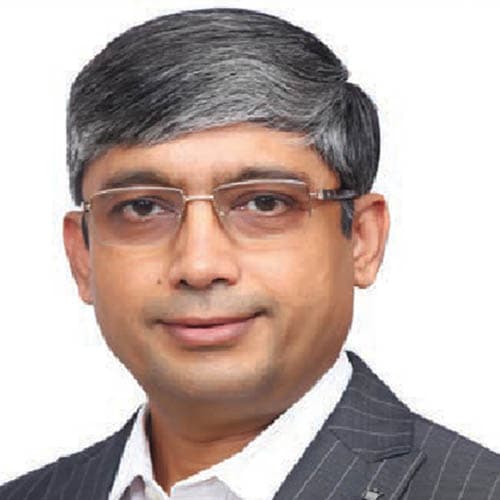
MANOJ PAUL
MANAGING DIRECTOR, EQUINIX INDIA
“AI workloads today span model training, inference, and data in motion, each requiring distinct performance characteristics, network architectures, and power densities. Architectures are being engineered to support higher rack power densities, advanced cooling configurations, and dense fiber interconnection to enable GPU clusters to operate efficiently and securely. In India, our data centers in Mumbai and Chennai are being developed as AI-ready environments with liquid cooling capability, where centralized training workloads can run alongside latency-sensitive inference closer to enterprise users through rich interconnection ecosystems. This ensures that enterprises can leverage high- performance computing while maintaining secure, low-latency access for mission-critical applications, enabling both scale and reliability.
Beyond core architecture, the next phase of AI growth in India will be shaped by ecosystem proximity and distributed intelligence. Distributed digital infrastructure, hybrid multicloud integration, and AI-optimized interconnection are expected to play a central role, as enterprises increasingly seek architectures that bring compute closer to users while maintaining seamless access to public and private cloud environments. Hybrid approaches are being adopted to balance regulatory requirements, data sovereignty considerations, and performance objectives. Interconnected data centers are positioned as neutral hubs where enterprises, networks, and cloud providers converge. As AI inference becomes more embedded across financial services, healthcare, and manufacturing, edge deployments are strengthened to support low-latency processing and real-time decision-making. This model is viewed not only as a technology shift but also as a strategic enabler of India’s digital economy, supporting emerging applications across 5G, generative AI, and advanced analytics.
As capacity scales to meet AI demand, growth must align with environmental responsibility. Rapid expansion is being pursued alongside a focus on sustainability and operational efficiency, as energy intensity rises with high-density computing. Energy-efficient cooling systems, automation, and renewable power procurement strategies are integrated to reduce carbon emissions and optimize resource utilization. Industry recognition, including leadership in global sustainability assessments, reinforces the importance of transparent environmental targets and measurable progress. Over the next three years, advancements in liquid cooling, AI-driven workload orchestration, edge acceleration, and early-stage quantum-adjacent infrastructure exploration are expected to influence performance and competitiveness. Operators that combine scalable architecture, dense interconnection ecosystems, and disciplined sustainability execution will be best positioned to lead India’s next phase of AI-enabled digital growth.”