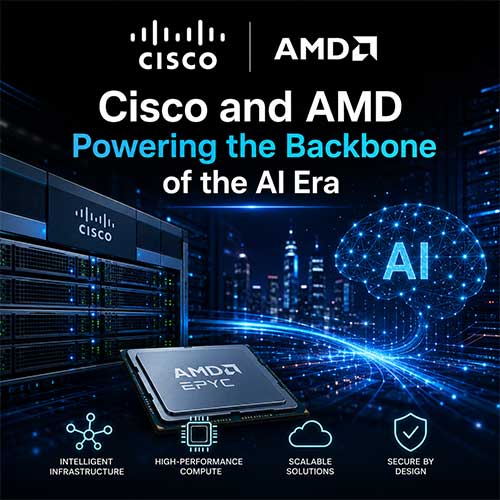
The artificial intelligence revolution is not just a software story — it is fundamentally an infrastructure story. As AI workloads grow exponentially in scale, complexity, and speed, the networks and compute systems that carry them must evolve just as rapidly. Two of the technology industry's most enduring giants — Cisco and AMD — have emerged as the defining partnership powering the next frontier of AI networking and compute infrastructure, with a collaboration that spans Silicon Valley, Amsterdam, and an ambitious 1 gigawatt AI buildout in Saudi Arabia.
The Partnership That Is Redefining AI Infrastructure
AMD, Cisco, and HUMAIN have announced a joint venture to develop large-scale AI infrastructure in Saudi Arabia and beyond, beginning with a 100MW deployment scheduled to go live in 2026, with plans to build up to 1GW of capacity by 2030 — combining HUMAIN's data centre platform with AMD compute and Cisco networking and critical infrastructure. This is not a pilot programme or a proof of concept. It is a full-scale, geopolitically significant infrastructure commitment that signals how seriously both companies are treating the AI infrastructure opportunity.
AMD and Cisco will act as exclusive technology partners to the joint venture, with phase one featuring AMD Instinct MI450 Series GPUs and Cisco's industry-leading critical infrastructure. As AMD CEO Dr. Lisa Su stated: "Delivering high-performance global AI infrastructure at scale requires strong partnerships. Together with HUMAIN and Cisco, we're combining leadership compute and networking technologies to expand the capacity and global competitiveness of the Kingdom's AI ecosystem."
Cisco's Silicon Revolution: The G300 Breakthrough
At Cisco Live EMEA in Amsterdam in February 2026, Cisco delivered what may be its most consequential product announcement in a decade. Cisco unveiled the Silicon One G300, a 102.4 Tbps switching silicon designed for massive AI cluster buildouts. The Silicon One G300 powers new Cisco N9000 and Cisco 8000 systems that push the frontier of AI networking in the data centre, featuring innovative liquid cooling and high-density optics to achieve new efficiency benchmarks.
The numbers are extraordinary. The G300 offers Intelligent Collective Networking, delivering a 33% increase in network utilisation and a 28% improvement in job completion time. For enterprises running large-scale AI training and inference workloads, these are not marginal gains — they represent transformative improvements in the economics of AI compute. Every percentage point of improved network utilisation translates directly into millions of dollars of infrastructure savings at hyperscale.
AI traffic is expected to triple in the next three years, and robotics, manufacturing, and physical AI will put even more traffic on networks at an incredible pace. Every AI agent generates 450% more traffic than a human doing the same task — making networking the new bottleneck. Cisco's Silicon One G300 is specifically engineered to address this bottleneck before it becomes a ceiling on AI ambition.
AMD's Compute Engine: Challenging the Status Quo
While Nvidia has dominated AI compute headlines, AMD is mounting a credible, sustained challenge with its Instinct MI series accelerators. Cisco is validating AMD MI300 GPUs with Cisco networking infrastructure — and while the AMD ecosystem and benchmarking base may still be earlier than Nvidia's, the direction matters. The validation work between Cisco and AMD represents a deliberate strategy to offer enterprises an open, standards-based alternative to Nvidia-centric architectures — reducing single-vendor dependency and improving competitive economics across the AI infrastructure stack.
Cisco has joined a new multi-source agreement to set open standards for expanded beam optical connectivity in AI data centres — an alliance that includes Meta, AMD, Arista Networks, Oracle, and others focused on interoperable high-speed networking. This standards work is strategically significant: by shaping the open connectivity specifications for AI data centres, Cisco and AMD are positioning themselves as the architects of the next generation of AI networking infrastructure — not merely participants in it.
The Agentic AI Challenge
Cisco Cloud Control brings every product in the portfolio under one platform, delivering zero trust, identity intelligence, and AI guardrails to give teams complete visibility into where agents are running and what they can access. This is critically important as agentic AI — autonomous AI systems that take independent actions — becomes mainstream. Agentic workloads generate traffic patterns, security requirements, and infrastructure demands that are categorically different from traditional human-driven computing. Cisco and AMD are co-engineering solutions for this emerging reality.
The most important takeaway from Cisco Live 2026 is that AI data centre infrastructure is becoming a systems problem. Faster silicon and faster switches are necessary, but not sufficient. Non-hyperscale customers increasingly need validated architectures that bring together compute, storage, networking, security, observability, orchestration, and operational tooling. The Cisco-AMD partnership is uniquely positioned to deliver precisely this integrated stack.
The Geopolitical Dimension
The Saudi Arabia joint venture is not merely a commercial transaction — it is a geopolitical statement. HUMAIN, owned by the Public Investment Fund, aims to deliver full stack AI services supported by modern data centre environments optimised for high-density compute, with ambitions to extend capacity to multiple gigawatts over time. Saudi Arabia's sovereign AI infrastructure investment, powered by American technology from Cisco and AMD, reflects the global race to build nationally controlled AI compute capacity — a race that will define technological and economic sovereignty for the next generation.
What This Means for the Enterprise
For enterprise technology leaders, the Cisco-AMD alliance carries clear strategic implications. Organisations that have built their AI infrastructure strategies around single-vendor Nvidia ecosystems now have a credible, validated, enterprise-grade alternative. Cisco's strategy appears built around the reality that the next phase of the AI infrastructure market, outside the hyperscalers, will not be won solely by the vendor with the fastest component — it will be won by the vendor that delivers the most complete, validated, and operationally manageable solution.
The combination of AMD's Instinct GPU performance, Cisco's Silicon One G300 networking throughput, and their joint commitment to open standards creates an infrastructure foundation that is faster, more efficient, more secure, and more economically competitive than anything the market has previously offered.
The Verdict
Cisco and AMD are not simply upgrading existing technology — they are redefining the architecture of AI infrastructure for the agentic era. From the 102.4 Tbps Silicon One G300 to the 1GW Saudi Arabia buildout, from open networking standards to validated GPU-network integrations, the partnership represents a comprehensive, coordinated bet on the future of AI at scale.
In a world where AI performance is increasingly constrained not by model intelligence but by network bandwidth, compute efficiency, and infrastructure reliability, Cisco and AMD have positioned themselves at the most critical chokepoint in the entire AI value chain.