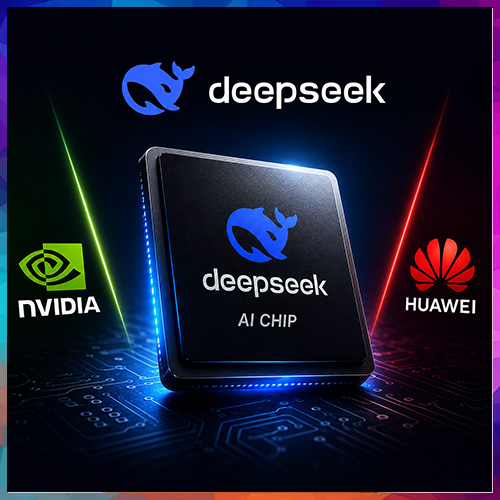
DeepSeek is reportedly preparing to deploy 160,000 Huawei AI accelerators at a gigawatt-scale data centre in Inner Mongolia, highlighting China’s growing reliance on domestic chips as access to Nvidia hardware remains restricted.
Chinese AI company DeepSeek is planning a major expansion of its computing infrastructure with a proposed deployment of at least 160,000 Huawei Technologies AI accelerators at a large data centre in Inner Mongolia. If completed, the installation could become one of the biggest publicly known clusters built around Huawei’s Ascend processors.
The project is expected to use Huawei’s next-generation Ascend 950DT accelerators to run DeepSeek’s artificial intelligence models. However, the deployment schedule could stretch beyond a year because Huawei is facing limitations in producing the chips and securing key components, according to people familiar with the matter.
DeepSeek is reportedly seeking additional supplies of Huawei’s high-end processors, but production constraints could make it difficult for Huawei to meet the demand quickly. Shortages of advanced components, including high-performance memory, are expected to limit the number of Ascend 950DT processors Huawei can manufacture this year.
DeepSeek turns to domestic chips for AI inference
The planned deployment is expected to focus primarily on inference, or running AI models after they have been trained. DeepSeek is not currently expected to use the Ascend 950DT chips for model training, despite Huawei positioning the processor for demanding AI workloads.
DeepSeek has previously experimented with Huawei hardware for training but has continued to rely heavily on Nvidia accelerators for this critical stage of AI development. The company has also reportedly sought greater support from Chinese authorities to secure faster access to Huawei’s chips.
The planned Inner Mongolia facility forms part of DeepSeek’s broader infrastructure expansion. The company is reportedly pursuing billions of dollars in funding to build additional computing capacity. Its infrastructure plans in the region are expected to reach gigawatt scale, with the 160,000 Huawei accelerators representing only part of the facility’s overall computing resources.
China accelerates push for Nvidia alternatives
The proposed cluster comes as Beijing intensifies efforts to reduce the country’s dependence on Nvidia processors. US export restrictions have significantly limited Chinese companies’ access to Nvidia’s most advanced AI accelerators, increasing pressure on domestic manufacturers such as Huawei to close the performance gap.
Huawei’s Ascend family has emerged as a central component of China’s domestic AI hardware strategy. The Ascend 950DT, introduced as a more advanced generation of the company’s accelerators, is positioned as a higher-performance option for AI workloads and is broadly viewed as competing with earlier generations of Nvidia processors.
Several Chinese technology companies are already increasing their use of locally developed AI chips. Meituan has reported training an AI model using tens of thousands of domestic processors, while other Chinese AI companies are building data centres designed around home-grown silicon.
DeepSeek’s proposed 160,000-chip installation would represent a significant increase in scale compared with earlier Chinese AI computing clusters. It also demonstrates how China’s AI ecosystem is adapting to technology restrictions by developing large-scale infrastructure around domestic processors.
However, Nvidia hardware continues to remain popular among Chinese technology companies, with firms seeking access through approved imports and overseas computing resources. The evolving balance between domestic chips and Nvidia accelerators is likely to remain a key indicator of China’s technological progress amid its broader competition with the US.

See What’s Next in Tech With the Fast Forward Newsletter







Tweets From @varindiamag
Nothing to see here - yet
When they Tweet, their Tweets will show up here.