The voice AI company's first partnership with an Indian state government will explore Kannada voice tools for skilling, citizen services and grievance redressal, as it expands Indian language support, accessibility work and its developer ecosystem.
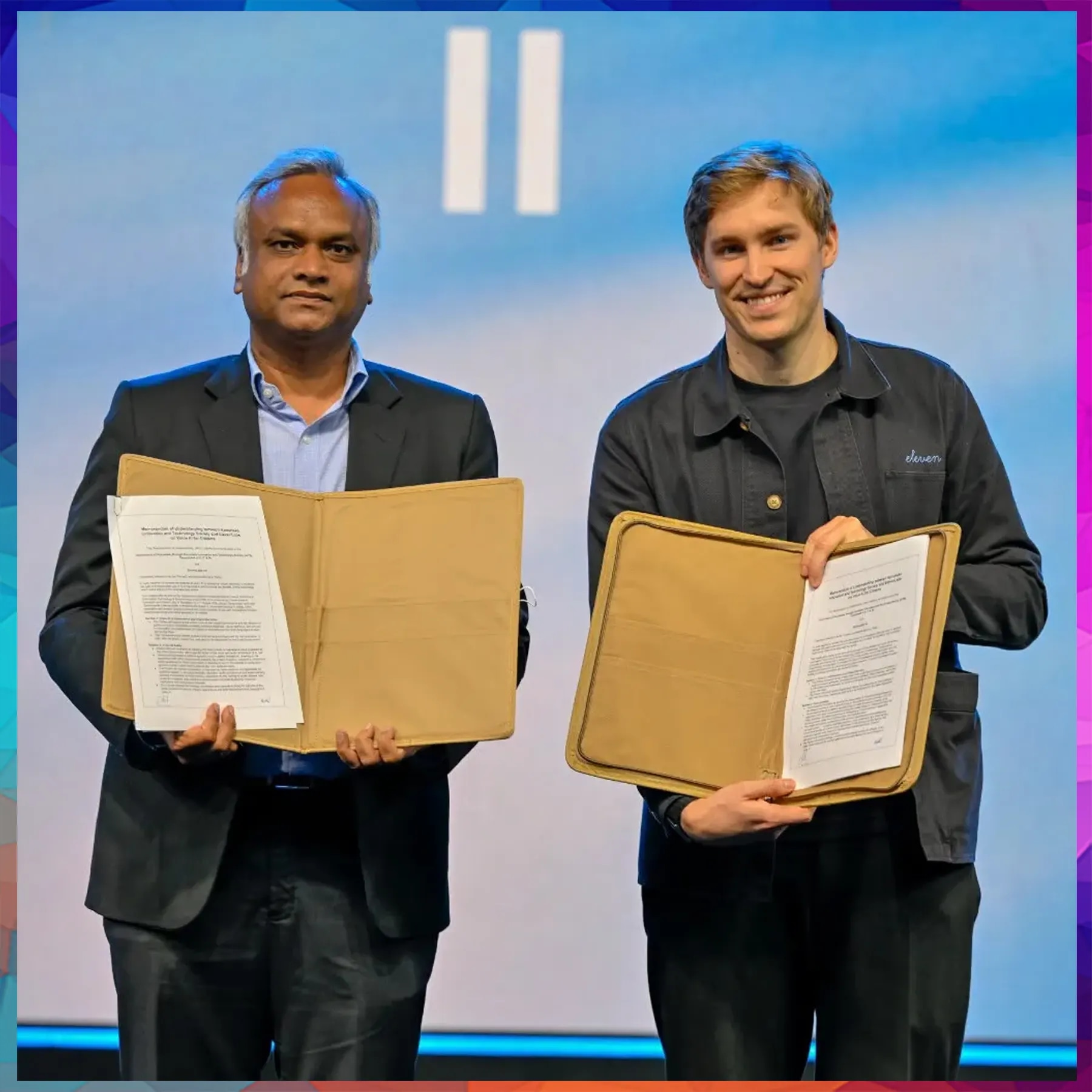
ElevenLabs has signed a memorandum of understanding with the Karnataka Innovation and Technology Society (KITS), marking its first partnership with an Indian state government. The agreement was announced at the company's inaugural India Summit, held in Bengaluru.
Co-Founder and Chief Executive Officer Mati Staniszewski and Karnataka's Minister for Information Technology and Biotechnology, Priyank Kharge, formalised the pact. The two sides will explore using voice AI in Kannada for skilling, citizen services and grievance redressal, and will also work on responsible AI and voice restoration.
The summit signalled a shift in the company's focus, from generating voices to conversational AI that can listen, understand and complete real-world tasks. India's linguistic diversity and the everyday habit of switching between languages mid-conversation make it an important market for such tools. Since the launch of Eleven v4, which the company describes as its fastest and most expressive model yet, the platform supports 14 Indian languages, with a plan to cover all 22 official languages. Staniszewski said India has been central to the company's journey from the start and that he was keen to deepen ties with local businesses.
Accessibility and social impact
Last week, ElevenLabs signed a national-level MoU with the Coalition of the Willing, working alongside the Department of Empowerment of Persons with Disabilities, The Quantum Hub and the Ministry of Social Justice and Empowerment. The aim is to widen access to voice technology for people with speech, hearing and voice-loss disabilities.
The company has also pledged to restore one million voices for people who have permanently lost theirs to conditions such as ALS, cerebral palsy, throat cancer and multiple sclerosis. Five Indian organisations are backing the effort: the ALS Care and Support Foundation, Organisation for Rare Diseases India, Yes We Can, the Nipman Foundation and The Quantum Hub.
Its wider Impact programme has given more than 75 NGOs in India free access to its technology. One of them, Elderra, uses conversational agents to help older people order groceries, medicines and other services through a WhatsApp voice note in their own language. It has trained 1,500 seniors, of whom 600 are already active. Another, Ally, uses native-language AI simulations so that India's emerging mental-health workforce can rehearse realistic client conversations before entering the field. Ten organisations are piloting it, and 5,000 more learners are expected to join over the next six months.
A growing developer community
On the commercial side, more than 25,000 developers and businesses build with the company's API every month. Over the past two years, its grants programme has supported 700 voice-native startups. The Voice Library now holds more than 2,700 voices from over 700 Indian creators, who can earn royalties whenever their voices are used.