
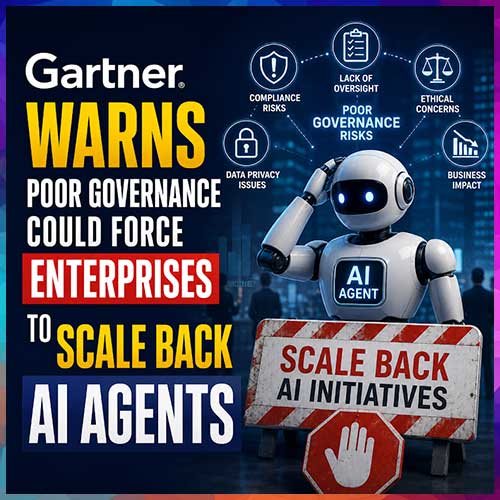
Gartner said 40% of enterprises could demote or shut down autonomous AI agents by 2027 because of governance failures discovered after systems are already deployed in production environments.
The research firm said many organizations are making a critical mistake by applying the same governance model to all AI agents, regardless of how much autonomy or system access those agents have.
According to Gartner, that approach is creating two major risks: over-restricting simple AI agents, which slows innovation and encourages shadow IT, or under-restricting more autonomous agents, which can expose organizations to security, operational, and compliance failures.
Shiva Varma said enterprises are wrongly treating AI governance as a binary choice between fully trusted or tightly locked-down systems.
“Agents operate at different autonomy levels and across different trust boundaries,” Varma said.
The warning comes as companies rapidly experiment with agentic AI systems that can independently perform tasks such as writing code, sending communications, modifying configurations, retrieving enterprise data, and executing workflows with limited human oversight.
Gartner said enterprises need a proportional governance approach where controls become stricter as AI agents gain greater autonomy and operational authority.
The company outlined four levels of AI agent autonomy.
At the first level, “observe” agents only retrieve or summarize information and have read-only access to data sources. Common use cases include document summarization and knowledge retrieval.
The second level, “advise” agents, can generate recommendations, draft emails, or suggest actions, but humans still make all final decisions and execute actions manually.
Gartner warned that even these advisory systems can create risks because employees may over-trust AI outputs due to automation bias.
The third level includes agents that can execute actions — such as updating systems or sending communications — but only after explicit human approval.
Varma said these systems require strong audit trails, approval workflows, and security testing because human oversight can weaken over time due to approval fatigue and operational pressure.
The highest level involves fully autonomous agents capable of independently executing actions within predefined guardrails while humans monitor outcomes rather than reviewing every action individually.
Gartner said these systems require the strictest controls, including continuous monitoring, rollback mechanisms, automated shutdown triggers, and clearly assigned accountability for agent behavior.
The report highlights growing industry concerns that enterprises are moving faster on AI deployment than on governance, risk management, and operational oversight.
As organizations increasingly deploy AI agents across customer service, software development, IT operations, cybersecurity, and enterprise workflows, governance is emerging as one of the biggest challenges to scaling agentic AI safely inside large organizations.
The warning also reflects a broader shift in enterprise AI strategy, where companies are beginning to realize that managing autonomous AI systems may require entirely new operational, compliance, and security frameworks rather than simply extending traditional software governance models.
The research firm said many organizations are making a critical mistake by applying the same governance model to all AI agents, regardless of how much autonomy or system access those agents have.
According to Gartner, that approach is creating two major risks: over-restricting simple AI agents, which slows innovation and encourages shadow IT, or under-restricting more autonomous agents, which can expose organizations to security, operational, and compliance failures.
Shiva Varma said enterprises are wrongly treating AI governance as a binary choice between fully trusted or tightly locked-down systems.
“Agents operate at different autonomy levels and across different trust boundaries,” Varma said.
The warning comes as companies rapidly experiment with agentic AI systems that can independently perform tasks such as writing code, sending communications, modifying configurations, retrieving enterprise data, and executing workflows with limited human oversight.
Gartner said enterprises need a proportional governance approach where controls become stricter as AI agents gain greater autonomy and operational authority.
The company outlined four levels of AI agent autonomy.
At the first level, “observe” agents only retrieve or summarize information and have read-only access to data sources. Common use cases include document summarization and knowledge retrieval.
The second level, “advise” agents, can generate recommendations, draft emails, or suggest actions, but humans still make all final decisions and execute actions manually.
Gartner warned that even these advisory systems can create risks because employees may over-trust AI outputs due to automation bias.
The third level includes agents that can execute actions — such as updating systems or sending communications — but only after explicit human approval.
Varma said these systems require strong audit trails, approval workflows, and security testing because human oversight can weaken over time due to approval fatigue and operational pressure.
The highest level involves fully autonomous agents capable of independently executing actions within predefined guardrails while humans monitor outcomes rather than reviewing every action individually.
Gartner said these systems require the strictest controls, including continuous monitoring, rollback mechanisms, automated shutdown triggers, and clearly assigned accountability for agent behavior.
The report highlights growing industry concerns that enterprises are moving faster on AI deployment than on governance, risk management, and operational oversight.
As organizations increasingly deploy AI agents across customer service, software development, IT operations, cybersecurity, and enterprise workflows, governance is emerging as one of the biggest challenges to scaling agentic AI safely inside large organizations.
The warning also reflects a broader shift in enterprise AI strategy, where companies are beginning to realize that managing autonomous AI systems may require entirely new operational, compliance, and security frameworks rather than simply extending traditional software governance models.