
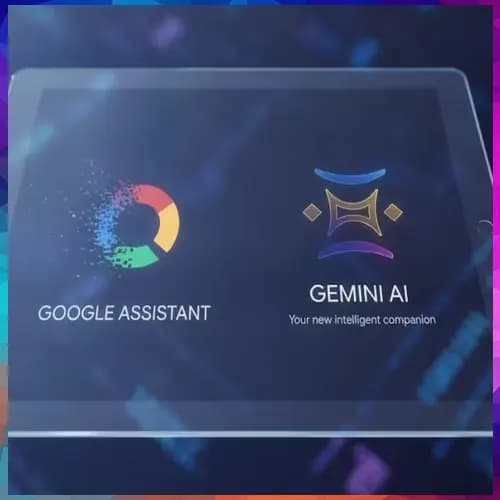
Google will begin phasing out Google Assistant in September 2026, replacing it with Gemini across supported devices as the company expands AI-powered experiences with advanced models, improved performance and new agentic capabilities for users.
Google has confirmed that it will begin retiring Google Assistant in favour of its generative AI-powered assistant, Gemini, marking a major shift in the company's approach to digital assistants. The phased migration is scheduled to start on September 4, 2026, with users on eligible devices gradually transitioning to the new AI experience over the coming months.
The company has already begun notifying customers about the change through email communications, informing them that Google Assistant will no longer be available on supported mobile devices. Once the migration is completed, users will not have the option to switch back to the legacy Assistant on compatible smartphones, tablets or connected accessories.
The transition will extend across a broad range of Google-supported devices, including Android smartphones, Android tablets, Wear OS smartwatches, Google Assistant-enabled headphones and Android Auto sessions projected from users' mobile phones. However, vehicles equipped with Google's native infotainment platform, Google Built-in, will continue to support Google Assistant for the time being.
Google said it is focused on ensuring a seamless migration and believes Gemini will provide a more capable, intelligent and helpful experience as it becomes the company's primary AI assistant.
Gemini expands AI capabilities across Google's ecosystem
The replacement of Google Assistant reflects the company's broader strategy of integrating generative AI into its products and services. Gemini is designed to offer more advanced conversational abilities, stronger contextual understanding and improved task execution compared to traditional voice assistants.
Google has continued enhancing the Gemini family of AI models to improve efficiency, responsiveness and performance across different categories of devices. Recent model updates, including Gemini 2.6 Flash, Gemini 3.5 Flash Lite and Gemini 3.5 Flash Cyber, have been optimised to deliver faster responses while consuming fewer computational resources. These improvements are intended to support a consistent AI experience across smartphones, wearables, smart speakers and other connected devices.
The expanded capabilities also position Gemini to handle more complex user interactions than earlier generations of virtual assistants, enabling richer conversations and broader support for productivity-related tasks.
Agentic AI to automate everyday digital tasks
Google is also introducing Gemini Spark, an AI agent designed to carry out multi-step digital activities with minimal user intervention. Unlike conventional voice assistants that primarily respond to individual commands, Gemini Spark is built to complete more complex workflows autonomously after receiving user permission.
With authorised access to a user's logged-in accounts and stored credentials, the AI agent can perform tasks such as booking appointments, filling online forms and completing routine web-based activities that would otherwise require manual interaction. The move reflects Google's growing focus on agentic AI, where intelligent assistants are expected to act on behalf of users while maintaining appropriate permission controls.
The retirement of Google Assistant marks the end of an era for one of Google's longest-running consumer AI products. As Gemini becomes the default assistant across supported devices, the company is signalling its commitment to a new generation of AI-driven experiences centred on generative intelligence, automation and deeper integration across its hardware and software ecosystem.