
Google unveils next-generation AI tools, Gemini 3.5 Flash and search upgrades at I/O 2026
The tech major introduced faster AI models, agent-based workflows, multimodal video generation capabilities and smarter productivity features as it expands Gemini across Search, YouTube, Chrome and enterprise applications.
At its annual developer conference, Google unveiled a series of major artificial intelligence upgrades aimed at strengthening its position in the rapidly evolving AI market. The company introduced new Gemini models, AI-powered productivity tools, agent-based systems and one of the most significant redesigns to Google Search in years.
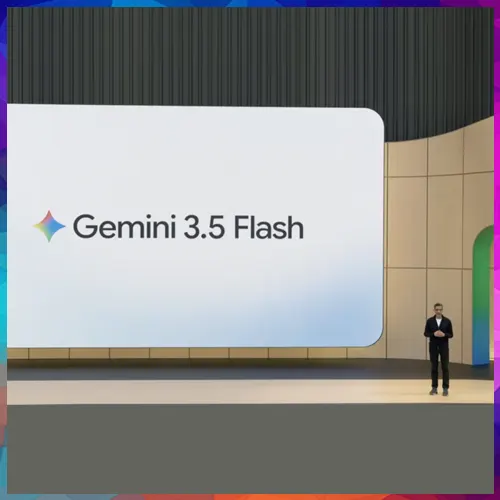
During the keynote presentation at Shoreline Amphitheatre in California, Alphabet CEO Sundar Pichai said the company is focusing heavily on AI systems capable of handling complex real-world tasks, coding assistance and multimodal interactions.
Google also revealed that the Gemini app has crossed 900 million users globally, more than doubling its user base within a year.
Gemini 3.5 Flash becomes the new default model
One of the biggest announcements at the event was the launch of Gemini 3.5 Flash, the latest addition to Google’s Gemini AI family. The company said the new model will replace Gemini 3.1 Flash as the default AI model within the Gemini app.
According to Google, Gemini 3.5 Flash delivers significantly faster responses while improving coding, reasoning and task execution capabilities. The company claimed the model performs better than earlier Gemini versions across several coding and agentic benchmarks.
Google executives also highlighted the model’s speed advantage, saying Gemini 3.5 Flash can generate outputs nearly four times faster than several competing frontier AI systems without compromising performance.
The model is already being integrated across multiple Google services and products, including its revamped Search platform and developer tools.
Gemini Omni pushes toward advanced AI video creation
Google DeepMind also introduced Gemini Omni, a new multimodal AI system designed to combine text, images, audio and video inputs for content generation and editing.
Demis Hassabis described the technology as a major step toward more advanced AI systems with deeper real-world understanding. Unlike conventional AI video tools that depend mainly on text prompts, Gemini Omni can interpret multiple forms of media together to generate and refine videos more naturally.
Google said the model demonstrates improved understanding of motion, gravity, fluid dynamics and physical interactions, helping create more realistic visual outputs.
The first version, Gemini Omni Flash, is rolling out for Google AI Plus, Pro and Ultra subscribers through the Gemini app and Google Flow. The technology will also power features in YouTube Shorts and YouTube Create.
Search receives major AI transformation
Google also announced one of the largest AI upgrades to its Search platform since its launch. AI Mode in Search is now powered by Gemini 3.5 Flash and is being merged more deeply with AI Overviews.
The company unveiled a redesigned AI-driven Search box capable of handling conversational queries more effectively. Unlike traditional search bars, the new interface dynamically expands as users type and supports searches through text, images, files and videos simultaneously.
Google said the updated experience enables users to move seamlessly between AI-generated answers, traditional web links and follow-up conversations without losing context.
The redesigned Search experience is being rolled out globally across desktop and mobile devices.
Gemini Spark and Antigravity 2.0 introduced
Another key announcement was Gemini Spark, a new AI agent platform designed to perform long-running tasks in the background. Google described Spark as a “personal AI agent” capable of managing workflows using dedicated virtual machines on Google Cloud.
The system can automatically collect information from emails, documents and chats, then complete tasks such as creating summaries or drafting personalised content. Google plans to expand Spark into Chrome to support more agentic web interactions.
Alongside Spark, the company launched Antigravity 2.0, an upgraded developer platform focused on AI-assisted coding and multi-agent orchestration. The platform introduces support for sub-agents, asynchronous task management and collaborative AI workflows.
Google said millions of developers are already using Antigravity, and the new version significantly improves integration and coding performance.
New AI features across Google services
The company also announced several new AI-powered consumer tools. “Ask YouTube,” a Gemini-powered search feature for YouTube, will launch in the United States later this year. Google also introduced Docs Live, allowing users to create and edit documents using voice commands.
In addition, Google revealed a new image editing application called Google Pics, expected to launch this summer.
Google also confirmed broader support for its invisible watermarking technology SynthID, which is now being adopted by companies including OpenAI.

See What’s Next in Tech With the Fast Forward Newsletter








Tweets From @varindiamag
Nothing to see here - yet
When they Tweet, their Tweets will show up here.