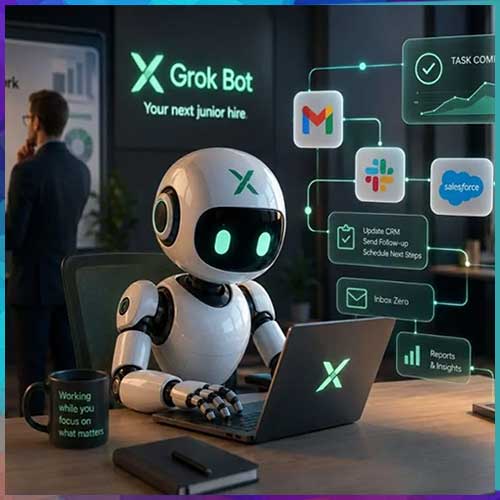
The next phase of artificial intelligence is moving beyond answering questions toward taking actions on behalf of users. Grok Bots represent this broader shift toward persistent AI agents that can potentially navigate software, execute multi-step workflows and continue working after the user has stepped away. The significance is not simply better automation—it is the emergence of AI as a delegated digital worker.
Unlike conventional chatbots, this agentic model operates closer to the way employees work. An agent can potentially move between email, CRM platforms, spreadsheets, support systems and websites, completing a workflow rather than merely recommending what should be done. Persistent cloud environments and computer-use capabilities are particularly important because they can allow agents to interact with applications even when purpose-built API integrations are unavailable.
Productivity Comes With Privilege
The biggest advantage is also the biggest risk. An AI agent capable of completing real work requires real permissions. Once agents can access accounts, maintain sessions, modify records, communicate externally or initiate transactions, they effectively become non-human identities with enterprise privileges.
This fundamentally changes cybersecurity. Traditional identity systems were designed around employees, applications and service accounts—not autonomous software capable of reasoning about what action to take next.
Organizations therefore need to ask more than, “What can this AI do?” They must establish what it is allowed to access, which actions require human approval, how credentials are protected and how every action can be reconstructed during an investigation.
Multi-Agent AI Expands the Attack Surface
Multiple specialized agents working together could dramatically improve productivity. Sales agents could research prospects, operations agents could process routine workflows, while engineering agents investigate technical issues simultaneously.
But interconnected agents also create new risks. A compromised account, malicious instruction, prompt injection or incorrectly interpreted task could propagate across connected applications. The potential blast radius becomes much greater when agents possess persistent credentials and write permissions.
Enterprises consequently need least-privilege access, Zero Trust, behavioral monitoring, credential isolation, immutable audit trails and automated containment. Financial transactions, sensitive-data transfers, account modifications and other high-impact actions should require additional authorization.
The Agentic AI Race Is Accelerating
The broader competitive landscape is equally important. OpenAI, Anthropic, Microsoft and other AI companies are increasingly developing technologies that move AI from conversation toward task execution.
This means the next competitive battleground may not simply be which company has the smartest model, but which platform can safely connect intelligence to enterprise systems and reliably complete useful work.
Trust Becomes the Deciding Factor
The economic opportunity is enormous. Persistent agents could automate research, customer support, sales operations, administration, software development and numerous repetitive knowledge-work processes. Organizations could effectively create a digital workforce operating continuously alongside human employees.
Yet enterprise adoption will ultimately depend on trust rather than intelligence alone.
The central question of agentic AI is shifting from “Can AI perform the task?” to “Should AI be trusted with the authority required to perform it?”
Grok Bots illustrate where enterprise AI is heading: from copilots that recommend, to agents that execute. The organizations that benefit most will be those that combine autonomy with identity security, privacy, governance and human accountability.
AI working while humans sleep sounds powerful. The real breakthrough will be AI that enterprises can safely trust while nobody is watching.