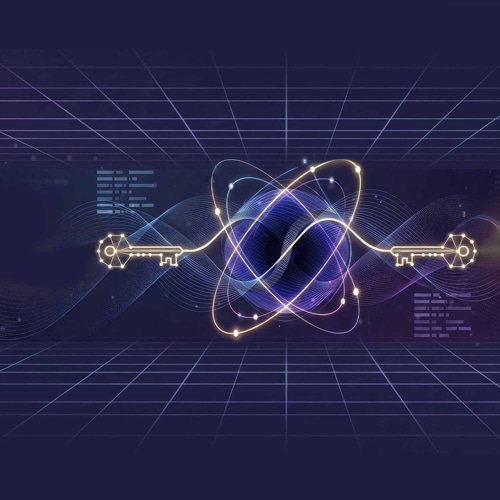
The demonstration shows how organisations can manage quantum-generated keys within existing security controls, combining hardware security modules and post-quantum cryptography with quantum key distribution for selected critical communications across financial services, telecommunications and government networks.
IDEMIA Secure Transactions (IST) and IonQ said they have validated interoperability between IonQ’s quantum key distribution (QKD) systems and IDEMIA Sphere, IST’s cybersecurity platform. The demonstration showed how organisations could manage and use keys distributed through QKD within existing enterprise security controls, compliance processes and operational workflows.
The integration is aimed at financial institutions, telecom operators and government agencies evaluating additional protection for selected communications as they prepare for future threats to encryption from quantum computing.
Integrating quantum keys with existing security controls
The demonstration brought together three technologies with distinct roles. Hardware security modules protect cryptographic keys and sensitive operations, while post-quantum cryptography uses algorithms designed to resist attacks by quantum computers. QKD provides an additional way to establish shared keys for specific communications. The validation focused on how those keys can be brought under existing controls for managing and protecting them throughout their lifecycle.
“The future of cybersecurity will be defined not by a single technology, but by the ability to orchestrate trusted security layers into resilient architectures,” said Marc Bertin, CTO of IDEMIA Secure Transactions. “This collaboration demonstrates a pragmatic path toward quantum-safe security, where interoperability between trusted technologies enables greater resilience, stronger protection and lasting confidence in digital infrastructures.”
“Quantum-safe security depends on technologies that can be trusted, scaled and integrated. IonQ’s platform is built for exactly that,” said Jordan Shapiro, President of Quantum Platform at IonQ. “This validation shows how our QKD systems can plug directly into enterprise-grade environments, giving organizations a practical path to strengthen critical communications with quantum-generated security.”
Implications for India’s critical networks
The companies pointed to India’s National Quantum Mission, which they said is working towards a 2,000-km national backbone by the end of 2026. They also cited the work of the Quantum Secure and Adaptive Financial Ecosystem (Q-SAFE) committee as part of India’s efforts to prepare the financial sector for quantum-era security risks.
For Indian banks, telecom operators and government agencies assessing QKD, the demonstration illustrates how an additional layer of protection for selected communications could fit into the systems they already use to manage cryptographic keys and meet compliance requirements.