


Signed as the UK’s most substantial trade deal since exiting the EU, the India-UK FTA will cut tariffs, boosting Indian exports like gems and apparel while giving British industries a stronger foothold in India through cheaper, high-value goods
In a major stride toward deepening economic ties, India and the United Kingdom have signed a comprehensive Free Trade Agreement (FTA), aiming to enhance bilateral trade by an estimated $34 billion annually. This pact marks the UK’s most substantial trade deal since its departure from the European Union in 2020.
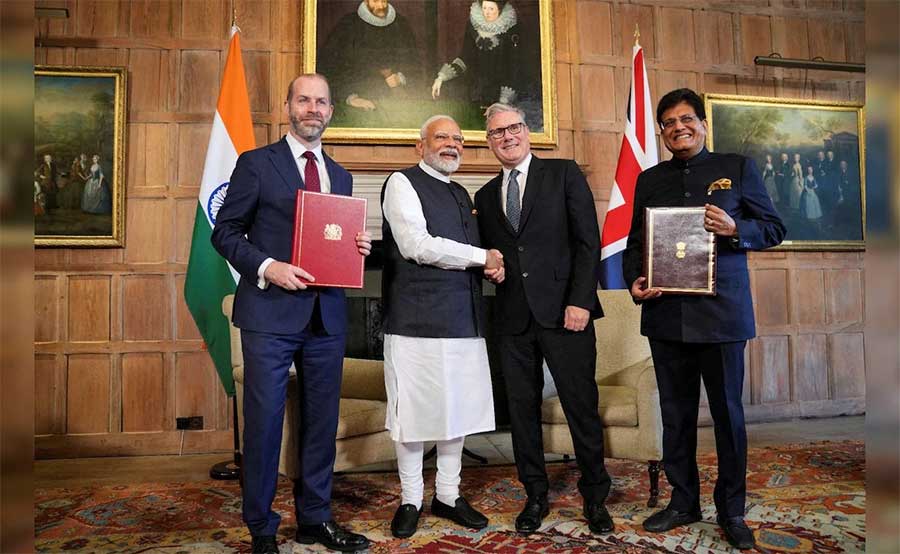
The agreement was formalised in London by India’s Commerce Minister Piyush Goyal and the UK Secretary of State for Business and Trade, Jonathan Reynolds. The signing followed high-level talks between Indian Prime Minister Narendra Modi and his British counterpart, Prime Minister Keir Starmer.
At a joint press briefing, PM Modi described the deal as a “blueprint for shared prosperity,” stating that the FTA would unlock new opportunities for sectors ranging from agriculture and textiles to pharmaceuticals and engineering. “Today is a historic milestone in the India-UK partnership,” Modi said. “This agreement brings new promise for our farmers, MSMEs, and youth.”
The deal is set to eliminate or reduce tariffs on a wide array of goods and services. Indian products like textiles, footwear, seafood, gems and jewellery are expected to gain easier access to the UK market, while British exports such as medical equipment and aerospace components will enter India more competitively.
UK Prime Minister Keir Starmer hailed the agreement as a “landmark deal” that would create thousands of jobs, drive investment, and stimulate economic growth in both nations. “This is the most significant trade deal the UK has entered into since Brexit,” Starmer said. “It will raise living standards and support working people by making trade cheaper, faster, and more efficient.”
Boosting trade, jobs, and workforce mobility
A key feature of the FTA is a social security arrangement allowing Indian firms to send employees to the UK without incurring double social security payments, reducing operational costs and encouraging workforce mobility.
Officials noted that under the agreement, 99% of Indian exports will receive duty-free access to the UK. The two countries now aim to double their trade volume to $120 billion by 2030.
The UK remains a key investor in India, having invested approximately $36 billion to date. Nearly 1,000 Indian businesses operate in the UK, supporting over 100,000 jobs.
India’s exports to the UK reached $14.5 billion in 2024-25, up 12.6% from the previous year, while imports stood at $8.6 billion. Bilateral trade increased to $21.34 billion in 2023-24.
This agreement marks India’s first major bilateral FTA with a developed nation in over a decade, underlining a new era of economic collaboration.

See What’s Next in Tech With the Fast Forward Newsletter







Tweets From @varindiamag
Nothing to see here - yet
When they Tweet, their Tweets will show up here.