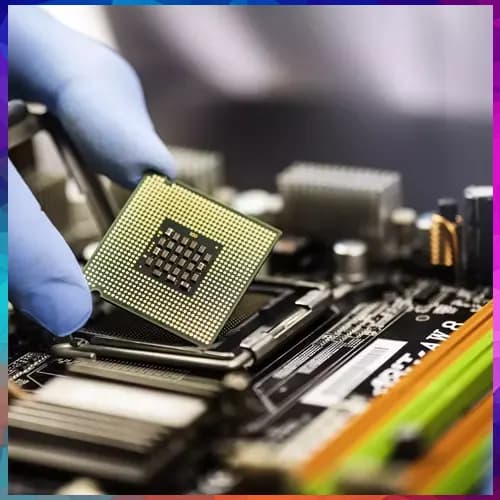

The expanded partnership focuses on integrating advanced processors and developing custom infrastructure chips, as Intel sharpens its AI strategy and strengthens its position in a highly competitive semiconductor market.
In a significant move to bolster artificial intelligence infrastructure, Intel Corporation has expanded its long-standing partnership with Google Cloud. The collaboration will centre on integrating Intel’s latest Xeon 6 processors into Google’s data centres, alongside the development of specialised infrastructure chips designed to support next-generation AI workloads.
The announcement comes at a crucial juncture for Intel, as it seeks to reinforce its standing in an AI chip market currently led by NVIDIA. The company is shifting its focus towards building “heterogeneous” AI systems—an approach that combines central processing units (CPUs), accelerators, and newly designed infrastructure processing units (IPUs) to efficiently manage complex computing tasks.
Expanding AI infrastructure capabilities
Under the agreement, Google Cloud will expand its deployment of Intel’s Xeon 6 processors across various cloud offerings, including compute instances tailored for demanding AI operations. These systems are engineered to support a wide range of workloads, from training large-scale AI models to enabling faster inference and handling everyday computing requirements.
A key aspect of the partnership involves the joint development of custom ASIC-based IPUs. These chips are expected to take over critical infrastructure functions such as networking, storage optimisation, and security—tasks traditionally handled by CPUs. By offloading these responsibilities, the companies aim to improve overall system efficiency and performance.
Industry leaders have highlighted the importance of this integrated approach. Amin Vahdat of Google Cloud noted that CPUs and infrastructure acceleration continue to play a vital role across the AI lifecycle, from development to deployment. Meanwhile, Intel CEO Lip-Bu Tan emphasised the need for balanced systems that go beyond standalone accelerators to meet evolving AI demands.
Broader strategic push
Alongside this partnership, Intel is also advancing its manufacturing ambitions. The company has reportedly entered into a major agreement with Elon Musk to build a large-scale semiconductor facility in Texas. The proposed “Terafab” plant is expected to manufacture advanced 2-nanometre chips at high volumes, supporting applications across AI, autonomous technologies, and space exploration initiatives linked to companies like SpaceX and Tesla.
Together, these developments underline Intel’s broader strategy to regain momentum in the AI ecosystem by combining innovation in chip design, cloud partnerships, and large-scale manufacturing investments.