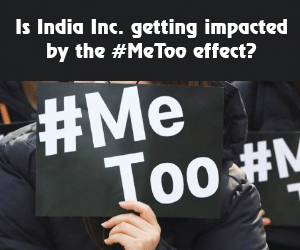
What started off with the Harvey Weinstein expose in the US has today catapulted into the large scale #MeToo movement.This campaign would not have gained such prominence had it not been for the power of Social Media that inadvertently worked as a recourse for many to vent out their angst against such harassments -
#MeToo, the online campaign that supports the survivors of sexual abuse, assault and harassment, has recently taken the social media by storm. Although it has gained popularity over the last two months, the initiative actually began 10 years ago. Apparently, Tanushree Dutta emerges as the movement leader of #MeToo in India.
The #MeToo India movement was sparked by actor Tanushree Dutta when she revived her sexual harassment accusation case against veteran Nana Patekar that took place on a film set 10 years ago. This movement is already dividing Bollywood into various groups and sub groups.
In India, the #MeToo movement has spread like a wildfire, which eventually led to an outpouring from women recounting their experiences. Working women and celebrities are coming forward on social media with stories and details of various forms of sexual harassment and misconduct. These stories are really painful who have been victims of such acts.
The #MeToo movement has brought many high profile names to the fore, who are regularly featured in Page 3. For instance, Suhel Seth,55, has been accused of sexual harassment and predatory behaviour at least by four women, including one who said she was a minor at the time of the alleged incident.
However a question arises on its authenticity. What kept victims silent for such a long time? What law and action will be taken now, as these crimes were done a long back? Will there be any action and prosecution to start, after such a long gap of years? If it is so, then up to what extent?
Also after allegations of sexual harassment are been made public, how are organisations and business associates with alleged perpetrators are going to react. Will they cut ties? Are they attempting to ignore the problem until it goes away? How will their reputation and image be treated in public?
There are also some like actor Govardhan Asrani who are calling this entire movement 'a publicity stunt'.
So Is India Inc. going to be impacted too?
The #MeToo campaign might not be confined to the film and the Media industry and with more women coming out in public, there are a few cases from the corporate world that are coming out into the limelight. The recent being the announcement made by Walmart Inc. that Flipkart co-founder Binny Bansal exited the company after an independent probe into allegations of sexual assault. Though Bansal has denied any wrongdoing and the investigators didn’t find evidence of assault, the process revealed “lapses in judgment” that troubled the parent company’s leadership.

Women in Corporate sector…
In a study indicating the participation of women in corporate India, the number of female employees in top 100 companies in terms of best workplace for the fairer sex picked up by 5 per cent in 2017 compared to the previous year. This has resulted in the overall percentage representation of women in 100 best companies for female employees going up to 30.55 per cent, from 25.25 per cent in 2016.
Tata Consultancy Services, Accenture Solutions, Deloitte in India, Procter & Gamble, IBM India are some of the corporates which figure on the list of top 10 best companies for women in India, while Northern Trust Bank, EY, People Combine Educational Initiatives, Schneider Electric India and Shell India Markets are the other companies on top 10 list.
The study points out that the top 10 companies together employ 2.36 lakhs of women, which is 50.52 per cent of all women in the list of top 100 best companies for females.
According to study, there has been an 11 per cent surge in women workforce at entry levels in 2017, from that of 2016. Among the top 100, companies from IT/ITES sector have the highest women representation at 36 per cent in 2017. This is followed by financial services with representation of 12 per cent women workforce.
In 2012, only 27 percent of adult Indian women had a job, or were actively looking for one, compared to 79 percent of men. In fact, almost 20 million women had dropped out of the workforce between 2005 and 2012. This is equivalent to the entire population of Sri Lanka.
It is a matter of pride that today women are represented on the board of every single company that comprises the BSE 100; women have held or are currently holding leadership positions in at least nine banks, five FMCG companies and eight IT/ITeS companies in India.
But the objective here is not just to increase ‘female representation’, as a result of knee-jerk reactions, but it is the duty of corporates to align long-term organisational goals with that of diversity and inclusion of women and also their safety at workplace. Organisations, besides removing barriers to progress of women should also put such measures in place that would ensure safety to women workers.
Ensuring homogeneity in salaries, better childcare options, accommodating unique aspirations of the millennial women, flexibility in work schedules, a supportive return-to-work policy, and a better work-life balance are always important. But at the same time, women safety has also emerged as a subject of priority for mostorganizations today. Recent episodes of harassment at workplace have also spiked a fierce debate nationwide on the importance of exhibiting appropriate behaviour toward women. With increasing number of women joining the workforce, it has become critical for organizations to reinforce the need to foster safer establishments.
How to avoid another #MeToo?
The key takeaway from the recent #MeToo campaign is that most film companies still don’t have adequate measures in place to protect women at the workplace. The situation is not helped by the fact that voluntary private organizations like the Cine & TV Artistes Association (CINTAA) or the Producers Guild of India do not hold the authority to either take legal action against the accused or file a complaint on behalf of the victim.
In most of the sexual harassment cases, women tend to not report it because of fear of retaliation by the harasser or the organization, while also the social stigma attached with such cases. Also, women may prefer to take care of the situation themselves rather than going through the entire complaints redressal procedure. They feel that they will be looked down upon if they report such a case, irrespective of who is at fault in that situation.
So what should be the solution in such a situation?
Prior to 1997, a person facing sexual harassment at the workplace had to lodge a complaint under Section 354 of the Indian Penal Code 1860, which deals with “criminal assault of women to outrage women’s modesty” and Section 509, which punishes an individual/individuals for using a “word, gesture or act intended to insult the modesty of a woman.”
The Vishakha Guidelines was soon superseded by the Sexual Harassment of Women at Workplace (Prevention,Prohibition and Redressal) Act, 2013 (the Act), which is a legislative act in India that seeks to protect women from sexual harassment at their place of work. The Act came into force on 9 December 2013 and prevented any kind of sexual harassment introduced by the Supreme Court of India. The Act defines sexual harassment at the workplace and creates a mechanism for redressal of complaints, while also providing safeguardsagainst false or malicious charges.
The Delhi government on its part has set a deadline of November 30 for all formal institutions and organisations in the city to form internal committees (ICs) which is mandated under the Sexual Harassment of Women at Workplace.
The government has also said that it is in the process of forming a committee to look into all issues arising from the #MeToo movement.The five-member committee, likely to be headed by retired Supreme Court judge Justice SS Nijjar will have the mandate to hear women who have publicly named their harassers. The committee is asked to submit a report in three months, while recommending the way forward to deal with the flood of sexual harassment allegations against senior leaders across professions, and suggest measures to make workplaces safer.
With the #MeToo movement gathering force in India, companies are struggling to engage with the need to make their workplaces safe by calling out and punishing sexual harassment. They are now looking to tightening policies so that the line between acceptable behaviour and sexual harassment is clear. One way is to make sure that cases are dealt with quickly.
However, zero tolerance should not just for sexual harassments but also for wrongful accusations, as pointed out by many. The Government has also shown its commitment to push corporates on compliance with various acts pertaining to women safety, especiallysexual harassment, through strict regulation and enforcement action.