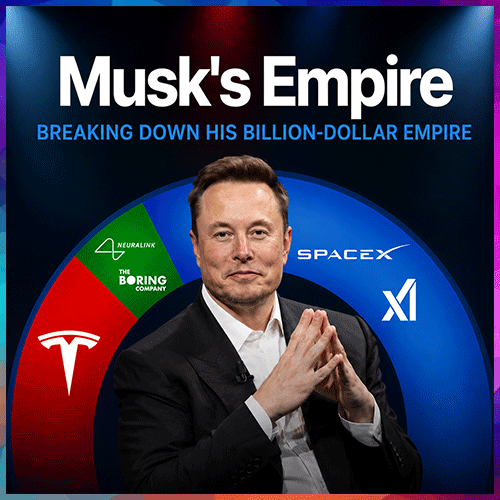
For years, Elon Musk ran Tesla and SpaceX as two distinct power centres—linked by the same founder but operating in separate worlds. That separation is now narrowing fast. In 2026, Tesla, SpaceX, and xAI are increasingly converging around chip manufacturing, AI infrastructure, energy storage, and cross-company transactions, fuelling fresh speculation about a possible future merger.
At the centre of this convergence is Terafab, a joint chip fabrication venture involving Tesla, SpaceX, and xAI. Launched on March 21, 2026, the project aims to produce massive AI compute capacity and reduce dependence on external chip suppliers. For Musk, Terafab is not just a factory—it is a strategic move to control the semiconductor backbone powering electric vehicles, humanoid robots, satellites, and AI data centres.
The facility is expected to support Tesla’s AI5 inference chips for vehicles and Optimus robots, along with specialised chips for SpaceX’s satellite constellation. This effectively places Tesla’s mobility ambitions, SpaceX’s orbital infrastructure, and xAI’s compute requirements on a shared technology foundation.
The financial links are also growing. SpaceX’s purchases from Tesla reportedly jumped sharply in 2025, while xAI has also become a major buyer of Tesla’s energy storage systems. These transactions show that Musk’s companies are no longer just sharing ideas and engineering talent—they are increasingly becoming operationally dependent on one another.
This has strengthened Wall Street speculation that a Tesla-SpaceX merger may eventually happen. Some analysts believe such a move could create one of the world’s most valuable technology conglomerates, combining electric vehicles, rockets, satellites, AI infrastructure, energy storage, robotics, and advanced manufacturing under one umbrella.
However, a formal merger remains far from simple. SpaceX’s defence-related obligations, regulatory restrictions, Tesla’s global manufacturing footprint, and unresolved questions around ownership, intellectual property, and valuation could make any combination complex and politically sensitive.
Still, the direction is clear. Whether or not Tesla and SpaceX formally merge, Musk’s companies are already moving closer through shared infrastructure, joint projects, capital flows, and overlapping strategic goals.
The bigger question is no longer whether Musk’s empire is converging. It is how far this integration will go—and whether Terafab becomes the first step toward building one unified Musk technology powerhouse.

See What’s Next in Tech With the Fast Forward Newsletter








Tweets From @varindiamag
Nothing to see here - yet
When they Tweet, their Tweets will show up here.