Successful user-evaluation trial marks a significant milestone in India's indigenous defence capabilities and conventional military preparedness.
India Advances Its Indigenous Missile Programme
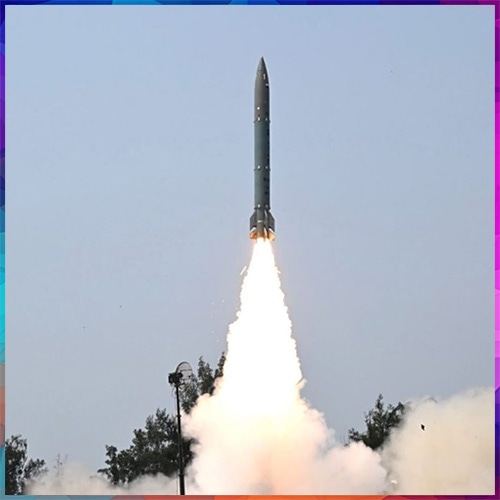
India has achieved another milestone in indigenous defence technology with the successful user-evaluation flight test of the Pralay quasi-ballistic missile on November 5, 2026. Developed by the Defence Research and Development Organisation (DRDO), the missile is designed to deliver precision conventional strikes against targets at distances of up to 500 kilometres.
The successful trial represents an important step towards operational induction, strengthening India's ability to respond to emerging security challenges while reducing dependence on imported weapon systems.
Pralay: A New Generation of Tactical Missiles
Pralay is a surface-to-surface, solid-propellant quasi-ballistic missile developed for conventional battlefield operations.
Unlike traditional ballistic missiles, which generally follow predictable flight trajectories, Pralay incorporates manoeuvring capabilities that make its path more difficult for adversary air-defence systems to anticipate.
Its principal capabilities include:
-
Operational range: Approximately 150–500 kilometres.
-
Payload capacity: Around 500–1,000 kilograms.
-
Propulsion: Solid-fuel technology supporting rapid launch readiness.
-
Launch capability: Mobile platforms for operational flexibility.
-
Strike capability: Precision engagement of designated military targets using conventional warheads.
The missile's first successful flight test in December 2021 established the foundation for subsequent technological validation and operational evaluation.
November 5 Trial Validates Operational Readiness
According to the reported test details, Pralay was launched at approximately 11:10 a.m. from Dr APJ Abdul Kalam Island off the Odisha coast.
The Integrated Test Range at Chandipur monitored the flight using advanced tracking and instrumentation systems.
The trial reportedly achieved its prescribed mission objectives, demonstrating the missile's guidance, trajectory control and manoeuvring capabilities.
Unlike developmental tests, user-evaluation trials assess whether a weapon system meets the operational requirements of the armed forces before acceptance and induction.
This makes the latest test particularly significant in Pralay's transition from development to potential deployment.
Strategic Advantage for India's Armed Forces
Pralay is expected to strengthen India's conventional deterrence by providing a mobile, precision-strike capability against important military targets.
Its operational range could enable engagement of adversary airfields, command-and-control facilities, radar installations, logistics infrastructure and other strategic military assets.
The combination of manoeuvrability, solid-fuel propulsion and mobile launch platforms could improve operational responsiveness while complicating interception by hostile air-defence networks.
Importantly, Pralay offers a conventional strike option, expanding military response capabilities without relying on nuclear weapons.
Strengthening India's Defence Self-Reliance
Beyond its military applications, Pralay highlights the growing maturity of India's indigenous missile development ecosystem.
The programme demonstrates DRDO's expanding capabilities in propulsion, guidance systems, flight control, missile integration and precision-strike technologies.
Successful development and production could also create opportunities for domestic defence manufacturers, component suppliers and advanced engineering companies.
This aligns with India's broader Atmanirbhar Bharat objective of building a technologically advanced and self-reliant defence industry.
From Successful Testing to Operational Deployment
Although the latest evaluation represents an important achievement, operational induction will depend on completing the necessary service acceptance, production, training and integration processes.
Large-scale deployment will also require reliable logistics, maintenance infrastructure and coordination with existing military command-and-control systems.
The missile's effectiveness will ultimately depend not only on its technical performance but also on its integration into India's wider surveillance, targeting and defence architecture.
The Bigger Picture: A Stronger Conventional Deterrent
Pralay represents a significant addition to India's evolving conventional strike capabilities, helping bridge the gap between shorter-range battlefield weapons and longer-range strategic missile systems.
Its combination of precision, mobility and manoeuvrability could enhance India's military flexibility in a challenging regional security environment.
The strategic significance of Pralay extends beyond its 500-kilometre range. It reflects India's growing ability to design, develop and potentially deploy sophisticated indigenous precision weapons, strengthening national security and defence self-reliance.
As the programme progresses towards induction, Pralay could become an important component of India's modern conventional deterrence architecture.