How Synthetic Media Guard, OSINT intelligence and human-controlled AI can protect banks without disrupting legacy systems.
India's banking sector faces a critical AI challenge: integrating intelligent automation into legacy core banking systems without compromising security, compliance or operational stability.
Industry estimates cited in the discussion suggest that 79% of Indian banks face data infrastructure limitations, while legacy maintenance consumes substantial technology budgets. These figures require independent verification.
Platforms such as Finacle, Oracle FLEXCUBE and TCS BaNCS remain central to banking operations. Replacing them is costly, making secure integration a more practical modernization strategy.
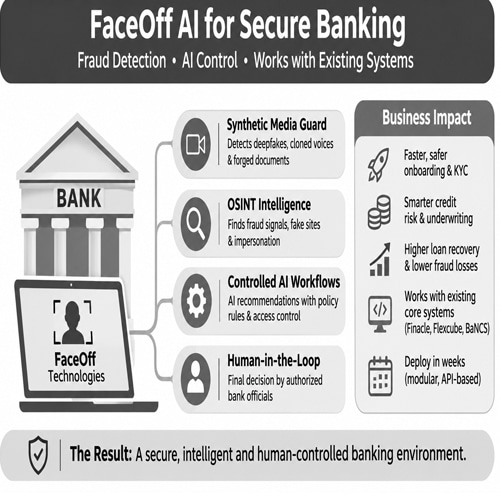
FaceOff Technologies proposes an AI-powered banking trust layer combining Synthetic Media Guard, OSINT intelligence, behavioral analytics and identity verification to strengthen financial security.
Its Synthetic Media Guard capabilities can examine suspicious videos, cloned voices, manipulated identity documents and synthetic identities, supporting safer onboarding, video KYC and transaction verification.
OSINT-based intelligence can identify suspicious public websites, phishing domains, impersonation campaigns and potential mule-account recruitment patterns, helping investigators detect emerging fraud networks.
Rather than replacing core banking software, FaceOff could connect through authorized APIs and middleware, enabling targeted AI capabilities while preserving existing transaction systems and operational workflows.
For faster deployment, banks could begin with narrowly scoped pilots covering identity verification, fraudulent loan applications or suspicious digital interactions, subject to integration and security approvals.
AI can also support backend operations by analyzing credit risks, prioritizing loan recovery, detecting transaction anomalies and identifying potentially fraudulent applications, improving operational efficiency.
However, automated credit scoring introduces risks of biased recommendations, manipulated inputs and unauthorized decisions. Explainable AI, policy enforcement and restricted permissions therefore become essential safeguards.
FaceOff's proposed governance framework would combine identity assurance, behavioral risk signals, human approval checkpoints and audit trails. AI recommends; authorized banking officials retain control over consequential decisions.
Ultimately, secure banking requires more than intelligent automation. By combining synthetic-media detection, OSINT-assisted investigation and human-controlled decision-making, FaceOff aims to help banks modernize responsibly, reduce fraud exposure and strengthen customer trust without destabilizing critical infrastructure.