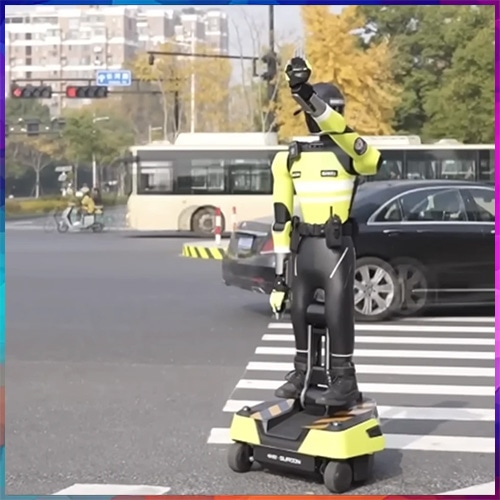
China has taken another significant step towards AI-powered policing by deploying humanoid robots to assist traffic officers during the 2026 Hangzhou Marathon, demonstrating how intelligent machines are moving beyond laboratories into public services.
The robots, named Hangxing No. 2, were developed by DEEP Robotics in collaboration with local traffic authorities. They patrolled four locations around Huanglong Sports Center during the November 1 event.
Equipped with artificial intelligence, advanced cameras and LiDAR sensors, the humanoids monitored intersections, identified traffic violations, guided pedestrians and delivered automated safety warnings while assisting human officers.
Standing 178 centimetres tall, the robots incorporate 275 TOPS of computing capability, enabling environmental perception, autonomous navigation and real-time monitoring. Their weather-resistant design supports operations in challenging outdoor conditions.
The marathon attracted 36,000 runners from more than 300,000 applicants, creating substantial crowd-management challenges. Deploying robots helped supplement conventional surveillance and reduce repetitive responsibilities for frontline personnel.
China's experiment represents a broader transition towards embodied AI, where intelligent systems interact directly with physical environments. Potential applications extend across airports, railway stations, industrial facilities, disaster response and urban security.
However, robotic policing introduces critical questions concerning surveillance, privacy, algorithmic accountability and operational reliability. Machines may assist in detecting violations, but enforcement decisions must remain subject to human oversight and appropriate safeguards.
The larger message is clear: the future of public safety will increasingly combine human intelligence with autonomous machines. China's marathon deployment offers a practical glimpse of that future, although widespread adoption will depend on demonstrated reliability, public trust, cybersecurity and responsible AI governance.