

Privacy Before AI

Artificial Intelligence has entered the privacy room, but most compliance frameworks are still trying to catch up. As enterprises accelerate AI adoption, boardrooms are increasingly asking a critical question: if consent is where privacy begins, what is really happening behind the systems, APIs, cloud environments, vendors, and AI workflows processing personal data?
This concern is now central to discussions around “Privacy After Hours: DPDP in the Age of AI.” Organizations are realizing that privacy is no longer limited to consent collection. AI systems today continuously process, infer, retain, and exchange massive volumes of sensitive information across interconnected digital ecosystems, creating new governance and compliance challenges.
Adding to the urgency, Gartner has warned that nearly 40% of enterprises could demote or shut down autonomous AI agents by 2027 due to governance failures discovered after deployment. According to Gartner, many organizations are applying identical governance controls to all AI agents regardless of their autonomy levels or access privileges. This creates two major risks — over-restricting low-risk AI systems, which slows innovation and encourages shadow AI adoption, or under-governing highly autonomous AI agents, exposing enterprises to operational, security, privacy, and compliance failures.
FaceOff Technologies believes these risks cannot be solved through traditional compliance playbooks alone. The company advocates a “Security and Privacy by Design” architecture where trust, governance, identity validation, behavioral intelligence, and data protection are embedded directly into enterprise AI infrastructure.
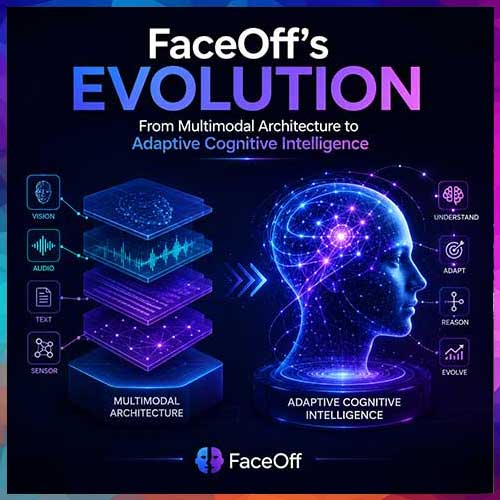
Its Adaptive Cognito Engine (ACE) is designed to secure AI-driven environments through multimodal identity verification, behavioral analytics, consent governance, deepfake detection, and AI forensic intelligence. Before AI systems take action, ACE continuously validates whether a user, digital identity, interaction, or behavioral pattern is authentic, manipulated, synthetic, or potentially fraudulent.
Unlike many competitors that focus only on AI detection or standalone cybersecurity tools, FaceOff combines privacy governance, identity security, behavioral trust, consent traceability, and AI security into a unified OEM platform. This reduces dependence on fragmented APIs and multiple vendors that often create operational silos, integration complexity, data exposure points, and compliance blind spots.
The platform also supports real-time trust scoring, immutable audit trails, continuous authentication, role-based access controls, and privacy-preserving workflows aligned with India’s DPDP framework and evolving global AI governance models. FaceOff is additionally building toward post-quantum security readiness to address future encryption and AI-driven cyber risks.
As AI agents increasingly automate banking operations, healthcare workflows, digital onboarding, insurance processing, and government services, enterprises will require more than compliance documentation. They will need trusted infrastructure capable of validating human authenticity, protecting consent integrity, governing AI behavior, and securing sensitive data at scale.
FaceOff Technologies positions itself not merely as a cybersecurity company, but as a trust infrastructure platform for the AI era — where privacy, governance, identity, and autonomous AI security converge into a single architecture designed for trusted intelligence.

See What’s Next in Tech With the Fast Forward Newsletter








Tweets From @varindiamag
Nothing to see here - yet
When they Tweet, their Tweets will show up here.