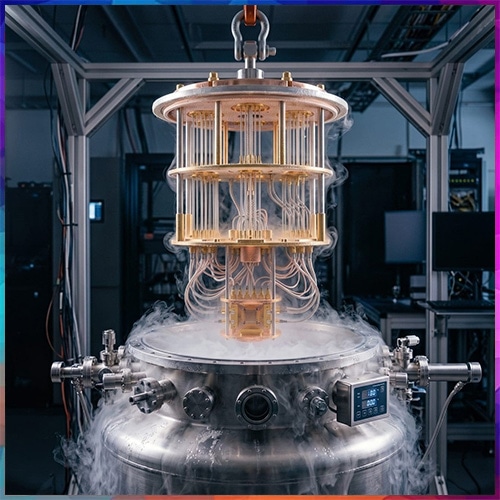
Quantum Machines is using AMD processors to bring classical computing closer to quantum operations. The company uses AMD EPYC CPUs and Versal adaptive SoCs to reduce latency and friction between quantum and classical computing.
The problem gets harder as systems grow. Quantum operations happen on nanosecond timescales, and qubits decohere rapidly, so control electronics must respond almost instantly.
Quantum Machines' answer is Hybrid Control. The approach unifies quantum and classical operations across software and hardware, and integrates classical computing directly into the quantum runtime.
At its core is the Pulse Processing Unit (PPU), a real-time processor that runs classical tasks such as pulse processing, active reset, calibration and feedback inside the quantum control loop. The PPUs are FPGA-based.
AMD's FPGA-based adaptive devices handle runtime pulse processing along with ultra-fast feedback, decoding and optimisation during active quantum operations, at the 100–400 nanosecond scale.
AMD Versal adaptive SoCs take on quantum error correction (QEC) decoding and customer-specific workflows.
AMD EPYC CPUs are the classical backbone for heavier processing outside the immediate quantum runtime, with very low round-trip latency.
Together, these chips form a single classical computing layer that covers timescales from nanoseconds to milliseconds. The platform supports trapped ions, neutral atoms and other qubit technologies.
Scaling is still the central challenge. Quantum Machines product manager Ethan Baratz put it simply: "Moore's Law does not apply to quantum computing."
Error correction is one of the biggest barriers to commercial-scale quantum computing, because it takes many physical qubits to form one reliable logical qubit. The company is scaling toward systems with tens of thousands of qubits.
With AMD, Quantum Machines can offer low-latency feedback, real-time control and scalable compute for error correction and next-generation quantum systems.