Barracuda researchers have uncovered a sophisticated phishing campaign using fake secure voicemail notifications delivered through HTML email attachments. The attack exploits routine business communications to deceive recipients into visiting attacker-controlled websites.
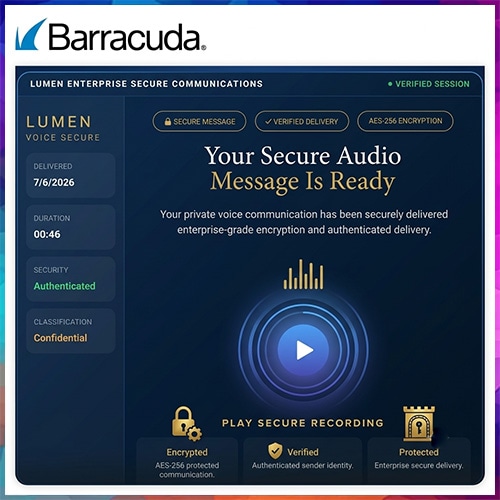
Unlike conventional phishing campaigns that rely on urgency, malicious scripts or software vulnerabilities, this attack uses simple HTML and CSS to create a convincing voicemail interface, featuring encryption badges, recording details and playback controls.
The entire webpage is embedded within a single hyperlink, turning every interaction into a potential security threat. Clicking the play button, graphics or even blank spaces redirects users to malicious infrastructure.
The campaign demonstrates how cybercriminals exploit interface design and human behaviour without deploying JavaScript, obfuscated code or sophisticated malware, potentially bypassing conventional security mechanisms.
Although researchers encountered an identity verification page, they did not observe subsequent credential harvesting during testing. However, the infrastructure could potentially facilitate credential theft, account compromise and unauthorised access to enterprise resources.
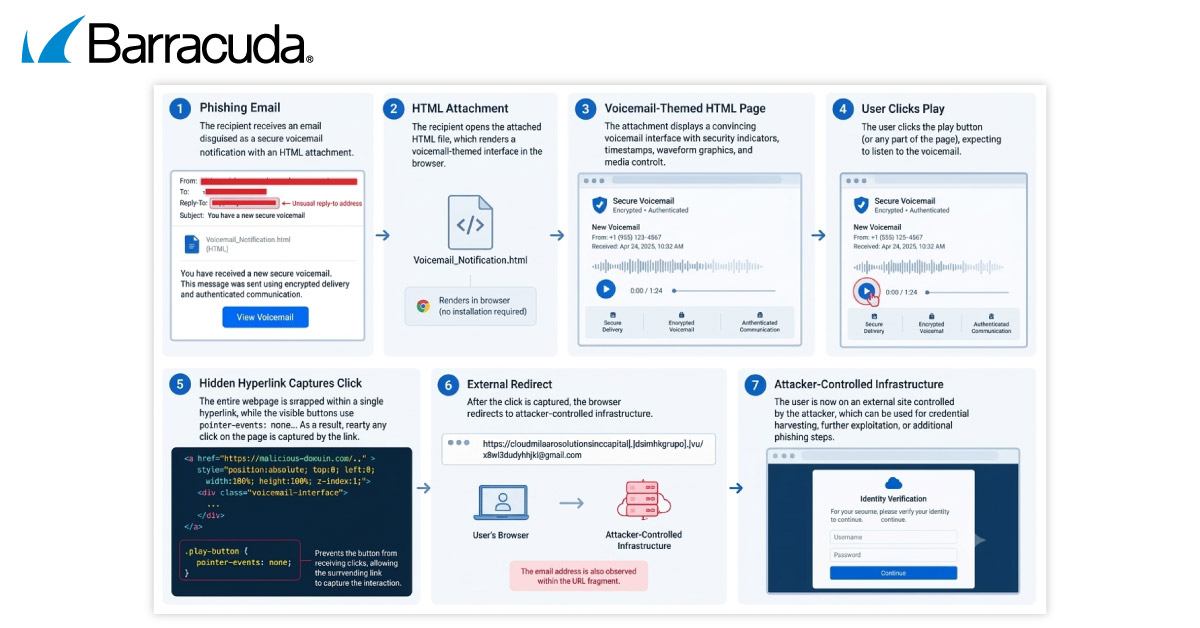
Barracuda emphasises that organisations must treat HTML attachments as active content, strengthen attachment inspection, analyse redirect chains and implement phishing-resistant authentication mechanisms, including passkeys and FIDO2 security keys.
The findings highlight an evolving cybersecurity challenge: even seemingly harmless digital interfaces can become powerful attack vectors, making continuous employee awareness, proactive threat detection and comprehensive email security increasingly critical.