Unlike the myth, Samsung invests heavily into its R&D activities of both the formats – Hardware and Software. Each product before getting manufactured in various facilities of Samsung across the world is visualized on the basis of customer’s feedback, a prototype hardware design takes place and then the software is created for making it responsive to the user’s needs. Even after that, a lot of customization and tailor-making takes place, as per the geography and climatic conditions. Finally, the product gets manufactured. For these activities, Samsung has 16 R&D centres across the globe. And, in India only, it has two – one in Bangalore and another in Noida.
Var Speak
Samsung India Software Centre, Noida contributes to Samsung Global Digital Media Technology : By -Samsung R&D Centre inauguration
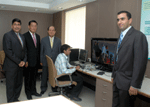
It was heartening to visit the state-of-the-art Samsung Software Centre located at Sector 59, Noida. It is “seeing to be believing”. Housed in a sprawling facility, nearly 8,000 sq. ft. or bigger than that, this software centre employs 440 developers. Like any other top-class R&D centre, the security persons frisked me, which is a routine activity for all incoming and outgoing people of the centre. It means they value the sensitivity of the data.
This facility is responsible for developing, integrating and customizing software for Samsung Global products in the Digital Media category. One might not believe it, but it is absolutely true. Dr. Vikram Vij , Vice-President, Samsung India Software Centre, says, “Initially, when Software R&D Centre started in 2002, it was in the same campus of Samsung Manufacturing, but we have shifted to this facility last year in the month of May. It was simply because we were not able to cope with our employees’ growth. There was dearth of space.” I remember it was a grand event and the new facility was inaugurated by Mr. H. B. Lee, Regional President & CEO, Samsung South West Asia, in the presence of Mr. Frank Oh, Director, SISC, Dr. Vikram Vij, Vice-President, Samsung India Software Centre and Mr. R. Zutshi, Deputy Managing Director, Samsung India, among others.
When the Software R&D Centre started in Noida, it had only 15 employees, but now it has touched 440 and, as per Dr. Vikram Vij, they will recruit another 90 people by the end of this year. This Software Centre at Noida is said to be one of the largest in the world, among other Samsung Software centres. Basically, the Noida facility caters to the global software requirements of the company in fairly broad areas, including Analogue and Digital TVs, CDT and LCD Monitors, Camcorders, DVD Players, MP3 Players, Client Server-based Displays, Notebook and Desktop PCs. According to Dr. Vikram, they are also working on projects in the areas of next-generation Digital TVs, next-generation Wireless Technology (WiFi, WiBro, etc.), Thin Clients, Home Network Solutions, which is soon to be launched in the Indian market, Digital Photo frames, etc. It is also developing software applications for Set-Top Boxes. Most of the common areas that the facility works in these projects is to make the User Interface more customer-friendly with different options of languages. They are also involved in developing applications like Gaming, Multimedia streaming, and making the products more intelligent and adaptable to the changing scenario of connectivity. Initially, the Samsung India Software Centre was merely supporting the projects for its headquarters, but later on this facility is involved in activities supporting the Global Digital Media solutions. Dr. Vikram Vij says, “Over the past five years, the role of Samsung India Software Centre has evolved from project support for our headquarters’ requirements to base IP development for key areas in TVs/Monitors/DVD Players and Camcorders. The mission of this Software Centre is to create and provide Software solutions for the global Digital Media Business.”
He maintains, “Samsung India Software Centre has played a leading role in developing software solutions for the Company’s Bordeaux Art and Mosel Blaque series of LCD televisions launched last year as well as the platform for the recently launched Samsung Full HD Series 5 and 6 LCD TVs as well as 3D Plasma TVs. Samsung India Software Centre has also worked on the software support for the just launched Bluray DVD players in the Indian market.”
As part of its successful projects, Samsung India Software Centre has developed software solutions for televisions supplied to various vertical industries, i.e. hospitality industry, airports and hospitals
It has created a niche in developing global software for many of the worldwide best-seller products such as YH-J70 and YH-J50, MagicTune Premium (Software Solution for Button Less Monitors), Natural Colour Expert for LED Blu Monitors, MagicRotation for Samsung Monitors, Hitch TV (Samsung’s First Slim Fit in India), Hitch Hotel TV (First Slim Fit Hotel TV), NEOS Interactive Hotel TV, Milano Hotel TV, Bordeaux Hotel TV, Green TV, Aravalli Hotel TV, etc.
Dr. Vij said, “Samsung India Software Centre has already applied for 50 patents so far and we expect to file another 25 patents by the end of this year.” In its efforts to broad- base its R&D activities, Samsung India has also started collaborating with select IITs.
As various projects are already going on for various geographies across the world, Dr. Vij said that there are basically five development teams, handling the entire projects. Though he did not reveal much, he broadly said that the team working for the monitors is the largest one. They are responsible for developing Firmware solutions for different types of display devices and the associated PC applications that help the users use their Display Devices creatively and conveniently. The group has full responsibility of developing Monitor Control Applications and also works in a plethora of other related technologies like Imaging, Networking, Display Quality Appraisal Systems, Photo Players and LED Monitors on all the platforms like Windows, Macintosh and Linux.
It is followed by the team for TV, the number of which is nearly 110 people. The TV Product Development Group has engineers working towards Global Software Development across all TV platforms. The Group works closely with HQ / Global subsidiaries towards Innovative Product Design and Development which includes Interactive Applications, Device Drivers, User Interface and various Protocol Developments. The team contributes from the concept Inception stage to the Final Product Mask spanning itself actively in the entire product life cycle. In pursuit of Samsung Global’s objective of “Innovation”, the team is actively into IP (Intellectual Property) and Patents.
Digital Media and the Computer Division is being taken care of by 80 people. The Digital Media Group develops new products and technologies in the digital media domain like Camcorders, Audio/Video players, DVD/HD-DVD/Bluray DVD Players and Recorders, DTV, etc. Continuous evolution of state-of-the-art technologies for improvement of existing product quality and features and new products, as well as accumulating Intellectual Property in the form of patents is major motivation of this group to meet Samsung Global’s objective of “Innovation”.
A focussed and dedicated team of engineers in this group is also involved in the development of explicit tools specific to Samsung’s product development environment as well as automated product design and testing environment. These exclusively specialized tools reduce risks of human errors and works as the foundation stone for timely delivering superior quality embedded software products by speeding up and streamlining the large, commercial scale software development and testing processes. The group is working on various 2D/3D Graphics Engines, i.e. Audio Video Codec, Image Codec, Digital/optical Storage Media, Digital Streaming Media based on standards such as JPEG, JPEG2000, H.264, MPEG-2, MPEG-4, WMV 9.0, DivX, AAC, MP3, AC3, OGG, WMA, MTP, PTP, etc.
Apart from that, there is a team for Set-Top Boxes and Thin Clients, where the developer team works on various options on User interface, third interface, middle wire, etc. There are other two divisions, including Software Quality Assurance and Software Process Improvement. Samsung India Software Centre is also involved in developing platforms for MP3 players and navigation devices like GPS and other applications.
Finally… In addition to its focus on the software R&D, Samsung has a Hardware R&D Centre in its manufacturing facility in Noida. This was also set up in the year 2000 and is involved in developing customizing products for the Indian market as well as for the SAARC markets. Hopefully, the combined efforts of Hardware R&D and Software R&D Centres will take the Brand Samsung to a different league and answer some of the queries that the consumers might have.
Join the Conversation
Loading comments…
Share your thoughts on this story. Comments are moderated before they appear.
Be respectful. Comments are reviewed before publication, and spam or abusive language will be removed.