Hosting Chinese AI models on Indian infrastructure raises questions about data sovereignty, technology dependence and national AI security.
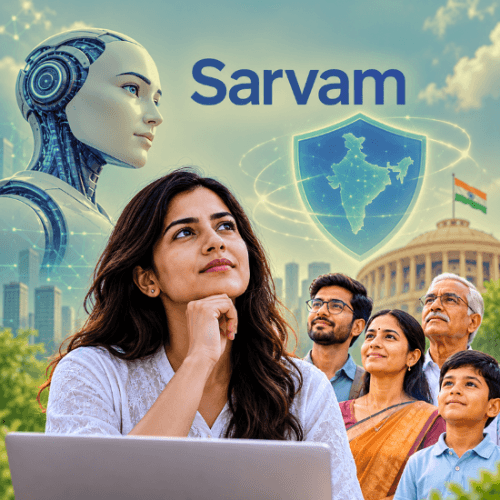
India's ambition to build sovereign artificial intelligence rests on three fundamental pillars: data sovereignty, technological independence and national security. The reported decision by Indian AI startup Sarvam to host Chinese-origin AI models on domestic infrastructure raises important questions about what genuinely constitutes sovereign AI.
Hosting AI models in India does not automatically make them sovereign. Data residency is only one component of sovereignty. True technological independence also requires control over model architecture, training pipelines, software dependencies, security updates and operational governance.
The concern is particularly significant when foreign-developed models are deployed in sensitive environments such as banking, government, defence, telecommunications and critical infrastructure.
On November 16, 2026, Sarvam launched Token Factory, offering Chinese-developed models from DeepSeek, Moonshot AI, Z.ai and Alibaba alongside Google's Gemma and Sarvam's own models. This is a significant commercial expansion, but it also creates a need for transparent model-level risk assessments.
The risks extend beyond where servers are located. Enterprises must examine model provenance, hidden dependencies, software supply chains, potential vulnerabilities, prompt injection, data leakage and the possibility of malicious or unexpected model behaviour.
However, there is currently no verified evidence in the cited reporting that Sarvam is transferring customer data to China or that its hosted Chinese models contain backdoors. Locally deployed open-weight models can operate without transmitting customer prompts to their original developers, provided the infrastructure and dependencies are appropriately controlled.
Another concern involves public investment. Sarvam has received government-backed support for indigenous foundation-model development under the IndiaAI Mission. This raises a legitimate question: how should publicly supported sovereign AI initiatives balance commercial opportunities with original Indian research?
Sarvam's co-founder Vivek Raghavan recently warned against excessive dependence on foreign AI technologies, describing the danger of India exporting data while importing intelligence. His remarks make the distinction between indigenous model development and foreign-model hosting particularly relevant.
At the same time, Sarvam has developed Indian foundation models and is collaborating with C-DAC on sovereign AI infrastructure. Hosting foreign models does not negate these achievements, nor does it automatically compromise security.
Five Critical Risks Enterprises Must Evaluate
|
Risk area |
Questions enterprises should ask |
|---|---|
|
Data sovereignty |
Are prompts, outputs, logs, backups and encryption keys retained exclusively under approved Indian control? |
|
Model provenance |
Can the provider verify model weights, dependencies, licensing and update integrity? |
|
Cybersecurity |
Have models undergone independent adversarial testing, red-teaming and vulnerability assessments? |
|
Regulatory compliance |
Are deployments aligned with applicable DPDP obligations and sector-specific requirements? |
|
Vendor dependency |
Can customers independently audit, replace or migrate models without operational disruption? |
For banks, government agencies and critical infrastructure operators, the prudent approach is to require independent security certification, contractual data protections, model transparency, isolation controls and continuous monitoring before deploying any third-party foundation model.
The central question for Sarvam is not whether it should host Chinese models, but whether it can demonstrate that every model offered through its sovereign AI platform remains secure, auditable and operationally under Indian control.
India must distinguish between three different achievements: AI hosted in India, AI developed in India, and AI genuinely controlled by India.
The future of sovereign AI should be measured by verifiable technological independence, not merely the geographical location of servers. Until these safeguards are independently demonstrated, enterprises handling sensitive information should approach such deployments with heightened due diligence.
Sovereign AI must mean sovereign control, sovereign accountability and sovereign trust—not simply foreign intelligence running on Indian infrastructure.