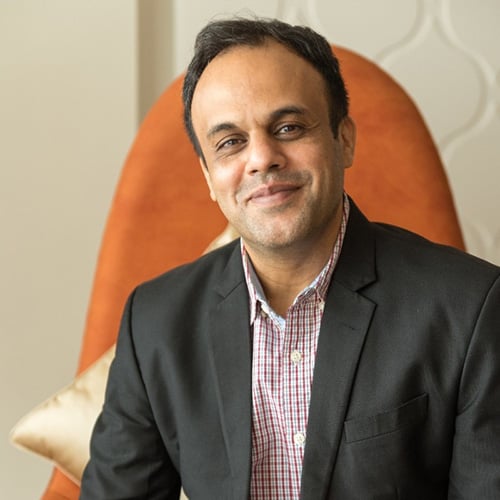
ROHAN SHETH
HEAD - COLOCATION, DATA CENTER BUILD AND GLOBAL EXPANSION, YOTTA DATA SERVICES
“AI workloads are fundamentally reshaping data centre design, with GPU clusters pushing rack densities from the traditional 6–10 kW range to 40–50 kW and beyond. At Yotta, we have redesigned our campuses to be AI-native from day one. Our hyperscale facilities in Navi Mumbai and Greater Noida are purpose-built for high-density GPU environments, featuring direct liquid-to-chip cooling, rear-door heat exchangers, and contained airflow to efficiently manage heat. The electrical backbone has been strengthened with captive power, high-capacity transformers, and modular distribution to scale rapidly as GPU demand grows. Networking is equally critical, as AI training requires ultra-low latency and high throughput. High-speed fiber and optimized spine-leaf architectures ensure future- ready, sovereign infrastructure that can scale reliably to thousands of GPUs without compromising efficiency or uptime.
India’s digital future will be distributed, not centralized, and edge, hybrid cloud, and AI-optimized infrastructure are central to this vision. As AI, 5G, fintech, and manufacturing workloads grow, latency becomes critical, making edge infrastructure essential to process data closer to where it is generated, while also meeting regulatory and sovereignty requirements. Enterprises are increasingly moving toward hybrid cloud models, seeking the agility of public cloud alongside the control and compliance of private infrastructure. Through our hyperscale campuses and AI- HPC cloud platforms, customers can seamlessly shift between colocation, private cloud, and GPU-as-a-Service depending on workload needs. AI-optimized infrastructure sits at the core: India needs domestic, scalable compute capacity to power its AI ambitions, and our focus is on building that backbone locally so growth remains sovereign, secure, and sustainable.
Balancing rapid capacity expansion with sustainability is critical, as AI significantly increases power consumption. Our Greater Noida campus operates on 100% renewable energy at current load, and Navi Mumbai is around 80%, with a clear roadmap toward full green alignment. Optimized cooling systems-including adiabatic chillers, direct-to-chip liquid cooling, closed-loop systems, and efficient airflow management—deliver a PUE of <1.4 on air-cooled CPU workloads and <1.2 on liquid-cooled GPU workloads, reducing both energy and water usage while maintaining optimal operating temperatures. Over the next three years, competitiveness will be defined by next-generation GPUs, large-scale liquid cooling, AI-led operations with predictive maintenance, automated orchestration, real-time energy optimization, and modular builds beyond metro cities. Ultimately, success will not be measured by megawatts alone, but by smarter, greener, sovereign infrastructure that scales with India’s AI ambitions.”