At National Space Day celebrations in Ahmedabad, the Union Minister backed wider private participation in the sector, while ISRO outlined India’s expanding startup ecosystem and ambitious plans for future lunar, planetary and human-spaceflight missions.
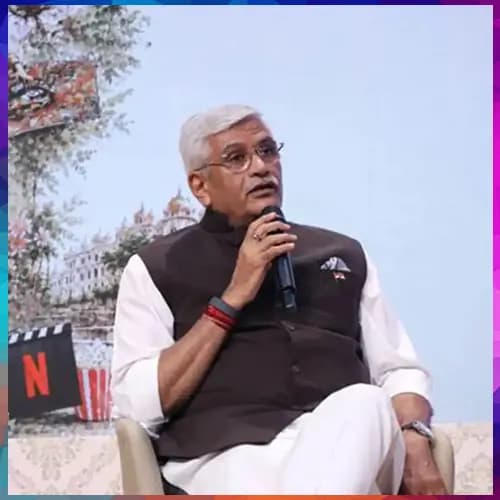
The convergence of advanced technologies such as space systems, artificial intelligence (AI), quantum technologies, robotics, semiconductors and high-performance computing will increasingly determine a nation’s economic strength and geopolitical position, Union Minister Gajendra Singh Shekhawat said on Sunday (August 23).
Speaking at the 3rd National Space Day celebrations in Ahmedabad, Shekhawat said technological disciplines that have traditionally developed independently are likely to become increasingly interconnected. Their integration, he said, will influence not only technological progress but also the global economy and the way societies function.
The Union Culture and Tourism Minister was addressing an event organised by the Space Applications Centre (SAC), Indian Space Research Organisation (ISRO) and the Department of Science and Technology.
Technology convergence seen as strategic imperative
Shekhawat said the world is entering an era in which advances in multiple technology domains will collectively reshape human life. He argued that countries capable of bringing these capabilities together would be better positioned to secure technological and economic leadership.
According to the minister, future competitiveness will increasingly depend on the ability to integrate emerging technologies rather than developing them in isolation. He also referred to the contribution of Indian space pioneer Vikram Sarabhai, describing his vision as an important foundation for the country’s space and technology journey.
Shekhawat also addressed concerns surrounding the growing participation of private companies and startups in India’s space sector. He said opening the sector to non-government players should not be viewed as diminishing the significance of institutions such as ISRO.
The creation of the Indian National Space Promotion and Authorisation Centre (IN-SPACe), he said, provided an institutional framework to enable, authorise and support private participation in the sector.
Private sector expansion to broaden space ecosystem
Shekhawat said private participation should instead be seen as a means of expanding the capabilities and reach of India’s established space institutions. He described the shift as the “democratisation of space opportunities”, with industry, startups, academia and investors becoming part of a broader ecosystem.
He said India has consequently moved from an organisation-led approach towards an ecosystem-driven space sector. At the same time, he flagged emerging challenges including space debris, cybersecurity, data protection and the responsible deployment of AI.
The minister also warned that future geopolitical competition could increasingly revolve around attempts to disrupt critical technological capabilities, making technological resilience a strategic priority for India.
ISRO Chairman V. Narayanan, Gujarat Science and Technology Minister Arjun Modhwadia and IN-SPACe Chairman Pawan Kumar Goenka attended the event.
Narayanan recalled August 23, 2023, when Chandrayaan-3 achieved a successful soft landing near the Moon’s south pole, calling it a landmark moment for India. He credited the government for observing the date as National Space Day.
He also highlighted the growth of India’s private space ecosystem following sectoral reforms introduced in 2020. According to him, the country now has around 440 space startups.
Narayanan said major programmes on the roadmap include Gaganyaan, Chandrayaan-4 and Chandrayaan-5, along with planned Mars and Venus missions. India also aims to deploy more than 300 satellites over the next six to seven years through government and startup participation and establish an Indian Space Station by 2035.