

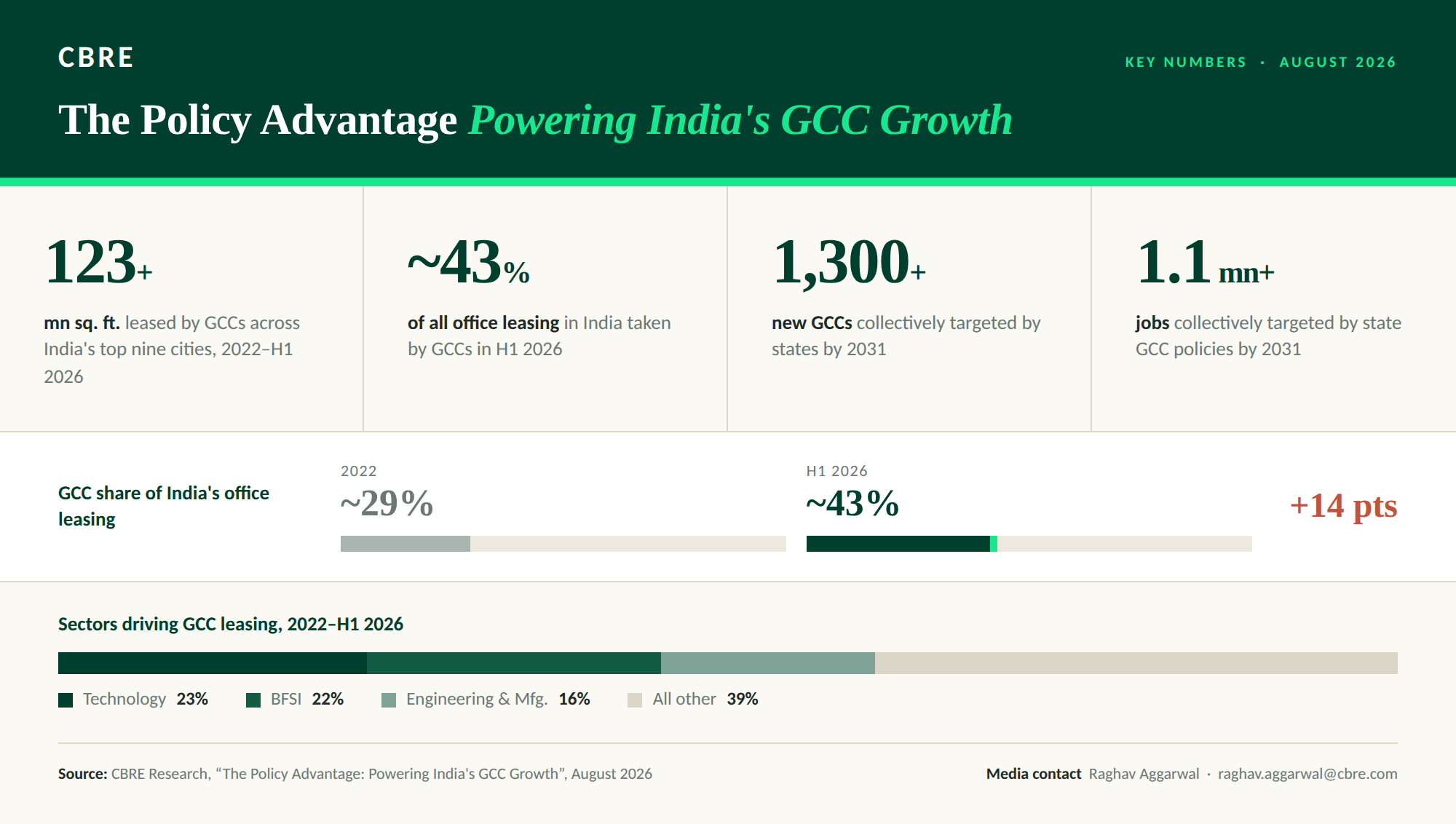
Dedicated policies across Indian states are driving GCC expansion, with governments targeting more than 1,300 new centres and 1.1 million jobs while growing demand from these centres reshapes India’s commercial office market.
Indian states are stepping up efforts to attract Global Capability Centres (GCCs) through dedicated policies and incentives, with more than 1,300 new centres and over 1.1 million jobs targeted by 2031. According to CBRE South Asia’s report, The Policy Advantage: Powering India’s GCC Growth, Karnataka, Maharashtra, Haryana, Uttar Pradesh, Gujarat, Rajasthan, Madhya Pradesh and Andhra Pradesh have introduced dedicated GCC policies.
Tamil Nadu has announced specialised incentives for GCC employees, while Telangana and Delhi have adopted policy frameworks to support the sector. Kerala is also among the states that have proposed a draft GCC policy.
The policy push comes as GCCs continue to expand their office footprint across India. CBRE said GCCs leased more than 123 million sq. ft. of office space across the country’s top nine cities between 2022 and H1 2026. Their share of total office leasing increased from around 29% in 2022 to approximately 43% in H1 2026.
States step up GCC targets
CBRE’s assessment shows that states with GCC-focused policy frameworks are collectively targeting around 1,380 new GCCs and approximately 1.18 million additional jobs between 2029 and 2031. Karnataka has set a target of around 500 new GCCs and 3.5 lakh jobs by 2029, while Maharashtra is targeting around 200 centres and four lakh jobs by 2030.
Rajasthan is targeting more than 200 GCCs and 1.5 lakh jobs, while Gujarat aims to attract more than 250 centres and over 50,000 additional jobs. Kerala’s draft policy targets around 80 GCCs and 1.6 lakh jobs, while Haryana and Madhya Pradesh are also pursuing new centres and employment opportunities.
“The speed at which state governments have moved to formalise dedicated GCC policies is unprecedented in India’s commercial real estate landscape,” said Anshuman Magazine, Chairman & CEO - India, South-East Asia, Middle East & Africa, CBRE. “This reflects a broader recognition that these centres are no longer a peripheral component of India’s services economy, but a central pillar that states are actively competing to host, through targeted incentives, faster approvals and long-term infrastructure commitments.”
Technology accounted for 23% of GCC leasing during the period, followed by BFSI at 22% and Engineering & Manufacturing at 16%. Together, these three sectors contributed more than 60% of the leasing activity, pointing to a broader diversification of GCC operations in India.
Bengaluru leads national GCC leasing
Bengaluru remained the largest GCC leasing market, recording more than 51 million sq. ft. between 2022 and H1 2026. This represented approximately 42% of India’s total GCC leasing during the period.
Hyderabad followed with more than 24 million sq. ft., accounting for around 20% of the national total. Chennai, Delhi-NCR and Pune each recorded more than 13 million sq. ft., contributing roughly 10-11% each. Mumbai accounted for nearly 5 million sq. ft., or around 4% of national GCC leasing, but remained a preferred market for BFSI occupiers.
“State policy frameworks are increasingly translating into real, on-ground real estate demand. As more states introduce dedicated capex support, payroll incentives and faster regulatory clearances, we are seeing this reflected directly in leasing activity. With states continuing to compete on execution speed and infrastructure readiness rather than incentives alone, we expect this policy-led momentum to further strengthen GCC leasing activity across both established and emerging markets in India,” said Ram Chandnani, Managing Director, Leasing Services, India, CBRE.
The findings indicate that GCC policies are increasingly becoming a key component of state-level investment strategies, while the expansion of these centres continues to generate demand across India’s major and emerging commercial real estate markets.