“Pleased at the prince’s devotion to the peasant girl, the witch hurled her wand and the deceased girl opened her eyes in her funeral bed at far-off lands.””– you might have had an earful of this from your grandmother. But the rapid strides made by IT and medical technology has made it feasible for a remote patient to realize the seasoned care of an experienced but invisible medical hand thousands of miles away. This wonderful convergence of IT and medicine what we call telemedicine, is all set to revolutionize the way healthcare services has been viewed
at. Simultaneously, it has also unearthed a mine of opportunities for the vendors and affiliated actors. VARIndia attempts a cautious weave of its permutations and combinations.
Tele-Pills for Screaming Ills
Our population continues to increase without the commensurate increase in the funds available for healthcare. While India is raring to fast transform it into an economic powerhouse, its teeming millions in the villages are yet to receive a standard healthcare service. Telemedicine can help meet the increasing demand for universal access to high quality medicine, irrespective of geography.
“The US Food and Drug Administration defines telemedicine as the delivery and provision of healthcare and consultative services to individual patients and the transmission of information related to care, over distance, using telecommunications technologies. Telemedicine incorporates direct clinical, preventive, diagnostic, and therapeutic services and treatment; consultative and follow-up services; remote monitoring of patients; rehabilitative services; and patient education.”
Healthcare providers are faced with scientific, social and economic challenges in the delivery of healthcare services. Telemedicine can meet many of these challenges in an organized and cost-efficient manner through a better exchange of information, medical expertise and access to quality care.
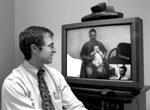
It is now possible to transmit text, sound, images and video from one location to another. Telemedicine interaction involves two- way live audio and video visits between patient and medical professionals. In this era of information superhighway, this can now be easily done through computers, CD-ROMs and the Internet.
Telemedicine can significantly reduce the time and costs of the patient transportation, Permitting physicians doing clinical research to be linked together despite geographical separation, charting patient records and diagnostic images.
As India walks the Tele-medical Ramp
The Government, in collaboration with the IT Ministry, is serious about a large-scale execution of e-care in India. It has already set up telemedicine facility at the district hospitals in the North Eastern regions of the country so that expert medical advice can be provided from a specialty hospital like AIIMS at Delhi. Apollo Hospitals and Shankara Netralaya in the private sector have been at the forefront in this field. The Escorts Heart Institute and Research Centre, New Delhi has an active tele-cardiology programme.
Tele-pathology is being practised on an experimental basis in www.pathoindia.com and www.telepathologyindia.com.
In Gujarat, a skeletal telemedicine service was used in the earthquake of the 26th January, 2001. The Indian Defence Service has also started telemedicine in the desert areas of Kutch. A WHO project on Tele-oncology using five Regional Cancer Centres across the country has also geared up to look into the feasibility of remote oncological advice from more advanced centres. One also hears of a mega telemedicine project to offer nationwide healthcare, which has been floated by Techno Telemedicine and Tele-healthcare, a Delhi-based company.
Handicaps All the Way
Specific ethical problems, which are likely to come up in the practice of telemedicine, include lack of doctor–patient contact, leading to erroneous decisions because of inadequate data and lack of the comforting role of the physician’s presence. Confidentiality and privacy of patient data and use of data for research without informed consent is another problem. The question of “what if something were to happen” needs to be addressed. If a doctor residing in India is giving opinion for patients residing in some other country, whose laws and which country’s judiciary would decide this situation? The problems of misdiagnosis, liability and malpractice are uppermost in the minds of policy-makers in the field of telemedicine. Despite these issues, telemedicine and tele-health have the potential to transform the world of healthcare.
Summer Days for Vendors
Apart from the multiple wonders that telemedicine bestows on India’s underprivileged, if the mega telemedicine project that the government, in collaboration with the Ministry of Information Technology, takes off, it will open up the floodgates of opportunities for various actors. Digitalising the odd PHCs, medical colleges and private hospitals and to bring them under a common network will require a colossal amount of optical fibre laying, satellite transponders, PCs, CD-ROMs. Lakhs of kilometres of optical fibre laying will be a multi-billion dollar business giving a shot in the arm to this sector. 2007 has been declared as the Year of the Broadband by the Government. Telemedicine will see this worth declared. The robust Indian PC hardware market would experience a somersault while feeding the gargantuan need of the programme. The market players like LG, Samsung, HCL, or the domestic assemblers would never get a better business opportunity than this.
Besides the software or hardware IT vendors, India’s telecom sector, the second fastest-growing telecom market in the world is gearing up to grab the opportunity. Two-way video-audio traffic is the crux of the programme and will utilize services of telephony on a grand scale. With the entry of the largest mobile telephony player Vodafone into the Indian market and well-entrenched players like Reliance and Bharti all set to take the battle to the optimum point, full-scale telemedicine project implementation definitely awaits some fireworks in this market segment.
In a nutshell
As India rapidly industrializes and the gospel of Mammon fast becomes the pan-Indian religion, the healthcare statistics present altogether a different picture. In such a scenario, telemedicine inspires a glint of hope for the realization of “Healthcare for All”. Telemedicine has revolutionized the delivery of healthcare services throughout the world. And, it is on the verge of becoming as common as the use of the telephone. It is not merely a privilege for those who selectively opt for it, but a light of hope for those who drastically need it. The vision that within the next ten years e-care will be a standard part of everyday healthcare practice is a very practical vision. Are we getting geared up for it? Do the government, the medical community and, of course, most importantly, the vendors listen?
Telemedicine: Digital Panacea for Distant Ills