
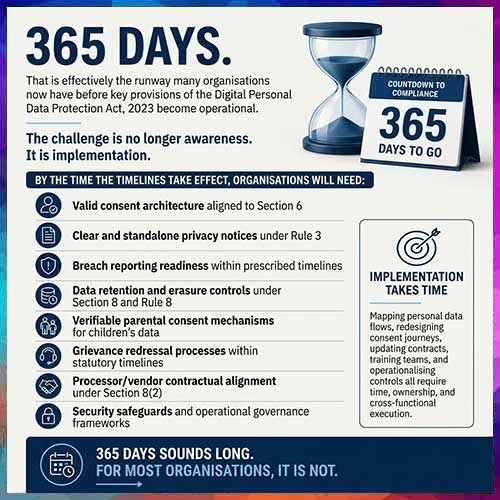
1. The Boardroom Delusion
Walk into the boardroom of any major Non-Banking Financial Company (NBFC), private bank, public sector bank, insurer, AMC, or fintech in India today, and you will witness the same dangerous intellectual exercise. Risk committees debate the precise legal definitions of Data Fiduciary, Data Principal, Significant Data Fiduciary, and Consent Manager. Compliance officers are engaged with Big 4 firms, paying exorbitant hourly rates to rewrite privacy policies and Terms of Service agreements. PowerPoint decks pile up. Steering committees multiply.
While these legal manoeuvres are necessary, they have created an operational delusion. The harsh, unfiltered engineering truth is this:
|
You cannot protect data you cannot see. You cannot delete data you cannot find. You cannot prove compliance for data you cannot map. While the C-suite reviews beautifully formatted compliance roadmaps, terabytes of unstructured customer Personally Identifiable Information (PII) are sitting abandoned across the enterprise. Loan origination documents stored as PDFs on shared drives. Aadhaar scans attached to support tickets. CIBIL reports cached in browser session folders. KYC video files multiplying in unsecured AWS S3 buckets. Excel sheets containing 50,000 customer records emailed between branch managers. PII exhaust from chatbot transcripts, written by employees into ChatGPT, surfacing later in third-party training data. Every one of these is a Data Principal record. Every one of them is a Data Fiduciary obligation. And every one of them, under the DPDPA 2023 Section 33 penalty matrix, is a contributor to the ₹250 Crore exposure your board has not yet quantified. The ₹250 Crore RealityThe Data Protection Board of India will not care how perfectly drafted your privacy policy is if a ransomware syndicate dumps your unmapped customer data onto a dark-web leak site. Section 33 of the DPDPA prescribes a maximum penalty of ₹250 Crore per instance for failure to take "reasonable security safeguards" (Section 8(5)). Additional penalties of ₹200 Crore apply for breach of Significant Data Fiduciary obligations, ₹150 Crore for breach of child-data provisions (Section 9), and ₹50 Crore for failure to notify breaches to the Board within the prescribed window. The penalties stack. The exposure compounds. Compliance is no longer a legal checkbox — it is a critical engineering mandate. The boardroom delusion has a cost, and that cost is measured in the gap between what your General Counsel has documented and what your actual file systems contain. Closing that gap is not a legal exercise. It is a discovery, classification, and remediation exercise that requires industrial-grade engineering — executed under a 365-day operating cadence. |
||||||||||||||||||||||||
|
2. What the Act Actually Demands — In Engineering Terms Strip away the legal language and the DPDPA imposes seven concrete engineering obligations on every regulated organisation. If you cannot demonstrate operational capability against each one — with evidence, telemetry, and audit logs — you are not compliant. You are exposed.
Each obligation maps to a specific engineering control. Each engineering control requires telemetry, audit logs, and operational evidence. And every single one of them depends on a foundational capability your organisation almost certainly does not yet possess at scale: knowing where your data is, what it contains, and who has access to it. The Rules Notification Has Changed the EquationThe notification of the Digital Personal Data Protection Rules, 2025, accelerated the practical compliance equation in three material ways. First, the Rules clarified the operational mechanics of consent — including the role of registered Consent Managers, the technical standards for consent capture, and the verification mechanisms required for child-data processing under Section 9. Organisations that have been treating consent as a tick-box checkbox on a registration form now have a precise technical specification to meet, and a registered third-party ecosystem to integrate with. Second, the Rules clarified breach notification mechanics. The 72-hour window to notify the Data Protection Board is now operational, not aspirational. The notification format, the categories of information required, the threshold definitions for what constitutes a notifiable breach — all of this has moved from "to be prescribed" to "you must do this now." Organisations without a tested breach notification playbook are running a real, present, regulatory exposure. Third, the Significant Data Fiduciary criteria are now more discoverable. The Central Government's framework for designating SDFs takes into account the volume of personal data processed, the sensitivity of that data, the risk to data principals, and the impact on India's sovereignty and integrity. Every major Indian bank, every large NBFC, every insurance carrier, every major fintech, and every healthcare aggregator should assume that an SDF designation is a matter of when, not if. The obligations that follow — mandatory DPO, independent audits, Data Protection Impact Assessments for high-risk processing — are operationally heavy and cannot be retrofitted in 90 days. The economic stakes have also been crystallised. Beyond the headline ₹250 Crore penalty for security safeguard failures, the cumulative exposure across stacked penalties (breach notification failure, child-data violation, SDF non-compliance, general non-compliance) can reach ₹500 Crore or more per material incident. Add the reputational damage, the customer churn, the cost of remediation under duress, and the regulatory scrutiny across RBI/SEBI/IRDAI that automatically follows a major DPDPA event — and the all-in cost of a single significant breach to a mid-tier BFSI organisation can run to ₹1,000–1,500 Crore. That is not a compliance cost. That is an existential cost. |
||||||||||||||||||||||||
3. The Anatomy of BFSI Data SprawlThe financial sector suffers from a uniquely punishing pathology — the Data Visibility Paradox. Data is hoarded at an exponential rate (regulatory retention requirements drive this), yet visibility into that data decreases proportionally with every passing quarter. Understanding your real DPDPA risk requires understanding the four tiers of data sprawl.
Consider a typical mid-sized Indian NBFC with 8 million customers. The core banking system holds the structured records. But a recent iManEdge engagement found that for every 1 GB of structured PII in core banking, there were 26 GB of unstructured PII scattered across email systems, shared drives, ticketing platforms, and Slack archives. Shadow data added another 14 GB. AI exhaust — discovered after auditing employee LLM usage logs — added a further 3 GB of pasted customer data leaked outside the enterprise. Under DPDPA, the NBFC is the Data Fiduciary for all of it. Not just the structured 2% they currently manage. |
||||||||||||||||||||||||
4. The Death of Legacy Compliance ToolingThe era of relying on traditional Data Loss Prevention (DLP) and Cloud Access Security Brokers (CASB) to satisfy regulators is over. These tools were built for a perimeter-based world that no longer exists. Indian BFSI organisations have spent crores deploying them over the last decade, and they have a place in the stack — but not at the apex of DPDPA strategy. Legacy DLP relies on manual user classification. It expects an overworked loan officer at a regional branch to meticulously tag every document as "Confidential." It operates on rigid regular expressions (RegEx) that generate thousands of false positives, inducing severe alert fatigue — to the point where SOC teams begin suppressing alerts entirely. Furthermore, these tools only trigger when data is in motion (someone trying to email a file or upload to Dropbox). They do absolutely nothing about the petabytes of toxic data sitting idle in misconfigured S3 buckets, OneDrive folders, abandoned test environments, and orphaned snapshots. CASB has the same architectural flaw, just in a different envelope. It sees what flows through the cloud proxy. It does not see what was already there, or what arrived via paths it does not inspect. It cannot answer the regulator's question: "Where, exactly, are all the Aadhaar numbers your organisation holds?" The Test the DPB Will ApplyWhen the Data Protection Board investigates a breach or a Data Principal complaint, the question they will ask is brutal in its simplicity: "Produce, within 72 hours, a complete map of where this individual's personal data is currently held across your environment." Organisations relying on DLP and CASB alone will spend weeks producing a partial answer, full of caveats. Organisations with modern Data Security Posture Management (DSPM) will produce it in minutes, with cryptographic evidence of completeness. |
||||||||||||||||||||||||
5. The Strategic Paradigm Shift — Data Security Posture ManagementTo operationalise DPDPA readiness, the architecture must evolve to Data Security Posture Management (DSPM). iManEdge architects platforms like Citadel DSPM precisely to solve the problem legacy tools ignore: autonomous, agentless discovery and mapping of all data — structured, unstructured, shadow, and AI exhaust — across every repository the organisation owns or operates. Modern DSPM does not wait for a user to label a file. It utilises ML-driven heuristics, entity-recognition models trained on Indian PII patterns (Aadhaar, PAN, Voter ID, driving licence formats), and graph-based access analysis to continuously crawl across on-premise datacentres, sovereign clouds, hyperscaler regions, SaaS applications, and even endpoint-attached storage. It understands context — differentiating between a random 12-digit string and a valid Aadhaar number tied to a specific financial ledger record. It identifies toxic combinations: a single file containing name + Aadhaar + bank account + mobile number is a different risk class entirely from a file with just a name.
The architectural distinction matters. Legacy DLP and CASB are point solutions for narrow problems. DSPM is the foundation layer beneath an entire compliance posture. It does not replace your existing tools — it makes them effective by giving them something true to act upon. |
||||||||||||||||||||||||
6. The Sovereign Cloud ImperativeA critical corporate myth deserves direct confrontation — the "Default Secure" illusion of hyperscalers. Board members and CIOs frequently assume that migrating to AWS, Microsoft Azure, or Google Cloud Platform automatically resolves security and compliance burdens. This is a profound misreading of the Shared Responsibility Model. The cloud provider secures the hardware, the underlying virtualisation layer, and the physical infrastructure. The organisation remains entirely responsible for securing the data, the identity access configurations, the network rules, the application layer, the encryption keys, and — critically for DPDPA — the data residency posture. The hyperscaler does not know whether a particular S3 bucket contains Aadhaar numbers. The hyperscaler does not enforce RBI data localisation. The hyperscaler does not produce evidence for the Data Protection Board. Compounding this, the reflexive engagement of large international consulting firms to audit these environments often results in bloated, overpriced, template-driven compliance reports that look impressive at the steering committee but fail under real-world distress. The reports are copy-pasted across clients. The auditors do not have practitioner depth. When a Data Principal complaint lands at the DPB, the report does not help. Indian financial institutions must architect with a sovereign mentality. This means three concrete commitments: â— Sovereign deployment: Critical DPDPA-relevant infrastructure — DSPM, key management, identity, audit logs — runs in Indian jurisdictions on Indian-controlled infrastructure. Yotta, CtrlS, ESDS, NxtGen, or appropriately ring-fenced regions of hyperscalers under the IndiaAI sovereign framework. â— Sovereign tooling: Platforms architected and built in India, by practitioners who understand the Indian regulatory context (DPDPA, RBI, SEBI, IRDAI, CERT-In) at first-principles depth — not as a translation of an American or European playbook. â— Sovereign accountability: Partners who carry skin in the game, who are reachable, who escalate to a named practitioner in 30 minutes — not a hierarchical foreign organisation where Indian operations are managed as a delivery centre rather than as a strategic relationship. Deploying localised, on-premise, or strictly sovereign-cloud DSPM solutions ensures Indian financial data remains unequivocally within Indian jurisdictions, fully compliant with RBI Cyber Security Framework directives, SEBI System Audit Guidelines, IRDAI Information & Cyber Security Guidelines, and CERT-In Direction (28.04.2022) reporting obligations — all while satisfying the DPDPA's overarching framework. |
||||||||||||||||||||||||
7. The 365-Day Operating CadenceOne year is enough — if you start tomorrow and execute with discipline. The iManEdge sovereign compliance methodology breaks the runway into five operational phases, each with specific deliverables, exit criteria, and board-level checkpoints. PHASE 1 · T-365 to T-275 · DISCOVERQuarter 1 · 90 days · Establish the truth of your data estate â— Week 1–4: Deploy agentless DSPM across all known repositories. Cloud (AWS/Azure/GCP), on-premise file shares, Microsoft 365, Google Workspace, Slack, Teams, SharePoint, ServiceNow, Jira, Confluence. â— Week 5–8: Run first complete discovery sweep. Expect surprise factor: most BFSI engagements surface 8–12x more PII than the organisation believed it held. â— Week 9–12: Establish baseline metrics: total PII volume by category, by repository, by jurisdiction. First exception report to the Audit Committee. Exit criteria: A signed baseline document. Total PII inventory. Top 20 toxic exposures identified. PHASE 2 · T-274 to T-185 · CLASSIFYQuarter 2 · 90 days · Separate signal from noise â— Week 13–18: Classify discovered data against DPDPA definitions — children's data (S.9), financial records, biometric data, health data, sensitive personal data categories. â— Week 19–22: Build the consent ledger. Map every PII repository back to the lawful basis under which the data was collected. Identify orphan data — records held with no documented lawful basis. â— Week 23–26: Identify Significant Data Fiduciary triggers. Prepare DPO appointment, DPIA framework, independent auditor engagement. Exit criteria: Classification taxonomy implemented. Consent ledger live. SDF posture defined. PHASE 3 · T-184 to T-95 · REMEDIATEQuarter 3 · 90 days · Close the toxic exposures â— Week 27–32: Aggressive access pruning. Revoke over-privileged accounts. Decommission orphaned vendor APIs. Quarantine shadow databases. â— Week 33–38: Encryption uplift. Apply field-level encryption to high-toxicity data. Implement HSM-backed key rotation. Address legacy unencrypted backups. â— Week 39–39: Data minimisation. Delete or de-identify data held beyond legitimate retention. Establish automated retention enforcement going forward. Exit criteria: Top 100 toxic exposures closed. Retention policies enforced. Encryption coverage report. PHASE 4 · T-94 to T-30 · OPERATIONALISEQuarter 4 · 65 days · Make compliance a daily operational reality â— Week 40–46: Stand up the Data Principal Rights handling capability. Self-service portal for erasure, correction, grievance. SLA monitoring. Volume forecasting. â— Week 47–52: Tabletop the breach notification process. Run red-team scenarios. Validate 72-hour notification capability under stress. â— Week 53–56: Integrate DSPM telemetry into the SOC. Tune detections. Build executive dashboards. Document evidence package for first internal audit. Exit criteria: Operational runbook tested. SOC integration live. Breach simulation passed. PHASE 5 · T-29 to T-0 · AUDIT-READYFinal 30 days · Sovereign posture confirmed â— Week 57–58: Independent third-party audit. iManEdge or qualified partner. Document gaps and remediations. â— Week 59–60: Board attestation. CISO + DPO + General Counsel sign-off. Submission of SDF compliance evidence if applicable. â— Day T-0 and beyond: Continuous monitoring becomes the new normal. Quarterly posture reports to the Audit Committee. Annual independent audit cadence locked in. Exit criteria: Audit-ready evidence pack. Board attestation. Continuous monitoring live. |
||||||||||||||||||||||||
8. The Stakeholder Action MatrixCompliance is not the CISO's problem alone. The DPDPA imposes obligations that cut across the boardroom, the C-suite, and the operational layer. Each stakeholder has a specific role and specific accountability.
|
||||||||||||||||||||||||
9. The Sovereign Vendor Evaluation FrameworkChoosing the wrong DSPM partner can set a programme back nine months — and BFSI does not have nine months to spare. The market is loud and crowded. International vendors are aggressive. Indian-built sovereign options are emerging. The board must be equipped to ask the right questions. The iManEdge sovereign vendor evaluation framework applies six tests. If any vendor under consideration fails three or more of these, the engagement carries unacceptable execution risk. 1. Jurisdictional Sovereignty. Where does the platform process data? Where are the control planes hosted? Where do the engineering teams sit? Can sensitive metadata about your environment leave Indian jurisdiction? If you cannot get a clear written answer in 24 hours, walk away. 2. Indian PII Coverage. Can the platform reliably identify Aadhaar, PAN, Voter ID, driving licence, ration card, and Indian bank account number formats with high precision and low false-positive rates? Most international vendors have weak Indian PII detection. 3. Regulatory Alignment. Does the vendor speak the language of DPDPA, RBI, SEBI, IRDAI, CERT-In, NCIIPC? Can they produce evidence templates aligned with these regulators — not just GDPR and CCPA? 4. Practitioner Depth. Are the consultants on your engagement actual CISO-level practitioners with BFSI scars, or are they juniors armed with PowerPoint? Ask for the lead practitioner's name and verify their credentials. 5. Sovereign Deployment Modes. Can the platform deploy fully on-premise, on sovereign Indian cloud, or in air-gapped configurations? For BFSI workloads under RBI scrutiny, this is non-negotiable. 6. Escalation Reachability. When a P1 incident hits at 2 AM IST, who picks up the phone? A founder? A regional director? Or a global ticketing queue? Sovereign partnership means sovereign accountability. |
||||||||||||||||||||||||
10. Three Vignettes from the BFSI Front LineThe following composite vignettes are drawn from iManEdge BFSI engagements. Identifying details are altered. The patterns are real, repeated, and predictable. Vignette 1 · The Mid-Tier NBFC With Eight Million CustomersThe compliance team reported 4 TB of customer PII based on their core banking inventory. The Citadel DSPM scan completed in 11 days. Actual discovered volume: 112 TB across 47 distinct repositories — a 28x undercount. Eighty-seven shadow databases were found in development environments seeded with production data, the oldest dating back to a 2019 platform migration that had never been formally closed out. Three former vendor APIs still had read access to the credit-decisioning datastore — none of the vendors had been on active contract for over 18 months. A misconfigured S3 bucket containing 340,000 KYC documents was publicly accessible to anyone with the URL. The board approved a ₹14 Crore remediation programme on the basis of the discovery report alone, with a fast-track approval cycle that bypassed the normal procurement process. Lesson: The first DSPM scan is almost always 8–28x larger than the organisation's self-reported baseline. Budget should be sized accordingly. The discovery itself, not the remediation, is where most boards lose nerve. Vignette 2 · The Listed Private Bank With An LLM PilotA retail-banking team had built a customer-service LLM pilot using a public foundation model API, deployed without a formal architecture review and without DPO sign-off. Employee usage logs revealed that, over four months, more than 47,000 customer interactions had been pasted into the model — including names, account numbers, transaction histories, and in 1,200 cases, full Aadhaar numbers. None of this had been sanctioned. None of this had been protected by a corporate LLM gateway. The data had effectively been transferred to a foreign cloud jurisdiction with no contractual data-protection terms. The DPDPA Section 8(5) exposure was material, and the cross-border aspect triggered separate concerns under RBI's data localisation guidance. The remediation involved emergency LLM gateway deployment, retroactive customer notification analysis, an internal disciplinary review, the rapid drafting of an Acceptable AI Use Policy, and a difficult conversation with the Audit Committee about how a sanctioned-but-uncontrolled productivity tool had become a regulatory liability. Lesson: Employee LLM use is the fastest-growing source of unsanctioned data egress in BFSI. An LLM gateway with content classification and PII redaction is now table stakes — not a future state. Vignette 3 · The Insurance Aggregator With Cross-Border ReplicationCustomer health-declaration data — including pre-existing conditions, medical test results, and treatment histories — was being replicated, by an automated nightly job, to an analytics datastore hosted in a US region. The replication had been set up two years earlier by an engineering team that had since rotated entirely. The original justification — supposedly for product analytics — was buried in a JIRA ticket that no one had referenced in eighteen months. The DSPM lineage map surfaced the flow within hours of deployment, including the exact records replicated and the timestamps of each batch. Remediation included immediate egress block, full deletion of the foreign-jurisdiction replicas with cryptographic evidence, an internal investigation, a formal communication to IRDAI regarding the historical exposure, and a complete refactoring of the analytics platform to operate entirely within Indian jurisdiction. The board was briefed; the CISO and CIO carried the conversation jointly. Lesson: Forgotten data flows are everywhere. Data lineage mapping is not a one-time exercise — it is a continuous control. The cost of finding such flows yourself, before the regulator does, is an order of magnitude lower than the cost of having them surfaced in an investigation. These three patterns — sprawl beyond expectation, unsanctioned AI ingestion, and forgotten cross-border data flows — describe the majority of BFSI exposures. None of them were uncovered by traditional DLP, CASB, or quarterly audits. All of them were surfaced by sovereign-grade DSPM in days. |
||||||||||||||||||||||||
11. The Executive Action Plan — Next 30 DaysThe 365-day clock has either started or it is about to. To transition from legal anxiety to operational readiness, the following actions are non-optional in the next 30 days: â— Constitute the DPDPA War Room. CEO-chaired. Weekly cadence. CISO, DPO designate, General Counsel, CFO, CTO, Head of Audit. No deputies. â— Acknowledge the Blind Spot. Deploy an agentless DSPM tool — Citadel DSPM or equivalent sovereign platform — to conduct an unvarnished discovery scan. Do not hire a Big 4 to make a PowerPoint about it. Run the actual scan. Document the actual baseline. â— Classify by DPDPA Definitions. Separate the signal from the noise. Apply DPDPA-specific taxonomy: financial records, health data, biometric data, children's data, sensitive personal data. â— Quantify the Exposure. Compute the ₹250 Crore × instance count exposure for the CFO. This number changes board behaviour faster than any compliance lecture. â— Enforce Least Privilege. Revoke access to sensitive data lakes for employees, third-party vendors, and legacy APIs that no longer require it. Document every revocation. â— Operationalise User Rights. Build the technical capability to fulfil Right to Erasure, Right to Correction, and Right to Grievance requests within the mandated timeframes. â— Abandon the Annual VAPT Mindset. Shift from point-in-time audits to continuous posture monitoring that flags new PII exposures in real time. â— Engage Sovereign Practitioners. Choose Indian-built tools and Indian practitioner depth. The DPB will be staffed by Indians, judged by Indian context, with Indian regulatory precedent. Your partner should be from the same context. â— Reserve Cyber Insurance Capacity. Carriers are tightening capacity for DPDPA-exposed BFSI risks. Get in front of the renewal cycle. â— Brief the Board Within 30 Days. Discovery baseline + exposure quantification + 365-day plan. Director liability deserves director-level attention. Cyber Insurance Is Tightening — Move NowA specific operational signal deserves explicit treatment. Cyber insurance carriers — both Indian and international — have begun materially repricing DPDPA-exposed risk over the last twelve months. Where BFSI cyber cover was previously available at competitive rates with limited exclusions, the underwriting questionnaires now include detailed DSPM-related questions: data discovery methodology, classification coverage, breach notification readiness, AI usage controls, and sovereign data residency posture. Organisations that cannot answer these questions credibly are seeing premium increases of 40–80%, reduced limits, broader exclusions for regulatory penalties, and in some cases outright denials of cover. The insurance market is sending a clear pricing signal: get sovereign-ready, or pay for the privilege of remaining exposed. There is a corollary opportunity. Organisations that can demonstrate a credible DSPM-anchored DPDPA programme — with discovery completeness, classification rigour, access controls, and incident response capability — are increasingly accessing better terms, broader cover, and dedicated capacity from carriers who recognise the reduced risk profile. The CFO conversation about DSPM investment becomes materially easier when framed against insurance premium savings, recovered capital from reduced cyber reserves, and the optionality value of insurable risk transfer for residual exposures. This is real money on the balance sheet, not theoretical compliance value. |
||||||||||||||||||||||||
12. The Sovereign ClosingDPDPA 2023 is not a law to be admired in legal briefings. It is an engineering specification disguised as legislation. The organisations that recognise this — and act with discipline over the next 365 days — will emerge with a defensible posture, an insurable risk profile, and a competitive advantage rooted in customer trust. The organisations that do not will discover the gap between their privacy policy and their file systems the hard way, in front of the Data Protection Board, while a ₹250 Crore penalty notice arrives by registered post. iManEdge is building the sovereign toolkit Indian organisations need — Citadel DSPM for data discovery and posture, the Prithvi sovereign capability maturity engine for measuring GCC and enterprise readiness, and practitioner-led advisory services anchored in 26 years of CISO scars across 42 countries. Built in India. Operated from India. Accountable in India. The 365-day countdown is not a deadline. It is an opportunity to architect sovereign compliance the way it should always have been — with the engineering rigour your customers deserve and the regulatory depth your board can defend. |
 Right to Erasure (Section 6):
Dhananjay Chandrashekhar Rokde Founder · Principal Advisor · Architect | iManEdge Digital Services
Bharat Pvt. Ltd. 26-year veteran CISO across 42 countries. Architect of Citadel DSPM and the Prithvi sovereign capability engine. Advocate for practitioner-led, sovereign risk governance for the Indian digital ecosystem. Global TOP 50 EC-Council CISO Hall of Fame 2025. CRISC · CGEIT · CCISO · CIPP · AIGP · TOGAF · ISO 27001 LA. #SecuringBharat | #MakeInIndia | #BharatFirst | #DPIITRegistered
www.imanedge.com · sales@imanedge.com