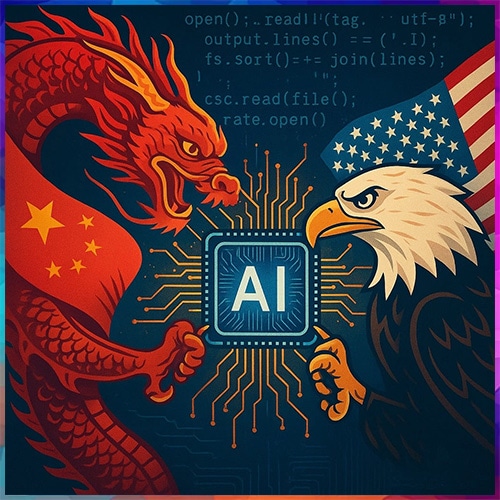
China's artificial intelligence industry faces mounting pressure as US technology restrictions threaten access to two critical resources: advanced semiconductors and AI computing capacity.
Washington's export controls have already constrained Chinese companies' ability to acquire cutting-edge processors essential for training and operating powerful AI models.
Now, restrictions on access to cloud-based computing and AI tokens could create another bottleneck, potentially limiting Chinese developers' ability to use advanced foreign AI services.
AI tokens represent units of text processed by language models. Access to large volumes of tokens enables businesses to build applications, automate workflows and deploy intelligent agents.
For Chinese startups, these restrictions could increase development costs, slow innovation and complicate competition with American AI leaders.
Major Chinese technology companies are investing heavily in domestic AI chips, cloud infrastructure and homegrown foundation models to reduce dependence on foreign technology.
However, replacing advanced hardware involves challenges extending beyond chip manufacturing, including memory, networking, software ecosystems and energy-efficient computing.
The emerging battle over AI tokens also highlights how geopolitical competition is shifting from controlling physical infrastructure to restricting access to digital intelligence.
Chinese developers may increasingly prioritise smaller models, efficient inference, open-source technologies and domestic computing platforms to overcome resource constraints.
Meanwhile, tighter restrictions could accelerate China's pursuit of technological self-reliance while fragmenting global AI supply chains into competing ecosystems.
The larger question is whether controlling chips and AI computing access will slow China's technological progress—or accelerate the creation of an independent Chinese AI ecosystem.