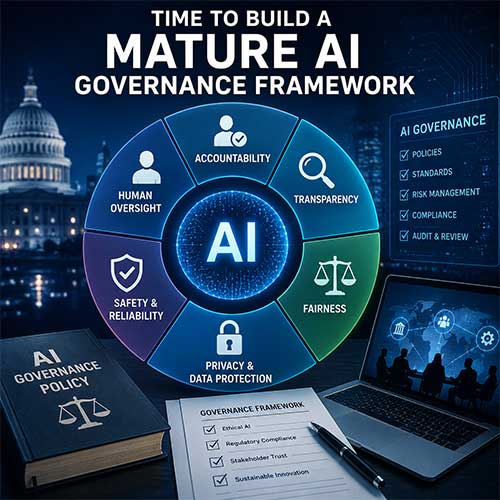
A recent survey of 525 U.S.-based professionals exposes a core paradox: organizations have invested heavily in AI governance infrastructure — funding, policies, board reporting — yet fewer than one in three have achieved genuine operational maturity. The lesson across all five themes is consistent: activity is not the same as readiness, and closing that gap requires deliberate structural choices, not just spending,reports Schellman.
Best Practices for Adopting an AI Governance Framework
1. Direct funding toward operating models, not just tools. 90% of organizations have allocated budget for AI governance, but only 27% describe their program as fully mature. The organizations that succeed invest across four specific areas: governance tooling that turns policy into enforceable workflows, documented processes and playbooks, independent audit and assessment (self-assessment alone is "unreliable, subjective, and often insufficient"), and structured, role-based training. Spending on tools alone without people and process is the most common failure pattern.
2. Govern agentic AI with tiered risk frameworks. With 46% of organizations already running autonomous agents in production, governance can't be all-or-nothing. Mature organizations classify agent actions into risk tiers — low-risk tasks (scheduling, expense reports) execute autonomously with audit trails; medium-risk tasks (email drafting, customer communications) get delayed review; high-risk tasks (financial systems, source code, access management) require preapproval; and critical actions (legal commitments, data deletion) always require human ownership. This lets organizations "move fast while acting safely" rather than either bottlenecking everything or trusting agents blindly.
3. Build technical controls as a baseline, not an afterthought. Every agent deployment should include access logging, rollback capability, rate limiting, output validation, integration controls restricting connections to approved systems, data residency enforcement, and full audit trails — the checklist that distinguishes governed autonomy from unmanaged risk.
4. Distribute accountability — don't concentrate it. Currently, one executive (usually the CIO, 37%) often owns both the adoption decision and the liability exposure, which is a structural risk: a single person evaluates risk they're incentivized to minimize, and escalation stalls because no one else is formally accountable. Mature organizations spread ownership across IT, security, compliance, legal, procurement, and business units, so each function owns the risks closest to its role — while still designating a clear AI governance lead for overall visibility.
5. Build a resilient regulatory tracking system, not one-off compliance sprints. With 94% of organizations operating under some AI regulatory requirement but wide gaps in actual preparedness (89% ready for U.S. rules vs. just 29% for the EU AI Act and 12% for APAC), the fix is a four-step cycle: awareness (tracking services, agency monitoring), assessment (mapping regulations to affected business processes and controls), roadmap (prioritizing by risk and enforcement timeline), and implementation (updating policies, training teams, auditing, documenting for regulators) — repeated continuously as frameworks like the EU AI Act shift.
6. Treat governance maturity as a business asset, not a cost center. 57% of organizations with effective governance report improved efficiency, and certifications like ISO 42001 are shifting from a "nice to have" to a standard RFP requirement. The market question is moving from "do you have an AI governance program?" to "can you prove it?" — meaning provable, audit-ready governance now directly affects sales cycles, customer retention, and competitive differentiation.
Security and Privacy Are Inseparable from AI Governance
Security and privacy aren't a subset of AI governance — they are its operational foundation, for three specific reasons the report makes clear:
Agents create a new class of access risk. Unlike traditional software that teams build and control themselves, autonomous agents "act on their own within vendor-supplied environments, with access that resembles but exceeds traditional application permissions." An agent connected to billing or customer support that starts as a productivity tool can end up executing account changes or triggering communications — meaning every governance conversation about agents is fundamentally a conversation about access control, data residency, and containment.
Third-party AI is the largest unmanaged security blind spot. Only 36% of boards discuss third-party or vendor AI risk, yet organizations are fully liable for the outcomes of embedded AI in SaaS tools they didn't build and often can't inspect. This mirrors the real-world pattern we've discussed elsewhere — a single compromised credential or an unmonitored vendor system (as in the Bank of Baroda breach) can expose an organization regardless of how strong its internal controls are, precisely because accountability doesn't extend to systems outside direct visibility.
Privacy and security together determine whether "trust" is provable, not just claimed. The report's central finding — that confidence outpaces maturity — is fundamentally a security and privacy verification problem. Formal risk assessments, documented incident response procedures, audit trails, and independent certification (like ISO 42001) exist specifically to convert governance from a policy document into demonstrable, auditable proof that data is protected and AI decisions are accountable. Without that security and privacy backbone, governance is optics rather than actual risk reduction — which is exactly the trap 74% of surveyed organizations report being confident they've avoided, even though the data suggests otherwise.