
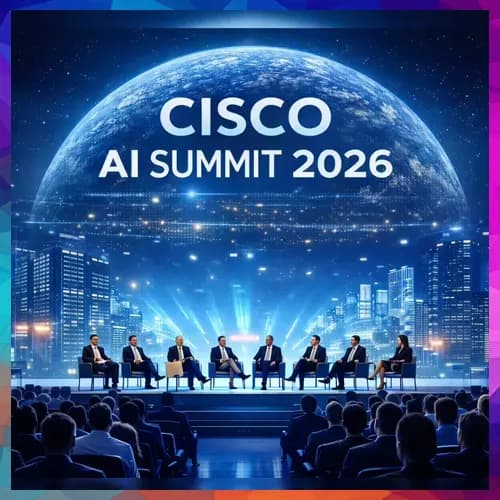
A handful of tech leaders, including OpenAI’s Sam Altman, Intel’s Lip-Bu Tan and AWS’ Matt Garman, joined Cisco’s top executives in conversations about the future of AI, leadership and technology’s impact on human progress during Cisco’s AI Summit 2026. The goal of the gathering was to provide a look at how AI is influencing software, compute, infrastructure and IT workers. The Technology CEOs all agreed that the landscape in 2026 is being defined by surging demand, rapidly advancing capabilities, and mounting pressure on infrastructure.
Software development was the topic mentioned most often, and the main question on many people’s minds is whether or not AI will be the death or rekindling of software development.
“Remember what software is. Software is a tool,” said Nvidia CEO Jensen Huang. The notion that the software industry is in decline and will be replaced by AI “… is the most illogical thing in the world, and time will prove itself,” Huang said.
Huang further reframed AI as more than a new capability—it’s a fundamental reinvention of the 60-year-old computing stack. “We’re moving from explicit programming (writing code) to implicit programming (defining intent). This results in a world where intelligence becomes abundant and engineers can treat compute constraints as effectively infinite,” he said.
Huang argued that coding itself is becoming a commodity. What matters now is domain expertise and understanding customer problems. Every company will eventually have “AI in the loop” to capture life experiences and turn them into intellectual property. And companies that deal in electrons rather than atoms will see their value explode.
OpenAI’s Sam Altman opened his statement with a vision that felt both thrilling and inevitable: AI is no longer just a tool we use—it’s becoming a collaborator we work alongside. AI has evolved from answering discrete questions to taking full control of a computer to execute complex, multi-step tasks. The implications are staggering.
He said that the biggest constraints aren’t technical. They’re architectural. We need new security paradigms for data access, and we need to rewrite software so it’s equally usable by humans and AI agents. The “upper limit” of this technology, he suggested, is companies run entirely by AI. By the end of 2026, he predicts a 10x improvement in the problems AI can solve.
Kevin Scott from Microsoft framed AI as a necessity, not a choice. With global population decline and labor shortages, AI is the only technological intervention that can maintain our quality of life. In coding, the bottleneck has shifted from creation to review and taste. Computer science education will evolve back to algorithmic thinking, and as inference becomes cheaper, demand for compute will never go down—humans will simply find more ambitious ways to use it.
Matt Garman from AWS focused on the transition from AI pilots to AI at scale. Many AI projects fail because companies don’t define success criteria upfront. Success at scale requires choice, security, and seamless integration. AWS is betting that inference will be built into every application and that personalized AI experiences will emerge from longitudinal data. The companies that win will move from “let’s try AI” to “AI is how we operate.”